

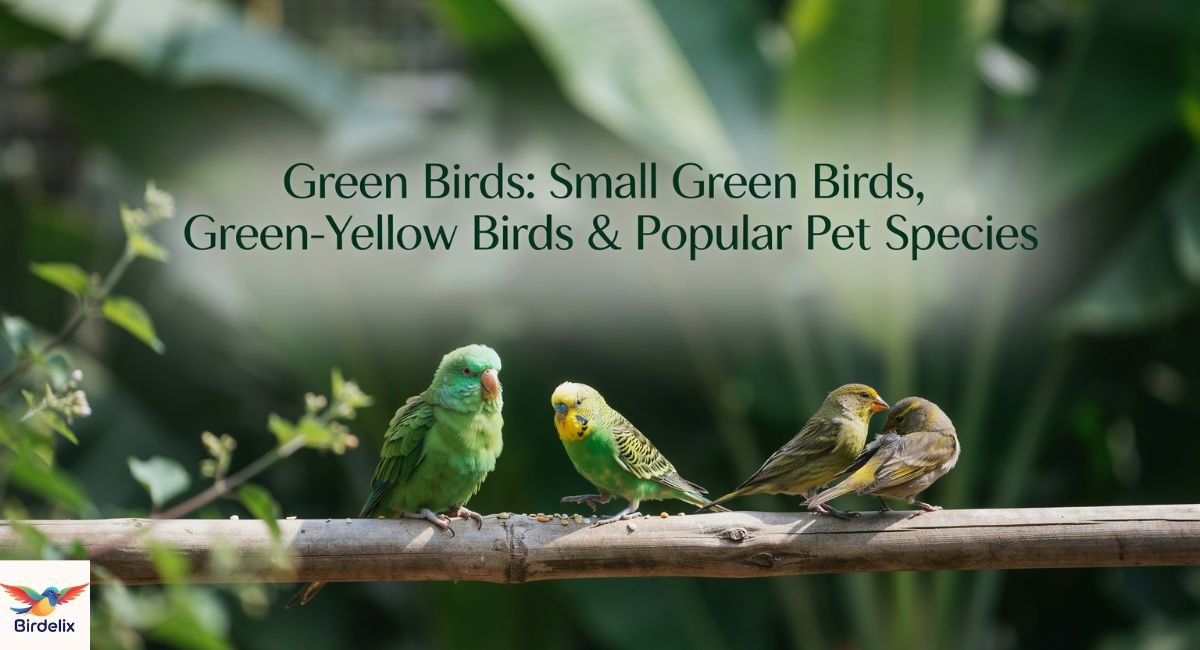
From tiny songbirds to colorful parrots, green birds bring a fresh splash of color to forests, wetlands, gardens, and cities. Their feathers can range from bright emerald and lime to muted olive and yellow-green shades. Some species, such as Green Jays, stand out with bold contrasting markings. Others, like Ruby-Crowned Kinglets, hide among leaves and shrubs. For birdwatchers, these colors can make identification exciting yet surprisingly tricky.
This guide explores 15 fascinating species and explains their appearance, habitat, behavior, diet, and seasonal patterns. You’ll also discover small green birds, green-yellow birds, and popular green pet birds, plus helpful tips for identifying unfamiliar species in your area.
Green Birds at a Glance
The table below gives you a quick field-guide style comparison. Size and habitat can vary by population, season, age, and region. Some species are wild birds while others are better known as companion birds.
| Bird | Main colors | Approximate size | Typical habitat | Range | Wild or pet | Key feature |
| Green Jay | Green, blue, yellow, black | 11–12 in | Thornscrub, woodland | South Texas southward | Wild | Blue crown and yellow tail |
| Green-Winged Teal | Green, brown, gray | 14 in | Wetlands | North America | Wild | Green wing speculum |
| Green Parakeet | Green, yellow | 12.5 in | Woodland, cities | Mexico, Texas, Florida | Both | Long pointed tail |
| Green Parrot | Mainly green | Varies | Forests, cities | Species-dependent | Both | Generic green-parrot appearance |
| Green-Winged Macaw | Green, red, blue | 35 in | Tropical forest | South America | Pet/wild | Huge size and red wing patches |
| Green-Cheeked Conure | Green, gray, red | 10 in | Forests | South America | Pet | Dark green cheeks |
| Pineapple Conure | Green, yellow, orange | 10 in | Captive environments | Captive | Pet | Warm pineapple coloration |
| Monk Parakeet | Green, gray, blue | 11–12 in | Cities, open woodland | South America and introduced U.S. populations | Both | Gray face and communal nests |
| Violet-Green Swallow | Green, violet, white | 4.7 in | Open woodland | Western North America | Wild | White rump “saddlebags” |
| Green Honeycreeper | Green, blue, black | 5.5 in | Tropical forest | Central and South America | Wild | Bright green plumage |
| Green Heron | Green, chestnut, gray | 18 in | Marshes, ponds | North and Central America | Wild | Compact stalking posture |
| Painted Bunting | Green, blue, red, yellow | 5.5 in | Shrubland | Southern U.S. southward | Wild | Females are green-yellow |
| Red-Eyed Vireo | Olive green, white | 5 in | Deciduous woodland | North and South America | Wild | Red iris |
| Ruby-Crowned Kinglet | Olive green, white | 4 in | Forest, shrubs | North America | Wild | Hidden ruby crown |
| American Goldfinch | Yellow, black, olive | 5 in | Open habitats | North America | Wild | Seasonal yellow plumage |
What Are Green Birds?
The phrase green bird describes appearance rather than one taxonomic group. Birds can look green because of pigments, feather structure, or a combination of both. Light can also change how the plumage appears. A metallic feather may look dull from one angle and brilliantly green from another.
True green can therefore be surprisingly complicated. Olive green, yellow-green, blue-green, and emerald shades can occur within the same bird. In species such as the Violet-green Swallow, sunlight reveals metallic tones that are easy to miss in shadow.
Where Can You Find Green Birds?
You can encounter green-colored birds in forests, wetlands, thornscrub, parks, gardens, and cities. Tropical regions support especially high diversity because dense vegetation provides food, nesting sites, and shelter.
In the United States, southern Texas is particularly interesting. The Green Jay and Green Parakeet occur around the Lower Rio Grande Valley. Western states host Violet-green Swallows, while many eastern areas receive olive-green migrants during spring and fall.
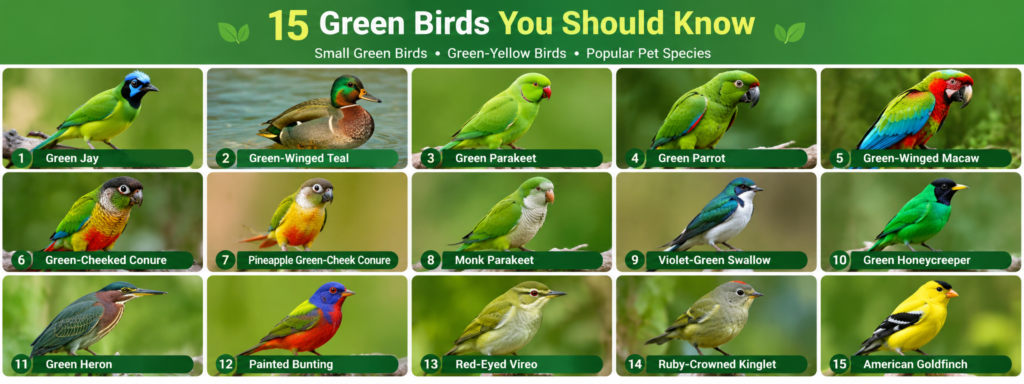
15 Green Birds You Should Know
1. Green Jay
The Green Jay looks almost tropical because it combines vivid green with blue, black, and yellow. Adults have rich green upperparts, pale yellow-green underparts, a blue crown, black facial markings, and bright yellow outer tail feathers. Cornell lists the species at roughly 11 inches long.
In the United States, this species is strongly associated with southern Texas. It favors native thornscrub, woodland, mesquite, and nearby citrus habitats. Green Jays eat insects, fruit, seeds, and small vertebrates. They also move in social family groups and communicate with varied calls.
2. Green-Winged Teal
The Green-Winged Teal is a small dabbling duck rather than a uniformly green bird. The male has a striking green facial patch that extends behind the eye. The species also shows a green speculum on the wing, which becomes easier to notice when the bird flies.
These ducks favor shallow wetlands, ponds, marshes, and flooded habitats. They feed by dabbling and filtering food from shallow water. Because the green appears mainly in specific plumage areas, this species is a useful reminder that bird identification depends on patterns rather than one color alone.
3. Green Parakeet
The Green Parakeet is a long-tailed parrot covered mostly in shades of green. Audubon describes it as roughly 12.5 inches long with a pointed tail. Some individuals show scattered red or orange feathers around the head.
Its natural range includes Mexico and northern Central America. In the United States, established populations occur in southern Texas. Flocks can also appear around residential neighborhoods. Escaped captive birds have established populations in some warm areas, which makes wild and introduced populations important to distinguish.
4. Green Parrot
“Green parrot” is a broad everyday description rather than one species. Many parrots have predominantly green plumage, including Amazon parrots, parakeets, conures, and macaws.
When someone reports a green parrot, identification requires more clues. Look at the head markings, tail length, bill shape, wing colors, size, voice, and location. A green parrot in southern Texas could point toward several different species, including established or escaped populations.
5. Green-Winged Macaw
The Green-Winged Macaw is among the largest parrots commonly kept as companion birds. Its body is mainly green with strong red coloration across parts of the head and wings. Blue tones can also appear toward the flight feathers and wing tips.
This macaw needs far more space and commitment than a small conure. Its powerful bill can destroy weak cages and household objects. A prospective owner must consider parrot care, enrichment, diet, veterinary needs, noise, and a decades-long commitment before choosing this species.
6. Green-Cheeked Conure
The Green-Cheeked Conure is one of the best-known green pet birds. It is a relatively small parrot with a green body, darker facial feathers, a grayish chest, and colorful accents depending on the individual.
These birds are active and social. They need daily interaction, enrichment, safe toys, varied food, and adequate exercise. Their small size can fool new owners because their behavioral needs remain substantial. A well-designed cage should allow comfortable movement and full wing extension.
7. Pineapple Green-Cheek Conure
The Pineapple Green-Cheek Conure is a color mutation of the Green-Cheeked Conure. Its plumage usually combines green, yellow, orange, and reddish tones in a warmer pattern than the wild-type appearance.
The mutation changes color rather than turning the bird into a separate species. Its personality and basic husbandry remain similar to other Green-Cheeked Conures. Owners should focus on nutrition, social interaction, enrichment, hygiene, sleep, and access to an avian veterinarian.
8. Monk Parakeet
The Monk Parakeet has a green body with a distinctive gray face and breast. Its pale pink bill and long pointed tail provide additional identification clues. In flight, blue can appear on the wings.
This species has an unusual nesting strategy. Unlike most parrots, Monk Parakeets construct large stick nests. Several pairs may occupy different chambers within the same structure. In the United States, these social birds often live around cities and suburban areas.
9. Violet-Green Swallow
The Violet-Green Swallow is one of the most striking small green birds in western North America. It measures only about 4.7 inches long. Its back can appear greenish-bronze while its rump shows iridescent violet.
Its white rump patches create a useful field mark often called “saddlebags.” These swallows catch flying insects in midair. They nest in tree cavities and artificial nest boxes. Texas observers may encounter them in western parts of the state, particularly around suitable woodland and canyon habitats.
10. Green Honeycreeper
The Green Honeycreeper is a tropical forest bird famous for intense coloration. Males and females can differ noticeably, making sex an important clue during bird identification.
These birds generally live in forested environments across parts of Central and South America. Their diet includes fruits and other plant resources. Their compact bodies and vivid feathers make them especially memorable among tropical green bird species.
11. Green Heron
The Green Heron is not uniformly green. Its back and wings show dark greenish tones while the neck and chest can appear rich reddish-brown. Its compact body also separates it from larger herons.
This species prefers ponds, streams, marshes, and wooded wetlands. It often hunts from quiet positions near the water. Its relatively short legs and hunched posture can make it look surprisingly small when compared with larger herons.
12. Painted Bunting
The male Painted Bunting is famous for blue, red, and green coloration. Females and immature birds look very different. They typically show greenish-yellow or olive tones, making them easy to mistake for another small yellow green bird.
Painted Buntings use grasslands, shrublands, woodland edges, and other open habitats. Their seasonal movements also affect identification. A bird that appears in your yard during one part of the year may not remain there year-round.
13. Red-Eyed Vireo
The Red-Eyed Vireo is an excellent example of an olive green small bird. It has olive-green upperparts, pale underparts, a strong white eyebrow, and a red iris that becomes easier to see at close range.
This species spends much of its time searching through foliage for insects and other food. Its repetitive song is often easier to notice than the bird itself. Dense leaves can hide the bird even when it is singing nearby.
14. Ruby-Crowned Kinglet
The Ruby-Crowned Kinglet is tiny, restless, and predominantly olive green. It measures roughly 3.5 to 4.3 inches long. A white eyering and white wingbar provide useful identification clues.
The male has a brilliant red crown patch. However, he often keeps it hidden. Excitement can reveal the ruby-colored feathers. During migration and winter, these tiny birds may appear in shrubs, parks, deciduous woodland, and suburban habitats.
15. American Goldfinch
The American Goldfinch creates confusion because its plumage changes with season and sex. Breeding males become brilliant yellow with black wings and a black forehead. Females and nonbreeding birds appear considerably duller and more olive.
Goldfinches often visit seed-rich habitats, gardens, fields, and woodland edges. Their seasonal appearance explains why one observer may describe a goldfinch as yellow while another notices a distinctly yellow-green bird.
Small Green Birds: How to Identify Them
Small birds can be difficult to identify because several unrelated species share similar colors. Start with structure rather than color. Size, tail length, wing shape, bill shape, habitat, behavior, and season usually narrow the possibilities faster.
The most useful approach is to combine several clues. A tiny olive bird with a white eyering suggests something different from a small bird with long pointed wings. Violet-green Swallows, for example, have long wings that extend beyond the tail while perched.
Small Green Bird Identification by Size
Size provides a valuable first filter. A bird smaller than a sparrow may point toward a kinglet or swallow. A robin-sized bird suggests a different group. A jay-sized green bird immediately narrows the possibilities further.
Remember that distance can distort perception. A bird sitting alone in a tree may look larger than it really is. Comparing it with a familiar nearby object or species can make identification more reliable.
Small Green Birds by Color
Color should come next. Bright emerald, muted olive, yellow-green, and blue-green feathers create different visual impressions. Sunlight can make iridescent feathers appear much brighter than they look in shade.
Look beyond the back. Examine the face, throat, breast, belly, wings, and tail. A white eyering or wingbar can be more useful than the overall green color.
Small Green Birds by Habitat
Habitat can solve identification puzzles quickly. Wetlands point toward ducks and herons. Dense woodland favors vireos and kinglets. Open western forests can produce Violet-green Swallows. Thornscrub in South Texas is particularly important for Green Jays.
Season matters too. Migration can bring unfamiliar birds into areas where they do not breed. That makes location and date important parts of any reliable bird identification process.
Small Green Birds in Texas
Texas offers exceptional opportunities for finding green-colored birds. Southern Texas is especially important because the Green Jay reaches the northern edge of its regular U.S. range there. Green Parakeets also occur around the Lower Rio Grande Valley.
The Rio Grande Valley combines thornscrub, woodland, farmland, wetlands, and urban habitats. That mixture creates a fascinating birding landscape. Western Texas also provides habitat for Violet-green Swallows, while migration brings many additional olive-toned songbirds through the state.
Green and Yellow Birds: Common Species to Look For
Green-and-yellow combinations occur across many unrelated bird families. The Green Jay has green upperparts and yellow outer tail feathers. The Green-Winged Teal displays green in specific wing and facial areas. American Goldfinches can shift between bright yellow and muted olive.
Lighting can exaggerate these differences. A bird photographed under warm sunlight may look more yellow than it appears to the naked eye. Always consider the entire pattern before deciding that you have found a particular green and yellow bird.
Small Yellow-Green Birds vs. Olive-Green Birds
A yellow-green bird often looks brighter and more saturated. An olive-green bird usually appears muted because brown, gray, or darker tones soften the green. Still, lighting and feather wear can blur that distinction.
Shape remains essential. A long-winged swallow does not become a kinglet simply because both look greenish. Compare the beak, tail, wing length, eye markings, and movement pattern before making a final identification.
Green Birds as Pets
Green parrots attract owners because their colors are cheerful and distinctive. Yet appearance should never be the main measure of suitability. Parrots need interaction, enrichment, safe housing, appropriate nutrition, and routine veterinary care.
The Association of Avian Veterinarians recommends safe, nontoxic enclosures and warns that birds have highly sensitive respiratory systems. Cage materials, fumes, cleanliness, and placement therefore matter greatly.
Green-Cheeked Conure
Green-Cheeked Conures are energetic companion parrots. They can form strong bonds with people and enjoy climbing, chewing, playing, and exploring. Their voices are generally less piercing than those of many larger parrots, although individuals still vary.
Their diet should not rely on seeds alone. Owners should discuss an appropriate balanced diet with an avian veterinarian. Fresh water, enrichment, exercise, sleep, and regular health checks are equally important parts of responsible conure care.
Pineapple Green-Cheek Conure
The Pineapple mutation gives a Green-Cheeked Conure a distinctive combination of warm colors. It does not create a separate species. Instead, it changes how the bird’s feathers express color.
Temperament still varies from bird to bird. Choosing a companion should therefore involve health, behavior, socialization, and breeder or rescue practices rather than color alone.
Green-Winged Macaw
Green-Winged Macaws require considerably more space and commitment than small conures. Their size, strength, intelligence, and long lifespan make them demanding companion animals.
Their enclosure must accommodate movement, large perches, enrichment, and safe toys. Household hazards also deserve careful attention. A large parrot can interact with objects in ways a new owner may not anticipate.
What Is the Best Cage for a Green-Cheek Conure?
There is no single perfect cage for every bird. However, the enclosure should be spacious enough for comfortable movement and should prevent the bird’s head from passing between the bars. PetMD recommends at least 24 × 24 × 30 inches for a single small conure and bar spacing of ¾ inch or less.
The Association of Avian Veterinarians emphasizes that the largest practical safe cage is preferable. Materials should be nontoxic and easy to clean. The cage should also stay away from kitchen fumes and other airborne hazards.
Green Birds vs. Similar-Looking Birds
Color alone rarely identifies a bird with certainty. Many unrelated species evolved similar green or olive plumage. Body structure and field marks provide stronger clues.
A good observer combines appearance with behavior and location. This approach reduces mistakes when several green bird species overlap.
Green Birds vs. Yellow Birds
Yellow birds generally show warmer, brighter body coloration. Green species often retain darker wing, back, or facial tones. Seasonal plumage can complicate the distinction.
American Goldfinches demonstrate this perfectly. Their breeding males look intensely yellow, while females and nonbreeding birds can appear much more olive.
Green Birds vs. Blue-Green Birds
Blue-green plumage often appears metallic or iridescent. Violet-Green Swallows provide a strong example. Their backs can look greenish-bronze while their rumps show violet tones in good light.
The viewing angle matters. Structural coloration can change dramatically as sunlight moves across the feathers. A photograph may therefore capture a shade that looks different from what you saw in person.
Green Birds vs. Olive Birds
Olive plumage usually looks softer and less saturated than emerald green. Red-Eyed Vireos and Ruby-Crowned Kinglets are useful examples of this muted color family.
Their body patterns offer stronger clues than color alone. The kinglet has a white eyering and wingbar, while the vireo has a characteristic face pattern and red eye.
Green Birds vs. Green-and-Yellow Birds
Green-and-yellow birds combine two strong color families. The exact distribution matters more than the presence of either color.
Look at where yellow appears. Is it on the belly, wing, tail, face, or entire body? Green Jays, goldfinches, and Painted Buntings each use green and yellow differently.
Why Are Some Birds Green?
Green feathers can result from complex interactions between pigments and microscopic feather structures. Birds do not always produce a simple “green pigment” that explains every green feather.
Structural effects can scatter light while pigments absorb selected wavelengths. This creates colors that may change with angle and illumination. Green plumage can also provide camouflage among leaves and vegetation, although its role differs among species.
Feather Pigmentation
Pigments such as carotenoids can contribute to yellowish colors. When combined with feather structures that alter reflected light, the resulting appearance may become green or yellow-green.
The exact mechanism varies between species. That is why two birds can both look green while producing their colors through different feather chemistry and structure.
Structural Coloration
Structural coloration becomes obvious in iridescent species. Microscopic structures in feathers influence how light reflects toward the observer.
Violet-Green Swallows are a useful example. Their metallic green backs can look dramatically different under direct sunlight.
Camouflage
Green feathers can blend into leaves, shrubs, and forest canopies. For smaller songbirds, this may make predators less likely to notice them.
Camouflage does not explain every green species. Bright parrots can be extremely conspicuous. Their colors may serve communication and social signaling rather than concealment.
Mate Attraction
Bright plumage can influence social interactions and mate choice in some birds. Color may signal age, condition, species identity, or breeding status.
However, it would be inaccurate to claim that every bright feather exists solely to attract mates. Bird coloration usually reflects several evolutionary pressures working together.
How to Identify a Green Bird You See
Start by recording the bird’s size and overall shape. Then examine the head, face, wings, tail, bill, and underside. Habitat and location can eliminate many possibilities.
Next, listen. A distinctive call may reveal a bird hidden inside thick vegetation. Finally, consider season. Migration can bring species into your area temporarily, while resident birds may remain year-round.
| Identification clue | What to observe | Why it matters |
| Size | Sparrow, robin, jay, or larger | Narrows species groups |
| Shape | Round, slender, long-tailed | Separates families |
| Face | Eyering, mask, crown | Often highly distinctive |
| Wings | Bars, patches, length | Useful for swallows and songbirds |
| Tail | Short, long, forked, rounded | Strong structural clue |
| Bill | Thin, thick, hooked | Indicates feeding style |
| Habitat | Forest, wetland, city | Narrows local possibilities |
| Season | Breeding, winter, migration | Changes expected species |
| Sound | Song or call | Helps identify hidden birds |
| Location | State or region | Range is often decisive |
Conclusion
Green plumage appears across an astonishing range of birds. Tiny kinglets, swift swallows, tropical honeycreepers, jays, ducks, herons, parrots, and macaws can all bring green shades into the landscape.
The best identification method combines color with structure, habitat, behavior, season, and location. That approach works far better than simply searching for a really green bird. Whether you are watching backyard visitors or considering a green pet parrot, those extra clues turn a vague sighting into a much more rewarding discovery.
FAQs
What is the most common green bird?
There is no single worldwide answer because abundance varies by location. Many common birds show olive or greenish plumage. A local field guide and recent sightings provide a more useful answer for a specific region.
What are the small green birds called?
Several species fit that description. Ruby-Crowned Kinglets, Violet-Green Swallows, vireos, honeycreepers, and some parakeets can appear small and green. Size, habitat, markings, and location are needed for accurate identification.
What is a small green and yellow bird?
Several birds can fit that description. American Goldfinches, Green Jays, Painted Buntings, and some honeycreepers may show green and yellow together. The pattern and location are more useful than color alone.
What bird is really green?
The Green Jay is one of the clearest examples. It has rich green upperparts with yellow-green underparts plus blue, black, and yellow markings. It is especially associated with southern Texas in the United States.
What is the small olive-green bird?
The Ruby-Crowned Kinglet is a strong candidate. It is tiny and olive-green with a white eyering and white wingbar. Males also possess a red crown that they often keep hidden.
What are some green birds found in Texas?
Southern Texas supports Green Jays and Green Parakeets. Western Texas can host Violet-Green Swallows. Texas also receives many migrating songbirds whose olive or greenish plumage can create identification challenges.
Are green birds good pets?
Some green parrots can make rewarding companion birds. However, color does not determine suitability. Species such as conures and macaws require substantial daily care, enrichment, safe housing, appropriate nutrition, and veterinary attention.
What is the difference between a Green-Cheeked Conure and a Pineapple Conure?
A Pineapple Conure is a color mutation of the Green-Cheeked Conure. The main difference is plumage coloration. Their basic species identity and core care requirements remain the same.
What is the green Angry Bird?
The green character from the Angry Birds franchise is fictional rather than a real bird species. The character is commonly known as Hal and is depicted as a green bird with a large curved beak.
What is the largest green bird?
The answer depends on whether you mean wild species, parrots, or birds that are predominantly green. Among large parrots, the Green-Winged Macaw is a major example. Its size makes it dramatically different from small green songbirds.

Welcome to Birdelix! I’m Anam Sattar, an AI-powered SEO Specialist and Content Writer with over 5 years of experience in creating high-quality, search-optimized content. I help businesses improve their search engine rankings, increase organic traffic, and build beautiful, user-friendly websites. My mission is to make SEO, content creation, and web design simple, effective, and accessible for everyone. Let’s grow your online presence and achieve success together!