

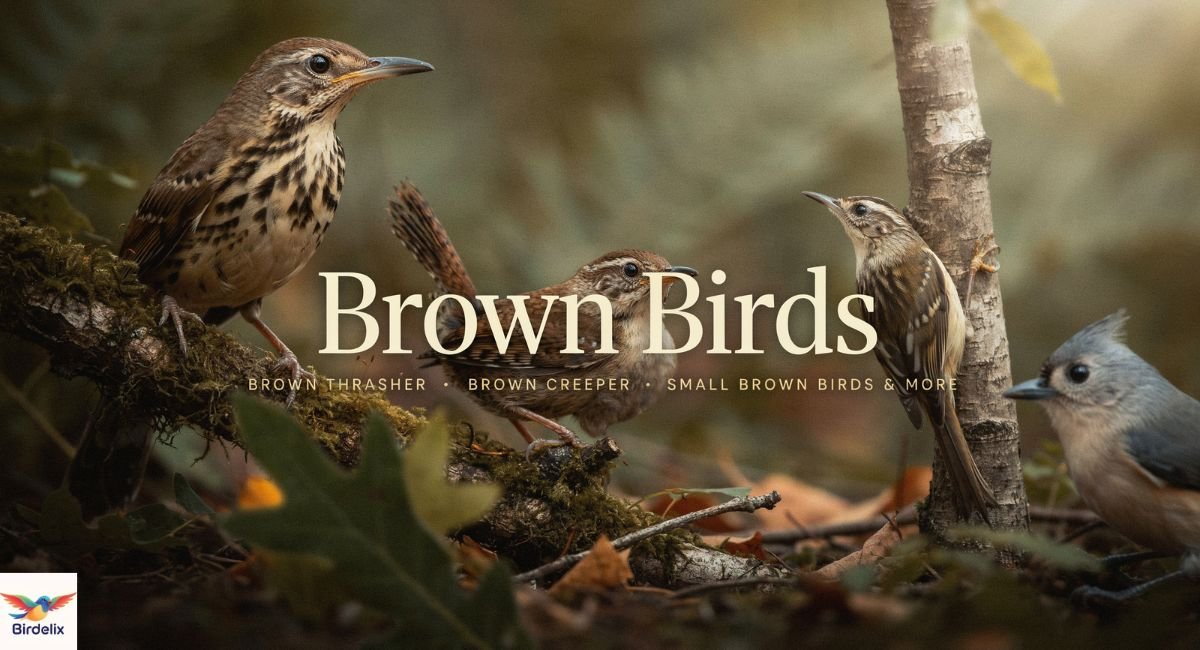
Brown birds appear in gardens, forests, wetlands, and open fields across the world. Although many share similar earthy colors, each species has features that make it unique. Some are tiny birds with short tails, while others have long bills, broad wings, or striking chest markings. Learning to notice these details makes brown bird identification much easier.
You can compare a bird’s size, shape, feather patterns, call, and feeding habits to narrow down its identity. This guide introduces 20 species, including familiar backyard visitors and unusual birds from other regions. You’ll also discover their natural habitats, diets, and helpful field marks so you can recognize them with greater confidence during walks.
Brown Birds at a Glance
Brown feathers appear across many bird families. Some species have plain brown plumage, while others show stripes, spots, pale bellies, or reddish backs. These colors often help birds blend into trees, soil, dry grass, and fallen leaves.
Before identifying a bird, look beyond its main color. Its size, bill, tail, chest pattern, and movement can narrow your choices. The table below gives you a useful starting point for recognizing common and unusual species.
| Bird | Approximate size | Main color and markings | Typical habitat | Key identification feature |
| Brown Thrasher | 9–12 inches | Reddish-brown back, streaked chest | Thickets and woodland edges | Long tail and yellow eyes |
| Brown Creeper | 5–6 inches | Mottled brown and white | Mature forests | Climbs tree trunks upward |
| Song Sparrow | 5–7 inches | Brown streaks and dark breast spot | Gardens, marshes, fields | Streaked chest |
| House Wren | 4–5 inches | Plain brown with fine barring | Backyards and open woods | Short, upright tail |
| Carolina Wren | 5–6 inches | Warm reddish-brown | Gardens and brush | Bold white eyebrow |
| Brown-headed Cowbird | 7–8 inches | Brown head and dark body in males | Fields and lawns | Stocky shape and short bill |
| Northern Flicker | 11–12 inches | Brown with black markings | Open woods and yards | White rump and spotted belly |
| Brown Pelican | 40–54 inches | Brown body and long bill | Coasts and estuaries | Large throat pouch |
| Brown Booby | 30–33 inches | Dark brown and white | Tropical ocean and islands | Long wings and diving flight |
| Brown Kiwi | 18–26 inches | Shaggy brown feathers | New Zealand forests | Flightless body and long bill |
| Brown Fish Owl | 19–22 inches | Mottled brown feathers | Forests near water in Asia | Large owl with prominent ear tufts |
| Brown-Capped Vireo | About 5 inches | Olive-brown body and brown crown | Scrub and woodland | Small size and brown cap |
| Clay-Colored Thrush | 9–10 inches | Mostly plain warm brown | Open woodland and gardens | Unmarked brown appearance |
| Tree Pipit | 5–6 inches | Brown-streaked upperparts | Grassland and open woodland | Walks and sings from trees |
| Dunnock | 5–6 inches | Brown and gray streaking | Hedges and gardens | Quiet, low ground movement |
| Common Nightingale | 6–7 inches | Plain brown with pale underside | Dense shrubs and woodland | Powerful, varied song |
| Red-Backed Shrike | 6–7 inches | Brownish female and young birds | Scrub and open country | Hooked bill and hunting behavior |
| Ruddy Quail-Dove | 8–10 inches | Rich reddish-brown | Tropical forests | Rounded body and ground habits |
| Buff-Banded Rail | 10–12 inches | Brown with pale and dark bands | Wetlands and damp grass | Secretive, rail-like shape |
| Banded Rail | 10–12 inches | Dark brown with barred markings | Marshes and wetlands | Strong body and short legs |
Sizes are approximate and can vary by sex, age, and regional population.
20 Brown Birds You Should Know
The following species show how much variety exists among brown-feathered birds. Some are easy to spot in ordinary gardens. Others stay hidden in forests, marshes, or coastal habitats. Their field marks, feeding habits, and calls help separate one species from another.
A bird’s color can also change with age, lighting, and feather condition. Juveniles may look duller or more heavily streaked than adults. For reliable bird identification, consider several features together instead of depending on color alone.
1. Brown Thrasher
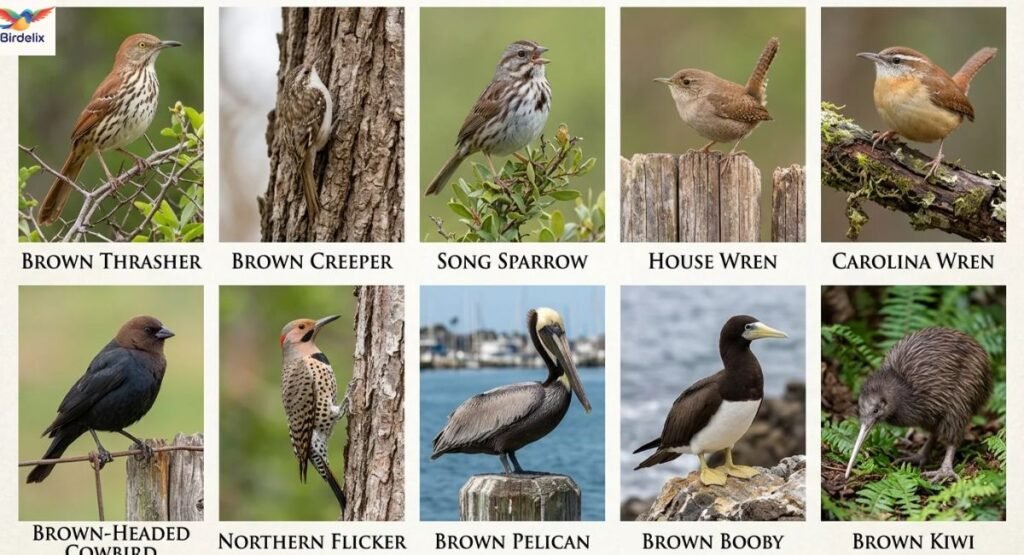
The Brown Thrasher is a large, reddish-brown songbird with a long tail and bold dark streaks across its pale chest. It has bright yellow eyes and a long, slightly curved bill. You’ll usually find it searching through leaf litter beneath dense shrubs. It eats insects, fruits, seeds, and other small food items. Its loud, varied song makes it easier to notice than its hidden body. It lives across much of eastern and central North America.
2. Brown Creeper
The Brown Creeper is one of the smallest woodland birds in this guide. Its mottled brown back blends almost perfectly with tree bark. A slender, downcurved bill helps it collect insects and spiders from bark crevices. Watch its movement closely: it climbs upward in short, jerky steps while using its stiff tail for support. After reaching a high point, it often flies down to another tree’s base and starts again.
3. Song Sparrow
The Song Sparrow has brown upperparts, a pale underside, and strong streaks across its chest. Many individuals show a dark central breast spot where the markings meet. It lives in gardens, marsh edges, fields, and brushy areas across North America. You may see it scratching through low vegetation for seeds and insects. Its appearance varies by region, so compare the bird’s overall shape and song rather than relying on one marking.
4. House Wren
The House Wren is a tiny brown bird with a compact body and an often upright tail. Its feathers show fine bars on the wings and tail, although these markings can be difficult to see from a distance. It moves quickly through shrubs, gardens, and low branches while searching for insects. House Wrens also use nest boxes and other small cavities. Their bubbling, energetic songs often reveal their presence before you spot them.
5. Carolina Wren
The Carolina Wren has warm reddish-brown upperparts, a pale underside, and a bold white eyebrow stripe. Its body looks fuller than a House Wren’s, and its bill is slightly curved. Look for it around brush piles, gardens, woodland edges, and thick shrubs. It often explores low branches and ground cover for insects and spiders. Its loud song sounds surprisingly powerful for such a small bird.
6. Brown-Headed Cowbird
Male Brown-headed Cowbirds have glossy black bodies and rich brown heads. Females look different, with plain gray-brown feathers and a less striking appearance. These stocky birds often gather in fields, lawns, and open spaces. They eat seeds and insects, sometimes joining mixed flocks of blackbirds. One unusual feature is their brood parasitism: females lay eggs in other birds’ nests instead of raising their own chicks.
7. Northern Flicker
The Northern Flicker is a large woodpecker with a brown back, black markings, and a spotted underside. A black crescent marks its upper chest, while its white rump becomes noticeable during flight. Unlike many woodpeckers, it often feeds on the ground. It uses its slightly curved bill and long tongue to collect ants and beetles. In eastern populations, the undersides of the wings and tail show yellow. Western birds show red instead.
8. Brown Pelican
The Brown Pelican is a large coastal bird with a long bill and an expandable throat pouch. Adults have brown bodies, a pale head, and a strong, broad shape. You’ll often see them resting on piers, beaches, buoys, or coastal rocks. They feed mainly on fish, catching prey through dramatic dives into the water. Their large size and distinctive bill make them easy to separate from smaller brown waterbirds.
9. Brown Booby
The Brown Booby is a tropical seabird with long, narrow wings and a dark brown back. Adults usually have a contrasting white belly and a pointed bill. They spend much of their time over warm ocean waters, where they search for fish. Their hunting style is especially striking: they plunge into the sea from above to catch prey. In the United States, sightings are most likely around tropical waters, Florida, and Hawaii.
10. Brown Kiwi
The Brown Kiwi is a flightless bird native to New Zealand. Its shaggy brown feathers give it a rounded, almost furry appearance. It has strong legs, small wings, and a long bill with nostrils near the tip. Unlike most birds, it searches for food mainly at night. It probes damp soil and leaf litter for worms, insects, and other small invertebrates. Its unusual shape and ground-dwelling lifestyle make it very different from flying brown songbirds.
11. Brown Fish Owl
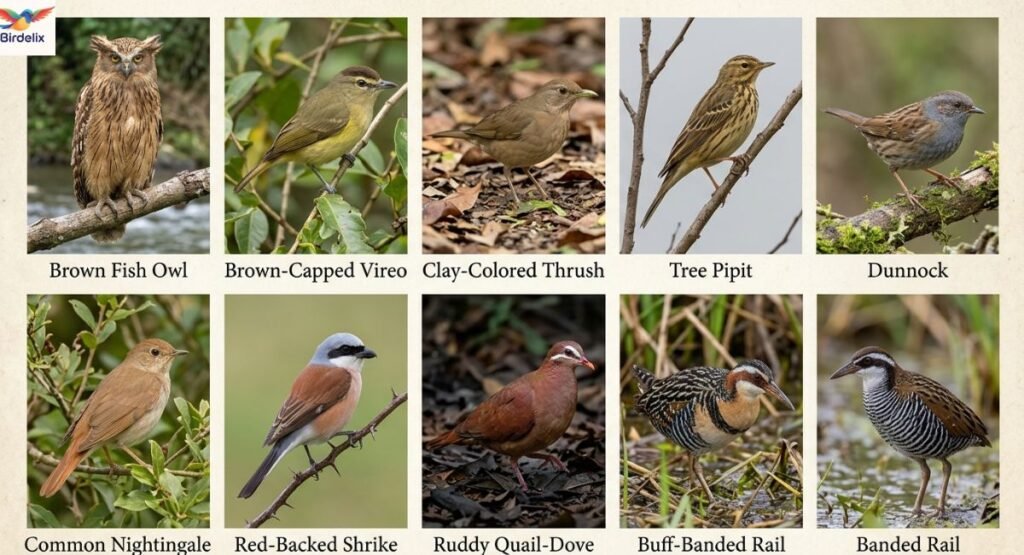
The Brown Fish Owl is a large owl found in parts of Asia. Its mottled brown feathers provide camouflage among tree trunks and shaded branches. Prominent ear tufts and strong feet give it a distinctive appearance. It often lives near rivers, lakes, and wooded wetlands. As its name suggests, fish can form an important part of its diet. It may also catch frogs, crabs, and other small animals near the water.
12. Brown-Capped Vireo
The Brown-Capped Vireo is a small bird with olive-brown upperparts, a darker crown, and pale underparts. Its subtle colors can make it difficult to notice among leaves and branches. It searches for insects in shrubs and woodland vegetation. When identifying one, look at its small body, short bill, and head markings. Since several vireos share similar shapes, location and vocalizations can provide useful extra clues.
13. Clay-Colored Thrush
The Clay-Colored Thrush has a simple, warm brown appearance without bold stripes or bright patches. Its plain feathers make it easy to overlook among other woodland birds. It lives from parts of Central America north into southern Texas. You may find it in open forests, gardens, and lightly wooded areas. It eats earthworms, insects, berries, and fruit. Its rich song stands out more than its understated appearance.
14. Tree Pipit
The Tree Pipit is a slender bird with brown upperparts and a streaked chest. Its pale underside and fine markings can resemble those of several sparrows. However, its body shape and behavior offer useful clues. It often feeds on the ground in open woodland and grassy areas. During the breeding season, it may sing from a tree or descend in a display flight. Its name reflects this habit, even though it spends much time on the ground.
15. Dunnock
The Dunnock is a small bird with brown, streaked wings and a grayish head and chest. Its quiet movements make it easy to miss beneath hedges and dense garden plants. It usually searches close to the ground for insects, spiders, and seeds. Unlike some more active garden birds, it often slips through cover rather than staying in open view. Look for its slim bill, compact body, and subtle gray-brown pattern.
16. Common Nightingale
The Common Nightingale has plain brown upperparts and a lighter underside. Its appearance may seem ordinary, but its song is anything but simple. This bird is known for its rich whistles, trills, and varied musical phrases. It prefers dense vegetation, woodland edges, and thick shrubs where it can remain hidden. It feeds on insects and other small invertebrates. When you hear a powerful song from a concealed brown bird, the nightingale is worth considering.
17. Red-Backed Shrike
Female and juvenile Red-Backed Shrikes often show brownish feathers with pale underparts and fine markings. Adult males look more colorful, with a gray head, reddish-brown back, and black facial mask. This bird lives in open country with scattered shrubs and hedges. It hunts insects and small animals from exposed perches. Shrikes sometimes store prey by impaling it on thorns, a behavior that makes them unusual among small songbirds.
18. Ruddy Quail-Dove
The Ruddy Quail-Dove has rich reddish-brown feathers and a rounded body. It spends much of its time walking quietly through tropical forest floors and thick vegetation. Its earthy colors help it blend into dry leaves and shaded ground. It feeds on seeds, fallen fruit, and other small food items. Because it moves quietly and stays under cover, you may hear or glimpse it before getting a clear view.
19. Buff-Banded Rail
The Buff-Banded Rail has brown upperparts, a banded body, and a distinctive pattern across its face and chest. It prefers damp grass, marshes, wetlands, and areas near freshwater. Rails often move through thick vegetation rather than crossing open ground. This makes them difficult to observe, even when they live nearby. Look for a compact body, long toes, and a short tail when identifying this secretive bird.
20. Banded Rail
The Banded Rail is a sturdy wetland bird with dark brown feathers and noticeable barring. Its short legs and strong body suit life among marsh plants and damp ground. It searches for insects, small animals, seeds, and other food in wet vegetation. Although it shares the rail family’s secretive habits, its overall pattern and body shape help separate it from other marsh birds. It is not a typical backyard species in North America.
Small Brown Birds vs. Large Brown Birds
Not every brown bird belongs to the same size group. Some are tiny enough to disappear inside thick shrubs. Others are large enough to stand out along a shoreline or open field. Size gives you an early clue, especially when you cannot see every feather marking.
However, size alone can mislead you. A young bird may look smaller than an adult, while distance can make a medium-sized bird appear tiny. Compare the bird with nearby objects and observe its body proportions before making an identification.
| Feature | Small brown birds | Large brown birds |
| Common examples | Brown Creeper, House Wren, Dunnock | Brown Pelican, Northern Flicker, Brown Thrasher |
| Body shape | Compact, slim, or rounded | Longer, heavier, or broader |
| Bill | Usually short or slender | Often longer or stronger |
| Tail | Short or medium, sometimes cocked | May be long, broad, or pointed |
| Typical feeding | Insects, spiders, seeds | Fish, insects, fruit, or larger prey |
| Common habitats | Gardens, shrubs, woodland | Forest edges, wetlands, coasts, open fields |
Brown Birds With Distinctive Markings
A brown bird rarely has only one shade across its body. Some have a white eyebrow, while others show a streaked chest or dark wing bars. These distinctive field marks can help you narrow down the species quickly.
Pay special attention to the head, breast, wings, and tail. These areas often hold the details that separate two similar birds. Good lighting helps, but movement and behavior can be just as useful.
| Marking | Possible bird | What to look for |
| White eyebrow stripe | Carolina Wren | Bold pale line above the eye |
| Heavily streaked chest | Brown Thrasher | Long dark streaks on pale underparts |
| Very long tail | Brown Thrasher | Tail looks long compared with the body |
| Brown head and dark body | Male Brown-headed Cowbird | Strong contrast between head and body |
| White rump | Northern Flicker | Bright white patch visible during flight |
| Mottled bark-like back | Brown Creeper | Camouflaged pattern against tree trunks |
| Plain warm-brown body | Clay-Colored Thrush | Few obvious markings across the body |
Tiny Brown Birds: How to Identify Them
Tiny brown birds can look almost identical when they move quickly through bushes. Their feathers often contain muted shades of brown, gray, and buff. Yet their shape, movement, and feeding style can reveal more than color alone.
Start by estimating the bird’s size. Then watch its tail, bill, and feeding position. A bird climbing a trunk is likely doing something very different from one hopping through leaf litter. Those small details matter.
| Identification clue | What to observe | Why it helps |
| Body size | Compare it with a sparrow or wren | Separates tiny birds from medium-sized species |
| Tail shape | Short, long, narrow, or cocked | Helps distinguish wrens and creepers |
| Bill shape | Thin, curved, or stout | Suggests the bird’s feeding method |
| Movement | Hopping, climbing, or creeping | Reveals common behavior |
| Feeding location | Ground, foliage, or tree bark | Narrows down likely species |
| Age | Look for softer or more heavily marked feathers | Helps avoid confusing juveniles with adults |
A young bird can look different from a fully grown adult. Juvenile feathers may appear duller, softer, or more heavily streaked. Therefore, avoid identifying a species from one unusual marking alone.
Brown Birds That Look Similar
Some species share the same basic colors but differ in body shape and behavior. A Brown Thrasher and Song Sparrow both show brown streaking. However, the thrasher is much larger and has a longer tail and bill.
Likewise, a Brown Creeper and a nuthatch may both appear on tree trunks. Their movements help separate them. The creeper usually climbs upward, while nuthatches often move in several directions, including headfirst down trunks.
| Similar birds | Main difference | Helpful identification clue |
| Brown Thrasher vs. Song Sparrow | Thrasher is larger and longer | Look for the long tail and yellow eye |
| Brown Creeper vs. nuthatch | Creeper usually climbs upward | Watch the direction of movement |
| House Wren vs. Carolina Wren | Carolina Wren is warmer in color | Look for the bold white eyebrow |
| Dunnock vs. small sparrows | Dunnock often shows gray on the head and chest | Check the face and body pattern |
| Brown Pelican vs. other coastal birds | Pelican has a very large bill and pouch | Watch its diving and fishing behavior |
Where Are Brown Birds Commonly Found?
Brown birds occupy many habitats because their colors suit different surroundings. Some species prefer dense forests and shaded woodland floors. Others live in open fields, marshes, coastal areas, or human neighborhoods. Their natural habitat often provides the first useful clue.
When you search for a particular species, consider the season and region too. Some birds stay in one area throughout the year. Others migrate or appear only during certain months. A habitat match does not prove an identification, but it makes your search more focused.
Backyards and Gardens
Backyards attract species such as House Wrens, Carolina Wrens, Song Sparrows, and sometimes Brown Thrashers. Shrubs offer shelter, while lawns and flower beds provide insects and seeds. Bird feeders can bring ground-feeding species closer to your home. However, dense native plants often matter just as much as food.
Forests and Woodland Edges
Woodlands support birds that feed among tree trunks, branches, and leaf litter. Brown Creepers search bark for insects, while Brown Thrashers forage beneath thick cover. Forest edges can attract several species because they combine trees, shrubs, and open feeding areas. Mature trees also provide nesting places and shelter.
Grasslands and Open Fields
Open habitats support birds that search for seeds and insects across the ground. Brown-headed Cowbirds often gather in fields and pastures. Tree Pipits also use open country, especially where grassland meets scattered trees. Watch fence posts, low branches, and exposed ground for feeding or resting birds.
Wetlands and Marshes
Wetlands provide food and shelter for rails, pelicans, and other water-associated birds. Marsh vegetation hides smaller species, while open water gives larger birds room to feed. Brown Pelicans hunt fish along coasts and estuaries. Rails often remain concealed among reeds and damp grass.
Coastal Areas
Coastal habitats attract seabirds that spend much of their lives around salt water. Brown Pelicans rest on piers and beaches, while Brown Boobies hunt over warm ocean waters. Their large bills, long wings, and fishing behavior make them different from most small brown land birds.
Urban and Suburban Areas
Some brown birds adapt well to towns and cities. House Wrens may nest in boxes, gardens, and small cavities around buildings. Song Sparrows can use parks and planted areas with enough cover. Even in busy neighborhoods, shrubs and trees provide important feeding and nesting spaces.
What Do Brown Birds Eat?
Brown birds do not all eat the same food. Their diets depend on their size, bill shape, habitat, and feeding behavior. Some search for insects beneath leaves, while others collect seeds from open ground. Larger species may catch fish or hunt small animals.
Food can also help you identify a bird. A small bird probing tree bark may be searching for insects. A large bird plunging into the water is more likely hunting fish. Observe where the bird feeds and how it handles its food.
| Food type | Birds that may eat it | Common feeding behavior |
| Insects | Wrens, vireos, pipits, thrashers | Picking prey from leaves and soil |
| Spiders | Brown Creeper, wrens, small songbirds | Searching bark and low vegetation |
| Seeds | Song Sparrow, cowbird, other ground feeders | Picking seeds from grass and feeders |
| Berries and fruit | Brown Thrasher, Clay-Colored Thrush | Feeding in shrubs and fruiting trees |
| Worms and invertebrates | Thrushes, rails, kiwi | Probing soil and leaf litter |
| Fish | Brown Pelican, Brown Booby, Brown Fish Owl | Diving or catching prey near water |
How to Identify a Brown Bird in Your Backyard
A mystery bird can be exciting, especially when it visits your garden more than once. Instead of guessing from its color, take a moment to observe its shape and behavior. Even a short, careful look can reveal useful details.
Try to notice the bird before it disappears into the bushes. Its size, bill, tail, and chest pattern can help you narrow the possibilities. If you can safely take a photograph, use it to compare the bird with a reliable field guide.
Start With the Bird’s Size
Estimate whether the bird is smaller than a sparrow, close to a robin, or much larger. Compare it with familiar birds nearby when possible. A tiny bird with a narrow bill may be a wren or creeper. A long-bodied bird with a large tail could be a thrasher.
Examine the Head and Chest
Look for a white eyebrow, dark breast spot, pale throat, or heavy streaking. These brown bird identification details can be more useful than the overall shade. For example, a Carolina Wren has a clear pale eyebrow, while a Brown Thrasher shows bold streaks across its chest.
Check the Bill and Tail
A bird’s bill gives clues about its food. Thin bills often help birds catch insects, while stronger bills handle seeds or larger prey. Tail length also matters. Brown Thrashers have long tails, while many tiny wrens have shorter tails that they often hold upright.
Watch How It Moves
Movement can separate similar-looking species. Brown Creepers climb tree trunks, while Song Sparrows usually hop or walk along the ground. A Northern Flicker may search for ants on a lawn. These habits provide useful clues when feather patterns are hard to see.
Listen to Its Call or Song
Bird sounds can help confirm what you see. Some species have clear, repeated songs, while others use short calls or quiet chips. House Wrens often sing energetically during warmer months. Brown Thrashers have a varied song with repeated phrases and occasional imitations.
Consider the Habitat and Season
Ask where you saw the bird and what time of year it was. A coastal bird is unlikely to be a woodland specialist, while a tree-climbing bird probably needs suitable trunks and bark. Migration also changes which species may appear in your area.
Why Are So Many Birds Brown?
Brown feathers help birds blend into their surroundings. Woodland species can disappear against tree bark, while ground-feeding birds often match dry leaves and soil. This camouflage can make it harder for predators to notice them. It can also help birds remain less visible while resting or nesting.
Brown does not mean every species has the same feather pattern. Some have dark streaks, pale edges, reddish patches, or mottled backs. These details can break up the bird’s outline and help it blend into a particular habitat. The same color family can therefore serve many different species in different ways.
Interesting Facts About Brown Birds
Brown birds may look ordinary at first glance, but many have remarkable habits. The Brown Thrasher has an unusually large song repertoire and can imitate other birds. Brown Creepers use their stiff tails for support as they climb tree trunks. These small details make identification more rewarding.
The Brown-headed Cowbird has one of the most unusual nesting strategies among North American songbirds. It lays eggs in other birds’ nests, leaving the host parents to raise its young. Meanwhile, the Northern Flicker often searches for ants on the ground instead of feeding on tree trunks like many other woodpeckers.
Conclusion
Brown birds come in many sizes and shapes. Some are tiny tree climbers, while others are large coastal hunters. Their feathers may look similar at first, but their markings, calls, habitats, and feeding habits reveal important differences. Learning these clues makes bird identification much easier.
When you spot an unfamiliar bird, look beyond its color. Notice its bill, tail, chest pattern, and movement. Then consider the habitat and season. With practice, you’ll become better at recognizing familiar backyard visitors and less common species alike.
FAQs
What Is the Most Common Small Brown Bird?
There is no single answer for every location. House Wrens and Song Sparrows are familiar small brown birds across many parts of North America. The most common species in your yard depends on your region, habitat, and season.
How Can I Identify a Brown Bird in My Backyard?
Start with its size, bill, tail, chest markings, and movement. Then consider where it feeds and what sounds it makes. A photograph can help you compare those details with a reliable bird guide.
What Is the Difference Between a Brown Thrasher and a Brown Creeper?
A Brown Thrasher is much larger, with a long tail, yellow eyes, and a heavily streaked chest. A Brown Creeper is tiny and mottled. It climbs tree trunks while searching for insects beneath loose bark.
Which Tiny Brown Birds Visit Gardens?
House Wrens, Song Sparrows, and Dunnocks may visit gardens in the regions where they occur. Brown Creepers may also appear near mature trees. Dense shrubs, trees, and natural food sources can make a garden more attractive to birds.
Why Do Many Birds Have Brown Feathers?
Brown feathers often help birds blend into soil, bark, grass, and fallen leaves. This camouflage can make them harder for predators to spot. Brown plumage also appears in many bird families, so it is not a feature of just one group.

Welcome to Birdelix! I’m Anam Sattar, an AI-powered SEO Specialist and Content Writer with over 5 years of experience in creating high-quality, search-optimized content. I help businesses improve their search engine rankings, increase organic traffic, and build beautiful, user-friendly websites. My mission is to make SEO, content creation, and web design simple, effective, and accessible for everyone. Let’s grow your online presence and achieve success together!