

Florida is home to many beautiful bird species with different shades of brown. You can find them in forests, wetlands, coastal areas, parks, and backyards. Some are tiny songbirds, while others are large birds with long bills and broad wings. Many also display black, white, yellow, orange, or reddish markings. These details make brown bird identification easier and more interesting.
From the familiar Carolina Wren to the impressive Brown Pelican, each species has unique features and habits. This guide explores 20 brown birds in Florida, including small brown birds, larger species, and brown and black birds you may spot across the Sunshine State.
Brown Birds in Florida at a Glance
The table below gives you a quick comparison of 10 familiar species. Use it as a starting point when identifying a brown bird in Florida.
| Bird | Size | Main Colors | Common Habitat | Key Identification Feature |
| Brown Thrasher | Large | Brown, white | Woodlands, yards | Long tail and streaked chest |
| Carolina Wren | Small | Reddish-brown | Backyards, forests | Bold white eyebrow |
| American Robin | Medium | Brown, orange | Lawns, parks | Orange-red breast |
| Brown Pelican | Large | Brown, white | Coasts, bays | Huge bill and throat pouch |
| Brown-headed Nuthatch | Small | Brown, gray | Pine forests | Tiny size and distinctive call |
| Great Crested Flycatcher | Medium | Brown, yellow | Woodlands | Yellow belly and large bill |
| Eastern Towhee | Medium | Brown, black, white | Shrublands | Rust-colored sides |
| Mourning Dove | Medium | Brown, gray | Yards, open areas | Long pointed tail |
| Northern Flicker | Large | Brown, black | Woodlands, yards | Spotted belly and barred back |
| House Sparrow | Small | Brown, gray | Urban areas | Compact body and striped head |
20 Brown Birds in Florida
Florida’s birdlife includes familiar backyard species and less noticeable woodland visitors. Some birds look mostly brown, while others have colorful markings that stand out. The following species are useful examples of the different Florida brown birds you may encounter.
1. Brown Thrasher
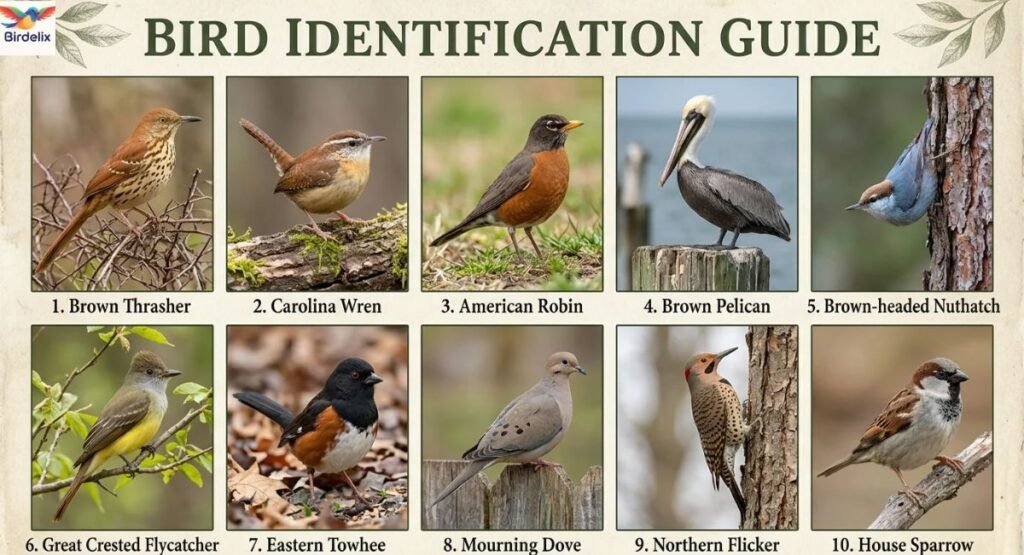
The Brown Thrasher is one of the easiest large brown songbirds to recognize. It has rich reddish-brown upperparts, a long tail, and bright yellow eyes. Its pale chest carries bold dark streaks that make the bird look heavily patterned. It also has a long, slightly curved bill that helps it search through leaves and soil.
In Florida, Brown Thrashers use thick shrubs, hedgerows, woodland edges, and overgrown gardens. They often forage on the ground for insects, beetles, worms, and other small creatures. They also eat berries and fruit when available. Their varied song can include many repeated phrases. Unlike a Northern Mockingbird, a Brown Thrasher has stronger chest streaks and a warmer reddish-brown back.
2. Carolina Wren
The Carolina Wren is a small, round-bodied bird with warm reddish-brown feathers. Its most noticeable feature is a long white eyebrow stripe above each eye. It also has a pale throat, buff-colored underside, and a slender bill that curves slightly downward. Its tail often points upward when it moves through bushes.
This wren is common around Florida homes, gardens, woodpiles, and wooded neighborhoods. It searches for insects and spiders among leaves, branches, and other sheltered places. Its loud song can sound surprisingly powerful for such a small bird. Listen for its clear, repeated notes when searching for small brown birds in Florida. The white eyebrow and upright tail help separate it from many other wrens.
3. American Robin
The American Robin has a brown back, dark head, and orange-red breast. Its rounded body and medium size make it easy to notice on lawns and open ground. The bird often walks across grass before stopping to pull an earthworm from the soil. Its bright breast provides a useful clue when identifying it.
Robins visit parks, gardens, golf courses, and residential areas in Florida. Their presence can change with the season and location. They feed on earthworms, insects, and fruit, often switching foods as conditions change. A robin may resemble other thrushes because of its body shape. However, its orange-red breast and familiar upright posture usually help distinguish it. Look at the breast color rather than relying only on its brown back.
4. Brown Pelican
The Brown Pelican is a large coastal bird with a heavy body, long bill, and enormous throat pouch. Adults usually show brown body feathers with a pale head and neck during parts of the year. Its broad wings and low flight over the water make it easy to recognize. It often travels close to the surface before diving for fish.
Brown Pelicans live around Florida’s beaches, bays, estuaries, and coastal islands. They catch fish by plunging into the water and scooping prey into their expandable pouches. They then drain the water before swallowing their catch. You may see them resting on docks, pilings, or sandbars. Their size and fishing behavior make them very different from small brown backyard birds.
5. Brown-headed Nuthatch
The Brown-headed Nuthatch is a tiny bird with a short tail and compact body. It has a warm brown cap, gray back, and pale underside. A small dark line near the eye adds contrast to its face. Its short bill and quick movements make it look busy as it searches along pine branches.
This species lives in southeastern pine forests and remains in Florida throughout the year. It often travels in pairs or small family groups. You may hear its high-pitched calls before spotting it among the branches. It searches for insects and other small food items in bark crevices. Its small size, brown cap, and gray back help identify it as a small brown bird in Florida.
6. Great Crested Flycatcher
The Great Crested Flycatcher has brown upperparts, a darker head, and bright yellow underparts. Its wings often show reddish-brown tones, while its tail can appear rusty orange. It has a broad bill and a slightly crested head. These features give it a stronger appearance than many smaller flycatchers.
In Florida, this bird uses wooded areas, tree-lined neighborhoods, and forest edges. It often waits on a branch before flying out to catch insects in the air. It may also eat berries and other small fruits. Its yellow belly is especially useful when identifying a brown bird with a yellow belly. The rusty tail and larger bill provide additional clues that separate it from other flycatchers.
7. Eastern Towhee
The Eastern Towhee shows a mix of brown, black, white, and rusty colors. Females usually have brown upperparts instead of the male’s black upperparts. Both sexes have warm reddish sides, a pale belly, and a long tail with white markings. Their strong legs help them scratch through dry leaves while searching for food.
Eastern Towhees prefer brushy habitats, woodland edges, and overgrown areas. They often stay close to the ground and may be difficult to see in thick vegetation. Their diet includes insects, seeds, and berries. A female can look like a brown and black bird in Florida, especially when viewed from a distance. Check the rusty sides and white belly to help confirm the identification.
8. Mourning Dove
The Mourning Dove has soft brown-gray feathers, a small head, and a long pointed tail. Its wings show dark spots, while its body often looks smooth and muted. A black spot appears on each side of the neck. These markings can be subtle, so its shape and flight are also useful identification clues.
Mourning Doves are common around Florida homes, farms, parks, and open spaces. They often feed on the ground, picking up seeds from lawns and bare soil. Their flight is quick, with pointed wings that produce a sharp whistling sound during takeoff. Their gentle cooing call is another familiar feature. If you notice a slender bird with a long tail and soft brown coloring, a Mourning Dove is worth considering.
9. Northern Flicker
The Northern Flicker is a large woodpecker with a brown back, black markings, and a spotted underside. Its back has dark bars, while its chest and belly show round black spots. A black crescent marks the upper chest. In Florida, the eastern form generally has yellow under the wings and tail, which may become visible during flight.
Unlike many woodpeckers, Northern Flickers often search for food on the ground. They use their slightly curved bills to find ants and other insects. You may spot them in open woodlands, parks, yards, and areas with scattered trees. Their spotted belly and barred back make them easier to recognize than many brown and black birds. Watch for their strong flight and bright yellow wing flashes.
10. House Sparrow
The House Sparrow is a small, compact bird that often lives close to people. Males have gray crowns, black bibs, brown neck patches, and streaked wings. Females look plainer, with brown and gray feathers and a pale stripe behind the eye. Their short bills are strong enough to crack seeds.
House Sparrows often gather around buildings, shopping areas, farms, and outdoor dining spaces. They build nests in gaps, roof spaces, and other sheltered spots. Their diet includes seeds, grains, and scraps of human food. Because they live around people, they are among the easiest small brown birds in Florida to observe. Check the head markings to tell males and females apart.
11. American Kestrel
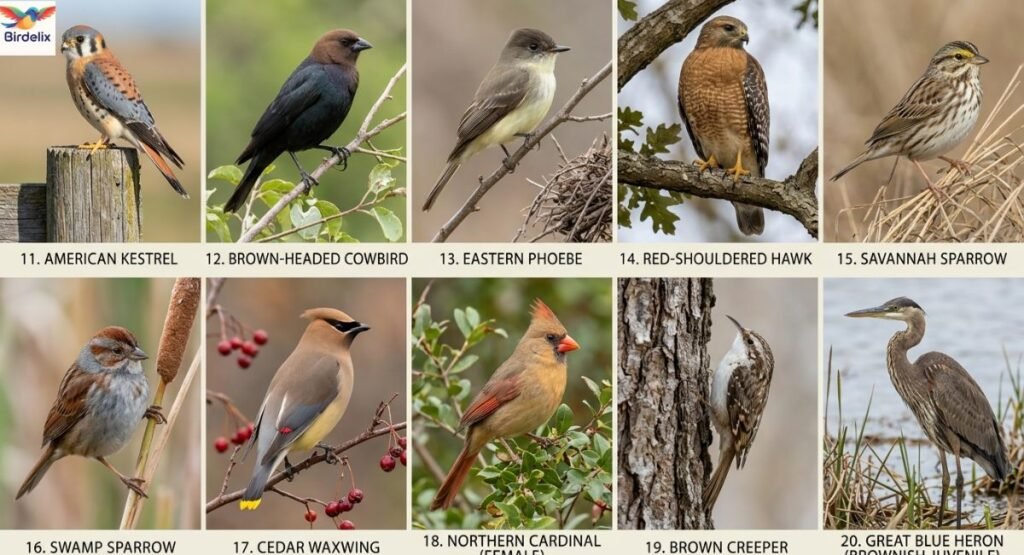
The American Kestrel is a small falcon with a colorful pattern of brown, rust, gray, and black. Its back and tail show reddish tones, while its wings and head have contrasting markings. Males usually have blue-gray wings, while females have more brown coloring. Both sexes have dark facial marks that help identify them.
American Kestrels use open fields, grasslands, roadsides, and other places where they can spot prey. They often perch on wires or poles before dropping toward insects and small animals. They may hover briefly while searching for food. Their hooked bill and hunting behavior distinguish them from ordinary songbirds. A brown-looking kestrel may be mistaken for a small dove at a distance, but its pointed wings and falcon-like posture reveal its identity.
12. Brown-headed Cowbird
The Brown-headed Cowbird looks very different depending on its sex. Males have glossy black bodies and brown heads. Females are mostly plain brown with subtle streaking and a lighter underside. The female is therefore more likely to be mistaken for an ordinary brown songbird.
This species often visits open fields, lawns, pastures, and woodland edges. It feeds on seeds and insects, sometimes joining mixed flocks of blackbirds and other birds. Brown-headed Cowbirds are also known for brood parasitism. Females lay eggs in the nests of other bird species rather than raising every chick themselves. Their behavior and the male’s dark body make this species especially interesting when comparing brown and black birds in Florida.
13. Eastern Phoebe
The Eastern Phoebe is a small-to-medium flycatcher with a brownish-gray back, dark head, and pale underside. Its coloring is usually understated, without the strong yellow belly of a Great Crested Flycatcher. It often flicks its tail while perched. This repeated movement can help you recognize it.
Eastern Phoebes visit Florida during the cooler months and may be seen around wooded edges, bridges, buildings, and open areas near water. They sit on a branch or structure before darting out to catch flying insects. Their simple call often sounds like a repeated “fee-bee.” Look for the dark head, plain chest, and tail movement when separating this bird from other flycatchers.
14. Red-shouldered Hawk
The Red-shouldered Hawk is a medium-to-large raptor with broad wings and a strong hooked bill. Its upperparts are brown and dark, while its underparts show reddish barring. Its tail has several dark and pale bands. The red shoulder patches may be easier to see when the bird is perched in good light.
This hawk lives in wooded habitats, especially near wetlands, streams, and swamps. It hunts small mammals, reptiles, amphibians, and other prey. You may hear its loud, repeated calls before seeing it flying above the trees. Its broad wings and banded tail help separate it from other hawks. When identifying a large brown bird in Florida, look for its flight shape and reddish chest pattern.
15. Savannah Sparrow
The Savannah Sparrow is a small brown bird with dark streaks across its back and breast. It has a short tail, a rounded body, and a small bill. A yellowish patch near the eye can sometimes be visible at close range. Its streaked chest is one of the best clues for identification.
Savannah Sparrows use grasslands, fields, pastures, and open areas. They are more likely to appear in Florida during the cooler months than during the breeding season. They feed on seeds and insects, often walking through low vegetation. Their streaked appearance can cause confusion with other sparrows. Check the breast pattern, head markings, and habitat before deciding which species you have seen.
16. Swamp Sparrow
The Swamp Sparrow has a brown back, gray face, and rusty tones on its wings and crown. Its breast is usually less heavily streaked than that of several similar sparrows. It has a rounded body and a fairly short tail. These details can help separate it from other small brown birds.
This species prefers wet habitats with thick vegetation. In Florida, it is mainly a cool-season visitor, appearing around marshes, wet fields, and damp areas. It searches for seeds and small insects among reeds and low plants. Its rusty crown and gray face are useful clues. If you spot a streaked sparrow near a marsh, compare its breast markings before identifying it as a Swamp Sparrow.
17. Cedar Waxwing
The Cedar Waxwing has smooth brown upperparts, a pale yellow belly, and a grayish tail with a bright yellow tip. A black mask crosses its face, and small red wax-like tips may appear on some wing feathers. Its sleek body and neat appearance make it different from many streaked brown songbirds.
Cedar Waxwings travel in flocks and often visit Florida when fruit is available. They feed heavily on berries, including fruit from ornamental trees and shrubs. Their movements can be irregular because they follow food supplies. You may see a group gathering quietly in a fruiting tree. Their black face mask, yellow tail tip, and flocking behavior make them easier to identify than their brown coloring alone suggests.
18. Northern Cardinal Female
The female Northern Cardinal is often overlooked because she does not have the male’s bright red plumage. Her body is mostly warm brown with reddish accents on the wings, tail, and crest. She also has a noticeable orange-red bill and a pointed head crest. These features make her a colorful example of a brown-looking bird.
Female cardinals live in woodlands, gardens, parks, and residential neighborhoods across Florida. They often visit feeders for seeds and may also eat insects and fruit. Their strong bills help them handle larger seeds. The crest and orange-red bill are especially helpful when identifying them. If a brown bird in your yard has a raised crest and reddish details, consider a female Northern Cardinal.
19. Brown Creeper
The Brown Creeper is a tiny woodland bird with mottled brown and white feathers. Its curved bill helps it pull insects and eggs from narrow spaces in tree bark. It usually climbs upward along a trunk in a spiral pattern. Its camouflage makes it look like part of the tree.
Brown Creepers are associated with forests and wooded habitats. They occur in Florida, but sightings can be less frequent and more localized than those of common backyard species. They are often easier to notice by their movement than by their coloring. Unlike the Brown-headed Nuthatch, which can move in several directions along branches and trunks, the Brown Creeper usually works upward from the base of a tree.
20. Great Blue Heron Juvenile
A young Great Blue Heron can look much browner than an adult. Juveniles often have a brownish neck and head with streaked markings. They also have long legs, a long neck, and a large pointed bill. Their overall shape is very different from that of a small brown songbird.
Great Blue Herons live around Florida’s ponds, lakes, marshes, rivers, and coastal waters. They stand still in shallow water while watching for fish and other prey. When an animal moves within reach, they strike quickly with their bill. Adults become more gray-blue as their plumage develops. If you see a tall brownish bird beside water, check its long legs and neck before identifying it.
Small Brown Birds in Florida
| Bird Name | Main Colors | Common Habitat | Key Identification Feature |
| Brown-headed Nuthatch | Brown, gray, white | Pine forests | Tiny body and brown cap |
| Carolina Wren | Reddish-brown, white | Backyards, forests | Bold white eyebrow |
| House Sparrow | Brown, gray, black | Urban areas, gardens | Short bill and striped head |
| Savannah Sparrow | Brown, cream, yellow | Grasslands, open fields | Streaked breast and yellow eyebrow |
| Swamp Sparrow | Brown, gray, rusty | Marshes, wetlands | Rusty crown and gray face |
| Brown Creeper | Brown, white | Woodlands, tree trunks | Curved bill and climbing behavior |
Medium-Sized Brown Birds in Florida
| Bird Name | Main Colors | Common Habitat | Key Identification Feature |
| American Robin | Brown, orange-red | Lawns, parks, gardens | Bright orange-red breast |
| Eastern Towhee | Brown, black, white, rusty | Shrublands, woodland edges | Rust-colored sides |
| Mourning Dove | Brown, gray, black | Backyards, open areas | Long pointed tail |
| Eastern Phoebe | Brown, gray, white | Woodlands, bridges, open areas | Dark head and tail movement |
| Great Crested Flycatcher | Brown, yellow, rusty | Woodlands, tree-lined areas | Yellow belly and large bill |
Big Brown Birds in Florida
| Bird Name | Main Colors | Common Habitat | Key Identification Feature |
| Brown Pelican | Brown, white, gray | Coasts, bays, estuaries | Long bill and large throat pouch |
| Northern Flicker | Brown, black, yellow | Woodlands, parks, yards | Spotted belly and barred back |
| Red-shouldered Hawk | Brown, reddish, black | Forests, wetlands | Broad wings and banded tail |
| Great Blue Heron (Juvenile) | Brown, gray, white | Lakes, marshes, coastal waters | Long legs, neck, and pointed bill |
Note: The Great Crested Flycatcher is medium-sized, not a large bird. It is included in the medium-sized table rather than the big-bird category.
Brown and White Birds in Florida
White markings can make a brown bird easier to recognize. Brown Thrashers have pale underparts covered in dark streaks, along with light wing bars. Brown Pelicans show pale areas on the head and neck. Eastern Towhees have white bellies and white tail markings that contrast with their darker feathers.
Northern Flickers have spotted pale underparts, while Brown Creepers show a pale underside and mottled back. These markings are often more useful than the overall brown color. When you see a brown and white bird in Florida, check whether the white appears on the chest, wings, belly, or tail. The location of the markings can help narrow down the species.
Brown Birds With Yellow, Orange, or Red Markings
Brown feathers often appear alongside brighter colors. These extra shades can provide some of the strongest identification clues. A yellow belly, orange breast, or reddish wing patch may help you recognize a bird before you notice its other features.
Brown Birds With Yellow Bellies
The Great Crested Flycatcher is a good example of a brown bird with a yellow belly. Its brown head and back contrast with bright yellow underparts. Cedar Waxwings also show pale yellow coloring on the belly and a yellow tail tip. Check the bird’s size, bill, and behavior before choosing between them.
Brown Birds With Orange or Red Markings
American Robins have orange-red breasts that stand out against their brown backs. Female Northern Cardinals show reddish accents on their wings and tails. Eastern Towhees have rusty sides, while Northern Flickers may show yellow under their wings and tail. These colors make brown birds with orange or red markings easier to recognize in good light.
Brown Birds in Different Parts of Florida
Florida’s regions support different bird communities because their habitats and seasonal conditions vary. Coastal areas offer feeding grounds for seabirds and wading birds. Inland forests, grasslands, and neighborhoods support many songbirds. Some species occur across the state, while others are more closely linked to particular environments.
Brown Birds in South Florida
South Florida has coastal wetlands, mangroves, parks, gardens, and subtropical habitats. Brown Pelicans are familiar around beaches and bays. Herons and other waterbirds use shallow wetlands, while Carolina Wrens and other songbirds may visit gardens and wooded neighborhoods. Seasonal visitors can add more variety during cooler months.
Brown Birds in Central Florida
Central Florida includes lakes, wetlands, pine forests, parks, and residential areas. You may see Mourning Doves and House Sparrows around homes. Brown-headed Nuthatches use suitable pine woods, while Great Blue Herons feed around lakes and ponds. The mix of open and wooded habitats supports many different bird species.
Brown Birds in North Florida
North Florida has forests, grasslands, wetlands, and backyard habitats. Brown Thrashers and Carolina Wrens use thick vegetation, while Eastern Towhees prefer brushy areas. Seasonal sparrows may appear in open fields and wet grasslands. Winter can bring birds that are less common during the warmer months.
Brown Birds in the Florida Keys
The Florida Keys offer beaches, mangroves, coastal scrub, and small areas of woodland. Brown Pelicans are familiar along the shoreline and around harbors. Other coastal birds use shallow water and mangrove habitats to feed. Island conditions and migration can affect which species you see during a visit.
Brown Birds in Florida by Habitat
Habitat is one of the most useful clues in bird identification. A bird found in a pine forest may be unlikely to appear in the same numbers along a beach. Paying attention to the surrounding environment can help you narrow down a species before studying its markings.
Backyards and Residential Areas
Carolina Wrens, House Sparrows, Mourning Doves, and female Northern Cardinals often use residential spaces. They may feed near gardens, shrubs, feeders, and buildings. Some also nest in sheltered corners or dense vegetation. Watch for their movement and feeding habits as well as their colors.
Forests and Pine Woodlands
Brown-headed Nuthatches are strongly associated with southeastern pine forests. Brown Thrashers use woodland edges and thick undergrowth, while Brown Creepers search tree trunks for small insects. Great Crested Flycatchers also use wooded habitats. Look among branches and trunks rather than only scanning the ground.
Wetlands and Marshes
Wetlands attract birds that feed on fish, insects, and other aquatic animals. Brown Pelicans use coastal waters, while Great Blue Herons hunt around ponds and marshes. Swamp Sparrows search for food among wetland vegetation. The water’s edge is a good place to look for large brownish birds with long bills or legs.
Coastal Areas and Beaches
Coastal Florida supports Brown Pelicans and many other water-associated birds. Pelicans may rest on docks, piers, and sandbars between fishing trips. Their large bills and diving behavior make them easy to distinguish from smaller birds. Look toward bays, inlets, and open shorelines.
Grasslands and Open Fields
Savannah Sparrows use open fields and grasslands, especially during the cooler months. American Kestrels also hunt in open areas where they can spot insects and small animals. Mourning Doves may feed on seeds across bare ground. Scan fence posts, wires, and low vegetation for birds resting between feeding trips.
Parks and Suburban Green Spaces
Parks offer a mixture of trees, lawns, ponds, and shrubs. American Robins may search lawns for earthworms, while Mourning Doves feed on seeds nearby. Northern Flickers can visit open lawns and tree-lined spaces. These mixed habitats are useful places to observe several Florida brown birds during one visit.
How to Identify Brown Birds in Florida
Identifying a brown bird becomes easier when you examine several features together. Color alone is rarely enough because many unrelated species have brown feathers. Start with the bird’s overall size and shape. Then study its markings, bill, tail, behavior, and surroundings.
Size and Body Shape
Estimate whether the bird is small, medium-sized, or large. A tiny rounded bird may be a Brown-headed Nuthatch, while a long-bodied bird with a long tail could be a Brown Thrasher. A tall bird beside water may be a young Great Blue Heron. Body proportions often provide a stronger clue than color.
Bill Shape and Length
A bird’s bill can reveal what it eats. A short, strong bill is common among seed-eaters such as House Sparrows. A long, slender bill may belong to a bird that searches for insects. The Brown Pelican’s huge bill and pouch are unmistakable. Check whether the bill is hooked, straight, thick, or slightly curved.
Tail Length and Pattern
Tail shape helps separate birds that have similar brown plumage. Mourning Doves have long pointed tails, while Brown-headed Nuthatches have short tails. Brown Thrashers also have long tails, but their bodies and bills look different from doves. Look for white edges, dark bands, or rusty coloring.
Breast and Belly Markings
The breast can be one of the best places to identify a brown bird. Brown Thrashers have strong dark streaks, while American Robins have orange-red breasts. Great Crested Flycatchers show yellow underparts. Some sparrows have heavy streaking, while others have cleaner-looking chests.
Wing Patterns and Head Markings
Wing bars, spots, and patches can help confirm an identification. Northern Flickers have dark bars on their backs and spots underneath. Brown Creepers have mottled brown upperparts that blend with tree bark. Carolina Wrens have a clear white eyebrow stripe. Check the head and wings when the bird is facing away from you.
Habitat, Behavior, and Calls
Notice where the bird is feeding or resting. A bird climbing a pine trunk may be a nuthatch, while one searching wet vegetation could be a Swamp Sparrow. A flycatcher often launches from a perch to catch insects. Calls can also help, especially when thick leaves hide the bird.
Season
Season matters because some birds migrate while others remain in Florida throughout the year. Brown-headed Nuthatches are mostly permanent residents. Savannah Sparrows and Swamp Sparrows are more likely to be encountered during the cooler season. Check the date and location of a sighting when comparing possible species.
Brown Bird Identification: Similar Species That Can Be Confusing
Several birds can look alike when seen briefly or from a distance. Their colors may overlap, especially in poor light or dense vegetation. Comparing a few specific features can prevent common identification mistakes.
Brown Thrasher vs. Northern Mockingbird
Both birds have long tails and can appear similar in size. However, the Brown Thrasher has a reddish-brown back and bold dark streaks across its pale chest. The Northern Mockingbird is usually gray above with a lighter underside and noticeable white wing patches. The thrasher’s yellow eye is another useful clue.
Carolina Wren vs. House Wren
Both wrens are small and brown, but their markings differ. Carolina Wrens have rich reddish-brown upperparts and a bold white eyebrow. House Wrens are generally duller brown and have a less striking face pattern. A Carolina Wren also has a loud, clear song and often holds its tail upward.
Brown-headed Nuthatch vs. Brown Creeper
These tiny birds both search for food on tree trunks and branches. The Brown-headed Nuthatch has a brown cap, gray back, and short tail. The Brown Creeper has mottled brown-and-white plumage and a slender curved bill. Its usual upward spiral along tree trunks is a particularly useful clue.
American Robin vs. Other Thrushes
American Robins are recognized by their orange-red breasts and brown backs. Other thrushes may have spotted breasts or more muted coloring. Check the breast pattern, head color, and overall shape. A clear orange-red breast strongly supports an American Robin identification.
Eastern Towhee vs. Sparrows
Female Eastern Towhees can resemble large brown sparrows. However, towhees usually have a stronger body shape and rusty sides. Many sparrows have more obvious streaks across the breast and back. Watch how the bird moves through leaf litter. Towhees often scratch with both feet while searching for food.
Great Crested Flycatcher vs. Other Flycatchers
The Great Crested Flycatcher has brown upperparts, yellow underparts, and rusty tones in its wings and tail. Eastern Phoebes look more gray-brown and have paler underparts. The larger bill and brighter yellow belly are useful clues. Behavior and calls can help confirm the identification.
A Simple Florida Backyard Identification Example
Imagine that you notice a small reddish-brown bird near a garden shrub. It has a pale stripe above its eye and keeps its tail raised. It moves through dense plants and makes a loud, repeated call. These clues point toward a Carolina Wren rather than a House Wren.
Now imagine a tiny gray-and-brown bird climbing a pine trunk. It has a short tail and makes high-pitched calls to nearby birds. The Brown-headed Nuthatch becomes a stronger possibility. This simple process shows why size, markings, habitat, and behavior work best together.
Conclusion
Florida offers many opportunities to observe brown birds in different habitats. You may find small wrens in your garden, nuthatches in pine forests, or pelicans along the coast. Each species has its own markings, feeding habits, and preferred environment.For accurate brown bird identification, look beyond feather color. Pay attention to body size, bill shape, tail length, breast patterns, and behavior. Also consider the season and location.
These details can help you identify small brown birds in Florida, larger species, and birds with black, white, yellow, or reddish markings.With regular observation, you will become more familiar with Florida’s birdlife. Keep a local bird guide nearby and record the features you notice. Even a brief sighting can teach you something new.
FAQs
1. What Are the Most Common Brown Birds in Florida?
Carolina Wrens, Mourning Doves, House Sparrows, Brown Thrashers, and female Northern Cardinals are familiar examples. The species you see depends on your location and habitat.
2. What Is the Small Brown Bird Commonly Seen in Florida Backyards?
The Carolina Wren is a common small backyard bird. Its reddish-brown body and bold white eyebrow make it easy to recognize.
3. What Are the Big Brown Birds in Florida?
Brown Pelicans, Northern Flickers, Red-shouldered Hawks, and juvenile Great Blue Herons can appear brown. Their body shapes and habitats are very different.
4. What Brown Bird in Florida Has a Long Beak?
The Brown Thrasher has a long, slightly curved bill and reddish-brown feathers. The Brown Pelican has a much larger bill with a noticeable throat pouch.
5. What Brown Bird in Florida Looks Like a Mockingbird?
The Brown Thrasher can resemble a Northern Mockingbird because both have long tails. Its reddish-brown back and heavily streaked chest help distinguish it.
Welcome to Birdelix! I’m Anam Sattar, an AI-powered SEO Specialist and Content Writer with over 5 years of experience in creating high-quality, search-optimized content. I help businesses improve their search engine rankings, increase organic traffic, and build beautiful, user-friendly websites. My mission is to make SEO, content creation, and web design simple, effective, and accessible for everyone. Let’s grow your online presence and achieve success together!