

Texas is home to many beautiful and interesting dark-feathered birds. Some are large and easy to recognize, while others are small and often go unnoticed. You may spot them in parks, backyards, wetlands, grasslands, and open fields. This guide explores black birds in Texas, including big black birds, smaller species, and birds with striking color patterns.
You’ll also learn about black and white birds and black birds with red wings. Each species has unique features that make identification easier. From long-tailed grackles to familiar crows, these birds add variety to Texas wildlife. Their size, beak shape, markings, and habitats offer helpful identification clues.
Black Birds in Texas at a Glance
Some dark-colored birds look almost identical from a distance. However, their tails, eyes, bills, and wing markings often reveal their identities. Use this table as a quick starting point before exploring each species.
| Bird | Size | Main Color | Key Markings | Habitat in Texas | Best ID Feature |
| Great-tailed Grackle | Large | Glossy black | Long V-shaped tail | Cities, fields, wetlands | Long tail and yellow eyes |
| Common Grackle | Medium-large | Iridescent black | Pale yellow eye | Fields, parks, woodlands | Long keel-shaped tail |
| American Crow | Large | Black | Heavy black bill | Towns, farms, forests | Familiar caw |
| Chihuahuan Raven | Large | Black | Shaggy throat feathers | Western Texas deserts | Heavy bill and deep call |
| Fish Crow | Medium | Black | Compact body | Coastal areas and waterways | Nasal-sounding call |
| Boat-tailed Grackle | Large | Glossy black | Long, broad tail | Gulf Coast marshes | Long tail and coastal habitat |
| Bronzed Cowbird | Medium | Bronze-black | Thick bill and red eyes | Fields and open areas | Stocky body |
| Brown-headed Cowbird | Medium | Black and brown | Brown head | Pastures and woodland edges | Contrasting head color |
| Brewer’s Blackbird | Small-medium | Glossy black | Pale eye | Fields and open spaces | Slender shape |
| Red-winged Blackbird | Small-medium | Black | Red and yellow shoulder patches | Marshes and wetlands | Bright red shoulders |
| Yellow-headed Blackbird | Medium | Black and yellow | Yellow head and white wing patch | Wetlands | Bright yellow head |
| Common Yellowthroat | Small | Olive, yellow, and black | Black facial mask on males | Brush and wetlands | Yellow throat |
| Eastern Meadowlark | Medium | Brown and yellow | Black chest marking | Grasslands and pastures | Yellow chest |
| Orchard Oriole | Small-medium | Black and orange | Orange underparts | Open woodlands | Chestnut-orange male |
| Baltimore Oriole | Medium | Black and orange | White wing markings | Woodlands and parks | Bright orange body |
| Black-and-white Warbler | Small | Black and white | Bold stripes | Woodlands | Striped body |
| Black-throated Sparrow | Small | Gray and black | Black throat | Desert scrub | White facial stripes |
| Lark Bunting | Medium | Black and white in breeding males | White wing patches | Open grasslands | Seasonal black plumage |
| Eastern Phoebe | Small | Gray-brown and dark | Dark head | Streams and wooded edges | Tail-wagging behavior |
| Scissor-tailed Flycatcher | Medium | Gray, black, and white | Extremely long tail | Open fields | Forked tail |
20 Black Birds in Texas
Texas has several true blackbird species. It also has crows, ravens, warblers, and flycatchers with dark feathers. The following profiles explain their appearance, behavior, and preferred habitats.
1. Great-tailed Grackle
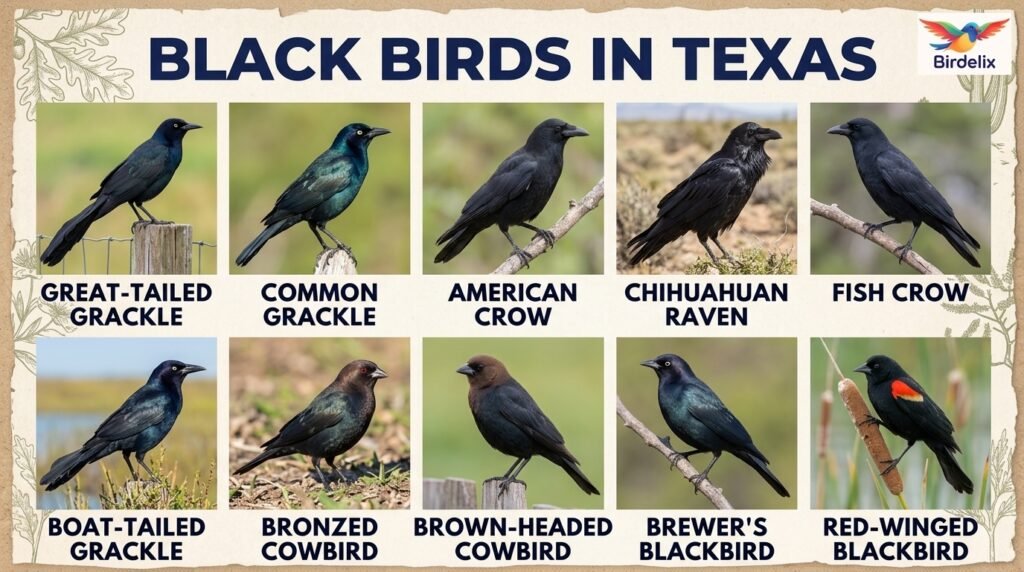
The Great-tailed Grackle is one of the easiest large dark birds to recognize. Adult males have glossy black feathers with purple and blue reflections. Their long, V-shaped tails stand out when they walk across open lawns. They also have bright yellow eyes and long legs.
Females look different, with brown feathers and shorter tails. You’ll often find these birds around parking lots, parks, farms, golf courses, and wetlands. They gather in noisy groups and may roost together in large neighborhood trees.
2. Common Grackle
The Common Grackle has a glossy black body that can show blue, purple, or bronze shades in sunlight. Its long tail, pointed bill, and pale yellow eye help separate it from many other dark birds. It is generally smaller than a Great-tailed Grackle.
In Texas, look for it around fields, parks, farms, wooded edges, and suburban neighborhoods. It searches for insects, seeds, and other food on the ground. Its narrow body and long tail make it look quite different from a crow.
3. American Crow
The American Crow is a familiar sight across much of Texas. It has an entirely black appearance, a strong bill, and sturdy legs. Its body looks broad compared with the slimmer shape of a grackle. Crows adapt well to cities, farms, forests, parks, and open countryside.
They eat insects, seeds, fruit, small animals, and food scraps. Their loud caw is another helpful clue. Unlike grackles, crows have heavier bodies and shorter-looking tails. They also show remarkable problem-solving skills and often gather in family groups.
4. Chihuahuan Raven
The Chihuahuan Raven lives in the dry landscapes of western Texas. It has black feathers, a heavy bill, and a strong body. Its throat feathers may look shaggy when viewed closely. This feature helps distinguish it from smaller blackbirds.
Look for it around desert scrub, open ranchland, rocky areas, and dry grasslands. It often feeds on insects, carrion, and other available food. Its deep calls may sound different from the familiar caw of an American Crow.
5. Fish Crow
The Fish Crow is a medium-sized crow with completely black feathers. It usually looks slightly smaller and more compact than an American Crow. Its nasal call is one of its best identification clues. Listen for a short sound that differs from the deeper caw of other crows.
In Texas, it is associated with coastal areas, rivers, and other waterways. It may search for food along shorelines and near wetlands. However, size alone cannot confirm its identity. Comparing its call, location, and body shape gives you a better answer.
6. Boat-tailed Grackle
The Boat-tailed Grackle is a large coastal bird with a long tail and glossy feathers. Adult males look mostly black, often with a purple shine around the head. Females are smaller and brown, with lighter underparts. Its broad tail helps explain its common name.
In Texas, look for this species near Gulf Coast marshes, coastal wetlands, and nearby open areas. It often feeds on the ground or around shallow water. Its coastal distribution helps separate it from the more widespread Great-tailed Grackle.
7. Bronzed Cowbird
The Bronzed Cowbird has a stocky body and dark feathers with a bronze or blue-black shine. Adult males often show noticeable red eyes. Its thick bill also gives it a different appearance from slimmer grackles.
In Texas, it may appear around pastures, farms, lawns, scrubland, and other open habitats. It feeds on seeds and insects while searching the ground for food. This species also practices brood parasitism, meaning females lay eggs in other birds’ nests.
8. Brown-headed Cowbird
The Brown-headed Cowbird has a clear color contrast. Adult males have a black body and a rich brown head. Females are mostly gray-brown and look less colorful. This difference can make the two sexes appear like separate species.
The bird often visits grasslands, pastures, farms, woodland edges, and suburban areas. It feeds on seeds and insects, sometimes following grazing animals to find disturbed insects. Like other cowbirds, it lays eggs in other birds’ nests.
9. Brewer’s Blackbird
The Brewer’s Blackbird is a relatively slender bird with glossy black feathers. Adult males often show subtle purple and green reflections. Their pale eyes stand out against the dark face. Females are duller brown and lack the male’s strong shine.
In Texas, this species may appear during migration and winter. Look for it in open fields, lawns, agricultural areas, and around towns. It often feeds on the ground in small groups. Its slim shape and pale eye help separate it from grackles.
10. Red-winged Blackbird
The Red-winged Blackbird is famous for its bright shoulder patches. Adult males have glossy black bodies with red patches bordered by yellow. These patches are called epaulets. They become especially noticeable when males display or defend their territories.
Females look very different. Their brown feathers have heavy streaks, which help them blend into marsh plants. This species is common in Texas wetlands, including marshes, ponds, wet fields, and reed beds. It also appears in open grassy areas.
11. Yellow-headed Blackbird
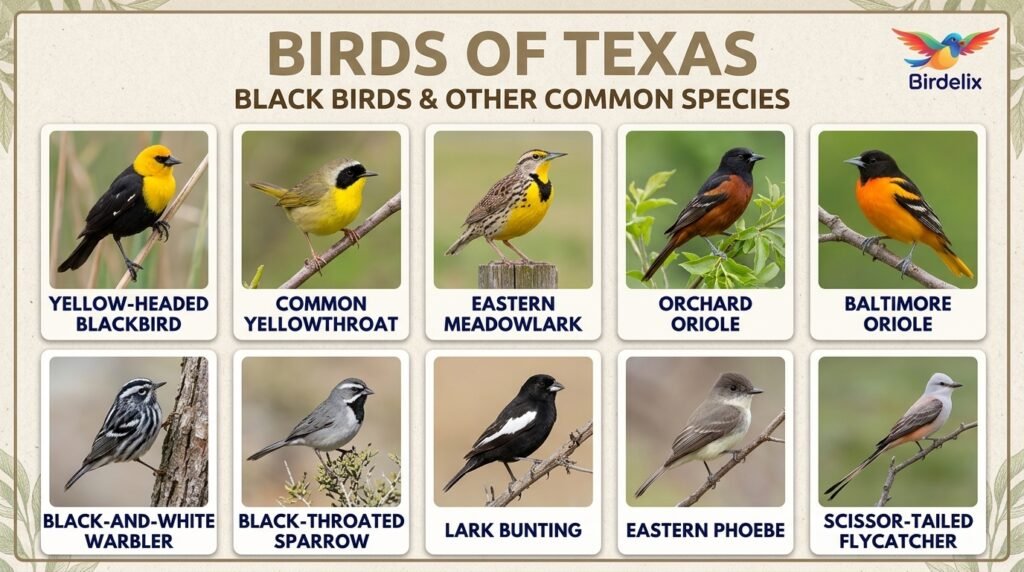
The Yellow-headed Blackbird has one of the most striking color patterns among North American blackbirds. Adult males have a black body, bright yellow head, and white wing patches. Females look duller, with brownish bodies and less vivid yellow coloring.
In Texas, this species may appear around marshes, wet fields, rice-growing areas, and ponds. It is not equally common throughout the state. Sightings often depend on season and location. Its yellow head makes identification easy when you get a clear view.
12. Common Yellowthroat
The Common Yellowthroat is a small songbird rather than a true blackbird. It has olive-brown upperparts and a bright yellow throat and breast. Adult males have a black mask across the face, often bordered with a pale line. Females lack this bold mask.
In Texas, search for it in dense brush, marsh edges, wet meadows, and grassy wetlands. It often stays low among plants, so it can be difficult to see. Its yellow throat and small size help separate it from larger dark birds.
13. Eastern Meadowlark
The Eastern Meadowlark has brown, streaked upperparts and bright yellow underparts. A bold black V-shaped marking crosses its chest. This pattern makes it easy to recognize when it faces you. It often lives in pastures, prairies, hayfields, and open grasslands.
Although its back has dark markings, it is not a true blackbird. It belongs to the meadowlark group and spends much of its time on the ground. Its yellow chest and upright posture help distinguish it from grackles and cowbirds.
14. Orchard Oriole
The Orchard Oriole is a smaller bird with striking differences between adult males and females. Adult males have black heads and backs with rich chestnut-orange underparts. Females and immature birds usually show yellow-green coloring. This difference can make identification confusing at first.
In Texas, look for Orchard Orioles in open woodlands, parks, orchards, and trees near rivers. They feed on insects, fruit, and nectar. Their smaller size and orange coloring help separate them from larger blackbirds. They are seasonal visitors in many parts of the state.
15. Baltimore Oriole
The Baltimore Oriole combines black, orange, and white feathers. Adult males have black heads and backs, bright orange underparts, and white markings on their wings. Females and younger birds usually have duller orange or yellow-orange coloring.
Texas provides important stopover habitat for these birds during migration. Look for them in wooded parks, gardens, river corridors, and mature trees. They may visit feeders that offer fruit or nectar. Their bright orange belly and dark head make them easier to identify.
16. Black-and-white Warbler
The Black-and-white Warbler is a small bird with bold stripes across its body. Its black-and-white pattern looks almost like a tiny zebra. Males often have stronger black markings than females. This warbler moves along tree trunks and branches while searching for insects.
In Texas, it may appear in woodlands, parks, forests, and wooded areas during migration. Its unusual climbing behavior is a helpful clue. Unlike a woodpecker, it does not use its tail in the same way for support. Its striped body makes it stand out.
17. Black-throated Sparrow
The Black-throated Sparrow is a small bird of dry, open country. It has a pale gray-brown body with a clear black throat patch. White facial stripes create a neat pattern around its face. This species is especially relevant to bird searches in western and parts of southern Texas.
Look for it in desert scrub, rocky areas, brushy slopes, and dry grasslands. It often moves through low shrubs while searching for seeds and insects. Its black throat and pale face help separate it from other small desert birds.
18. Lark Bunting
The Lark Bunting changes appearance with the season. Breeding males become mostly black, with bold white patches on their wings. Females and nonbreeding birds look brown and streaked. This seasonal change can make identification more difficult.
In Texas, the species may appear during migration or in suitable open habitats. Look across grasslands, prairies, and agricultural fields. Its white wing patches are especially useful when it flies. Remember that a brown bird may still be a Lark Bunting outside the breeding season.
19. Eastern Phoebe
The Eastern Phoebe is a small flycatcher with gray-brown upperparts and a darker head. Its underside is pale, and its overall appearance can look quite dark in poor light. One of its best clues is its repeated tail-wagging behavior.
It often perches near streams, ponds, bridges, buildings, and wooded edges. From a perch, it flies out to catch insects before returning. It is not a true blackbird, but its dark head may lead people to include it in broad bird-identification searches.
20. Scissor-tailed Flycatcher
The Scissor-tailed Flycatcher is one of Texas’s most recognizable birds. Its pale gray body, dark wings, and extremely long forked tail create a striking shape. Adult males usually have longer tails than females. You may see it perched on fences, wires, and roadside branches.
It prefers open fields, pastures, ranchland, and grasslands where flying insects are easy to catch. Although it is not a true blackbird, its dark wings and tail can make it relevant to searches for partly black birds. Its long tail is the clearest identification clue.
Big Black Birds in Texas
| Bird | Relative Size | Main Identification Clue |
| Great-tailed Grackle | Large | Very long V-shaped tail |
| Common Grackle | Medium-large | Long keel-shaped tail |
| American Crow | Large | Broad body and sturdy bill |
| Chihuahuan Raven | Large | Heavy bill and shaggy throat |
| Boat-tailed Grackle | Large | Long tail and coastal habitat |
A long tail does not always mean a bird has the largest body. Grackles can look much longer because of their tail feathers. Compare the body itself rather than judging size from the full silhouette. Also listen to its call. Crows and ravens sound different from grackles.
Small Black Birds in Texas
| Bird | Relative Size | Main Colors | Helpful ID Feature |
| Brewer’s Blackbird | Small-medium | Glossy black | Pale eye |
| Red-winged Blackbird | Small-medium | Black and red | Red shoulder patches |
| Common Yellowthroat | Small | Olive, yellow, black | Black facial mask on males |
| Black-and-white Warbler | Small | Black and white | Bold body stripes |
| Black-throated Sparrow | Small | Gray, black, white | Black throat |
| Eastern Phoebe | Small | Gray-brown | Tail-wagging behavior |
Pay attention to the bird’s body shape before focusing on its color. A small warbler has a different build from a stocky cowbird. The habitat also matters. A bird hiding in marsh grass may be a different species from one feeding in a dry field.
Birds with Yellow Beaks in Texas
| Bird | Bill Appearance | Other Useful Clue |
| Great-tailed Grackle | Dark | Yellow eyes and long tail |
| Common Grackle | Dark | Pale yellow eye and iridescent body |
| Brewer’s Blackbird | Dark | Pale eye and slender shape |
| Yellow-headed Blackbird | Dark | Bright yellow head |
| Brown-headed Cowbird | Dark | Brown head and stocky body |
The phrase black birds with yellow beaks in Texas may describe a bird seen from far away or in poor light. Sunlight can change how a bill appears. Try to observe the bill closely and compare it with the bird’s eyes, head, and body. A clear photograph can also help confirm the identification.
Black and White Birds in Texas
| Bird | Size | Black Markings | White Markings | Where Found |
| Black-and-white Warbler | Small | Bold body stripes | White stripes | Woodlands and parks |
| Lark Bunting | Medium | Black breeding plumage | White wing patches | Open grasslands |
| Scissor-tailed Flycatcher | Medium | Dark wings and tail | Pale body and outer tail feathers | Open fields |
| Downy Woodpecker | Small | Black wings and back | White back and markings | Woodlands and backyards |
Not every bird in this table has a mostly black body. Some have only dark wings, stripes, or patches. That is why checking the full pattern matters. A small striped warbler, for example, has a very different shape from a woodpecker.
Black and Red Birds in Texas
Black Birds with Red Wings and Red Markings
The Red-winged Blackbird is the best-known example of a black bird with red markings in Texas. Adult males have bright red shoulder patches with yellow borders. These patches may look hidden when the bird rests. They become more visible when the bird spreads its wings or displays.
Orchard Orioles also have dark and warm-colored feathers. Adult males show black upperparts and chestnut-orange underparts. This can lead people to describe them as orange and black birds. However, their orange coloring differs from the red shoulder patches of a Red-winged Blackbird.
Black Birds in Houston, Texas
Black Birds Commonly Seen Around Houston
Houston offers many habitats for birds. Parks, neighborhood trees, wetlands, lakes, and open fields attract different species. Great-tailed Grackles often visit parking lots, lawns, and busy public spaces. American Crows may appear around neighborhoods and wooded parks. Red-winged Blackbirds are more likely near marshes and wet grass.
The city’s location near the Gulf Coast also creates opportunities to see seasonal visitors. Look around water, brushy edges, and mature trees. Local birding areas offer different habitats to explore. Check a regional checklist before visiting because bird activity changes throughout the year.
How to Identify a Black Bird in Texas
Look at These Features First
Start by checking the bird’s size. Compare it with a sparrow, robin, grackle, crow, or raven. Next, study its bill and tail. A thick bill may suggest a crow or cowbird, while a very long tail may point toward a grackle. These small details can quickly narrow your choices.
Then examine the head, wings, and body markings. Look for a brown head, yellow face, red shoulders, or white stripes. Notice where the bird is feeding and how it moves. Habitat, behavior, and season all provide useful clues. Try to observe several features before deciding on a species.
Black Bird Identification by Color and Size
| If You See… | Possible Bird |
| Large black bird with long tail | Great-tailed Grackle |
| Black bird with red shoulder patches | Red-winged Blackbird |
| Small black-and-white bird | Black-and-white Warbler |
| Black bird with brown head | Brown-headed Cowbird |
| Black bird with yellow head | Yellow-headed Blackbird |
| Large all-black bird | American Crow or raven |
A bird’s color can look different in bright sunlight, shade, or cloudy weather. Young birds may also have different feathers from adults. For a more reliable result, compare several features instead of relying on color alone. A photograph or bird call can help confirm an identification.
Where to Find Black Birds in Texas
Best Habitats for Black Birds
Texas has many landscapes, so bird species vary from one habitat to another. Urban areas attract grackles and crows. Woodlands provide shelter and feeding sites for orioles and warblers. Grasslands support meadowlarks and other open-country birds. Wetlands attract Red-winged Blackbirds and other water-loving species.
Coastal areas may hold Boat-tailed Grackles and seasonal visitors. Agricultural fields attract cowbirds and grackles searching for seeds and insects. Western deserts and scrublands support species such as Chihuahuan Ravens and Black-throated Sparrows. When you search for birds, pay attention to nearby water, vegetation, food, and open space.
Black Birds in Texas by Region
North Texas
North Texas has suburbs, grasslands, lakes, farms, and wooded areas. Great-tailed Grackles often appear in towns and open spaces. American Crows and Red-winged Blackbirds also use suitable habitats. Check parks, pastures, and wetland edges for different species.
Central Texas
Central Texas includes ranchland, rivers, lakes, oak woodlands, and growing cities. Great-tailed Grackles are familiar around parking lots and lawns. Common Grackles and other dark songbirds may appear in wooded areas or during migration. Waterways can attract additional species.
East Texas
East Texas has forests, pine woodlands, bottomlands, and wetlands. American Crows and Common Grackles use many of these habitats. Wooded parks may also attract migrating warblers. Look near streams and forest edges, where birds can find food and shelter.
South Texas
South Texas has brush country, ranches, wetlands, and the Rio Grande Valley. Great-tailed Grackles and Bronzed Cowbirds are among the species to watch for. Migration can bring more birds through the region. Check both dry brush and wet habitats.
West Texas
West Texas has desert scrub, rocky slopes, dry grasslands, and open ranchland. Chihuahuan Ravens are especially associated with these arid landscapes. Black-throated Sparrows also suit dry, brushy habitats. Look across open areas and near scattered shrubs.
Gulf Coast
The Gulf Coast offers salt marshes, bays, coastal wetlands, and nearby urban areas. Boat-tailed Grackles are associated with coastal habitats. Red-winged Blackbirds may appear in marsh vegetation. During migration, wooded parks and coastal stopover sites can attract additional species.
Conclusion
Texas has many birds with black, dark, or partly black feathers. Some are large grackles and crows. Others are small warblers, cowbirds, and seasonal visitors. Their size, eye color, tail shape, and wing markings can help you identify them.
Look closely at the bird and its surroundings before making a choice. A red shoulder patch may reveal a Red-winged Blackbird. A long tail may point toward a grackle. With careful observation, each new sighting becomes a chance to learn more about Texas birds.
FAQs
1. What is the most common black bird in Texas?
The Great-tailed Grackle is one of the most familiar dark-colored birds in Texas. You may see it around parking lots, parks, farms, lawns, and wetlands. Its long tail and yellow eyes make it easy to recognize. Other common species include American Crows and Red-winged Blackbirds.
2. What are the big black birds in Texas?
Great-tailed Grackles, American Crows, Chihuahuan Ravens, and Boat-tailed Grackles are among the larger dark birds found in Texas. Grackles have long tails and slender bodies. Crows and ravens look heavier, with thicker bills and broader bodies.
3. What are the small black birds in Texas?
Brewer’s Blackbirds and Red-winged Blackbirds are smaller than crows and ravens. Small dark songbirds may also include Black-and-white Warblers and Common Yellowthroats. Check their size, facial markings, and habitat to tell them apart.
4. What black bird in Texas has a yellow beak?
Many birds that seem to have yellow bills actually have yellow eyes. Great-tailed Grackles and Common Grackles are good examples. Their bills are dark, while their eyes look yellow or pale. Check the bill carefully before identifying the species.
5. What black birds have red wings in Texas?
The Red-winged Blackbird is the best-known example. Adult males have glossy black feathers and bright red shoulder patches edged with yellow. Females look brown and streaked. Males often display their colorful shoulders near marshes and wet grasslands.

Welcome to Birdelix! I’m Anam Sattar, an AI-powered SEO Specialist and Content Writer with over 5 years of experience in creating high-quality, search-optimized content. I help businesses improve their search engine rankings, increase organic traffic, and build beautiful, user-friendly websites. My mission is to make SEO, content creation, and web design simple, effective, and accessible for everyone. Let’s grow your online presence and achieve success together!