

Red birds are among the most eye-catching birds you can spot in backyards, forests, parks, and gardens across the United States. Their feathers range from bright scarlet and crimson to rusty red and orange-red shades. Some species, such as the Northern Cardinal, have mostly red bodies, while others display red heads, breasts, or wings. Learning about different red bird species helps you recognize them by their colors, size, habitat, and behavior.
Many people also search for red bird meaning to understand their spiritual symbolism. From bright red birds to black and red birds, this guide explores 15 fascinating species and explains what makes each one unique.
Quick comparison of red birds
| Bird | Main color clue | Typical habitat |
| Northern Cardinal | Bright red body and crest | Backyards, shrubs, woodlands |
| Scarlet Tanager | Red body with black wings | Mature forests |
| Summer Tanager | Mostly red male | Open woodlands |
| House Finch | Red head and breast | Cities, suburbs, feeders |
| Vermilion Flycatcher | Vivid red underparts | Open habitats in the Southwest |
| Red-Headed Woodpecker | Entire red head | Open woodlands |
| Red-Bellied Woodpecker | Red crown and barred back | Eastern forests |
| Painted Bunting | Red underside, blue head, green back | Brushy southern habitats |
| Red-Winged Blackbird | Red shoulder patches | Marshes and wetlands |
| American Robin | Orange-red breast | Lawns, parks, forests |
| Purple Finch | Raspberry-red male | Forests and feeders |
| Pine Grosbeak | Rosy-red male | Northern conifer forests |
| Common Redpoll | Red forehead | Northern regions |
| Red Crossbill | Red plumage and crossed bill | Conifer forests |
| Hepatic Tanager | Deep brick-red male | Southwestern mountain forests |
15 Types of Red Birds You Should Know
North America has many birds with red or reddish feathers. Some are red across most of their bodies, while others have colorful heads, breasts, or wing patches.
1. Northern Cardinal
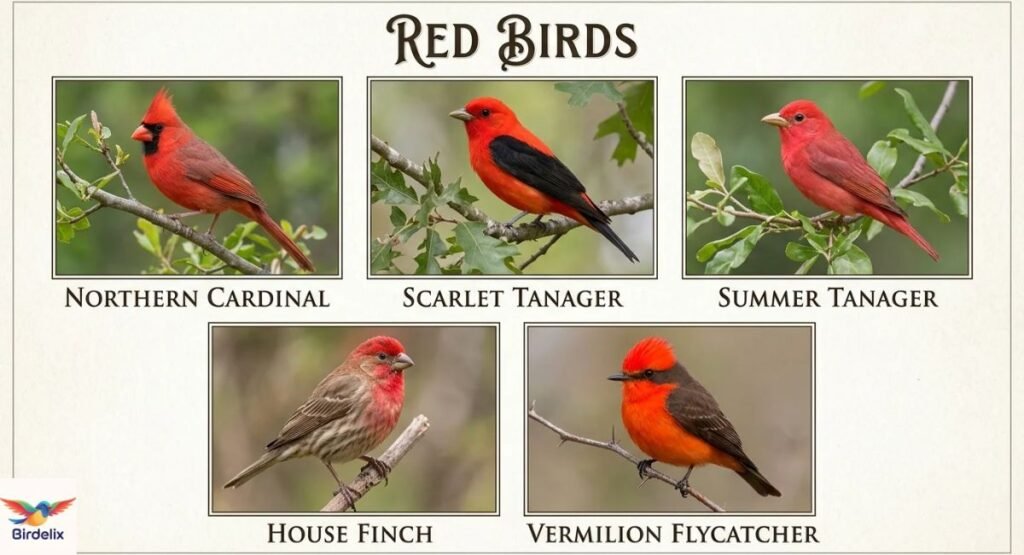
The Northern Cardinal is one of the most recognizable bright red birds in the United States. Males have vivid red feathers, a pointed crest, a thick orange-red bill, and a black face. Females are mostly brown with warm red accents. Adults measure about 8–9 inches long. They live in woodlands, gardens, and suburban yards, eating seeds, berries, and insects. Their crest and black facial mask help separate them from other red birds. Learn more from Cornell Lab of Ornithology.
2. Scarlet Tanager
The male Scarlet Tanager has a brilliant red body with black wings and a black tail during the breeding season. Females are usually olive-yellow, making them less obvious among green leaves. This bird measures about 6–7 inches long and breeds in mature forests across the eastern United States. It eats insects during summer and adds fruit to its diet during migration. Its red and black feathers are a key identification feature, although it often stays high in the forest canopy.
3. Summer Tanager
The Summer Tanager is known for the male’s nearly all-red plumage. Females are yellow-green, and young males may show a mixture of red and yellow feathers. Adults measure around 6–7 inches long. They favor open woodlands and tree-lined areas, especially in the southern and eastern United States. Their diet includes bees, wasps, other insects, and some fruit. Unlike the Northern Cardinal, this species has no prominent crest or black facial mask. Its plain red body and thick bill help identify it.
4. House Finch
The House Finch is a small, common bird that often visits backyard feeders. Males usually show red on the head, throat, and upper breast, while females have brown, streaked plumage. They measure about 5–6 inches long and live in cities, suburbs, parks, and open neighborhoods across much of the country. Their diet includes seeds, buds, fruits, and occasional insects. A streaked belly and short, cone-shaped bill help identify this small red bird. The amount of red varies among males, so color alone is not always enough.
5. Vermilion Flycatcher
The male Vermilion Flycatcher has striking red underparts and crown, with dark wings, a dark back, and a dark facial mask. Females are more muted, with gray-brown upperparts and pale underparts. This small bird measures around 5–6 inches long and occurs in open habitats, especially in the southwestern United States. It feeds mainly on flying insects, often catching them from an exposed perch. Its brilliant color and quick aerial movements make it one of the easiest red birds to recognize when visible.
6. Red-Headed Woodpecker
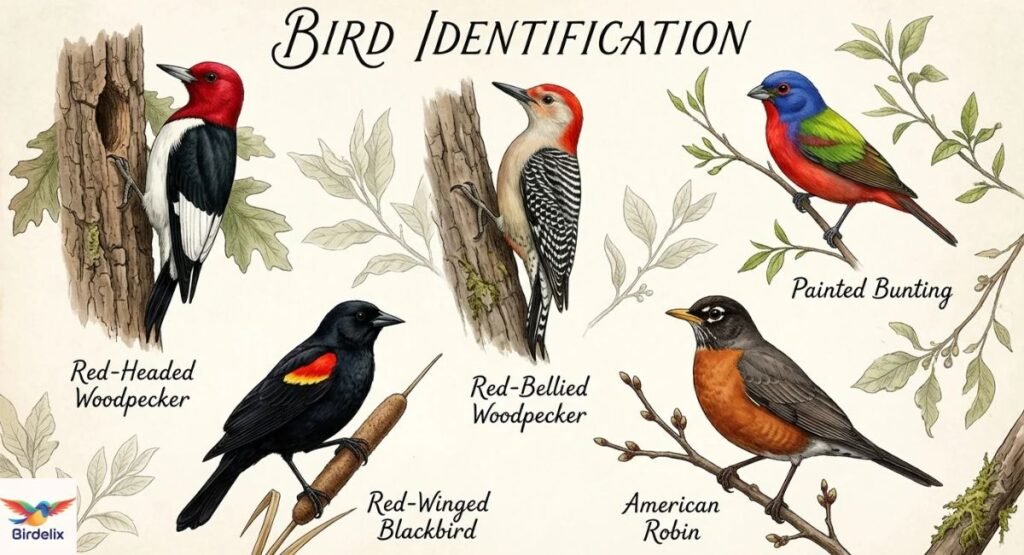
The Red-Headed Woodpecker has a fully red head, a white body, and bold black-and-white wings. Adults are approximately 7–9 inches long. They live in open woodlands, parks, and areas with mature trees, especially in parts of the eastern and central United States. Their diet includes insects, nuts, seeds, and fruit. The completely red head distinguishes this species from the Red-Bellied Woodpecker, whose red markings mainly cover its crown and nape. Watch for its striking wing pattern while it flies between trees.
7. Red-Bellied Woodpecker
Despite its name, the Red-Bellied Woodpecker is easier to identify by its red crown and nape than by its belly. Its back has black-and-white bars, and its underside is mostly pale with a faint reddish wash. It measures about 9–10 inches long and lives in forests, parks, and wooded neighborhoods across the eastern United States. It eats insects, nuts, seeds, and fruit, sometimes visiting feeders. Its barred back and rolling calls are useful clues.
8. Painted Bunting
The male Painted Bunting is one of North America’s most colorful songbirds. It combines a blue head, red underparts, and green back, while the female is mostly greenish-yellow. Adults measure around 4.5–5.5 inches long. They favor brushy areas, woodland edges, and suitable habitats in the southern United States. Seeds and insects make up much of their diet. Although this is not an entirely red bird, its vivid red underside makes it a standout among colorful red birds.
9. Red-Winged Blackbird
The male Red-Winged Blackbird has a glossy black body with red shoulder patches, often bordered by yellow. Females look quite different, with brown streaks that provide camouflage. Adults are about 7–9 inches long and commonly inhabit marshes, wetlands, ponds, and wet grasslands. They eat seeds, grains, and insects. The male’s bright shoulder patches are especially noticeable when he displays or defends his territory. If you see a black bird with red wings near a wetland, this species is worth checking first.
10. American Robin
The American Robin has a gray-brown back, a dark head, and an orange-red breast. It is larger than most finches, measuring around 9–11 inches long. Robins live in gardens, lawns, parks, forests, and neighborhoods throughout much of the United States. They feed on earthworms, insects, and fruit, often searching for food on the ground. Their upright stance, warm-colored breast, and familiar hopping movement make them easy to recognize. Although people sometimes call them red-breasted birds, their backs are not red.
11. Purple Finch
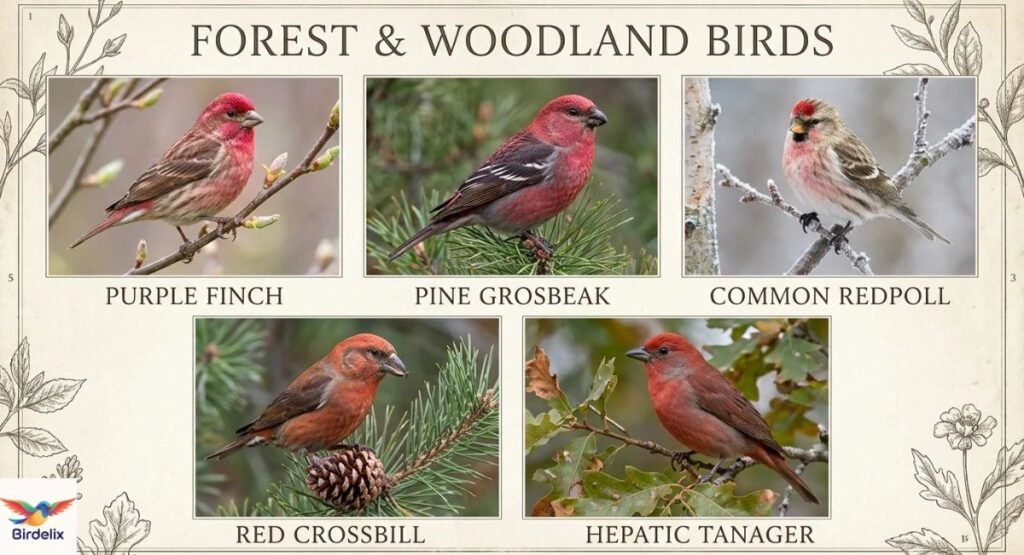
The male Purple Finch has raspberry-red coloring across its head, breast, and back. Females are brown and streaked, with no comparable red wash. This finch measures about 5–6 inches long and inhabits forests, wooded neighborhoods, and areas with feeders. Its diet includes seeds, buds, berries, and insects. The male’s color often looks blended into the brown plumage rather than sharply divided into separate patches. This helps distinguish it from some House Finches, which typically have stronger streaking below.
12. Pine Grosbeak
The Pine Grosbeak is a large, sturdy finch with a thick bill. Males often have rosy-red or pinkish-red plumage, while females tend to be yellowish or olive. Adults measure about 8–10 inches long. They live mainly in northern coniferous forests and mountain habitats, although some visit feeders farther south during winter. Seeds, buds, berries, and fruits make up their diet. Their large bodies and soft red coloring help distinguish them from smaller finches. They are especially interesting red birds in winter in the right regions.
13. Common Redpoll
The Common Redpoll is a small finch with a red forehead, brown streaking, and a short yellow bill. Some individuals also show a pinkish-red wash on the breast. It measures around 4.5–5.5 inches long and mainly inhabits northern regions, including boreal and Arctic areas. During some winters, flocks move farther south in search of food. They eat small seeds, particularly from birch and alder trees. Their red forehead and streaked body are the main identification clues, especially when they visit seed feeders.
14. Red Crossbill
The Red Crossbill has a distinctive bill with crossed tips that help it remove seeds from conifer cones. Males are often brick-red or orange-red, while females tend to be olive or yellowish. Adults measure roughly 5.5–7.5 inches long. They inhabit coniferous forests containing pine, spruce, fir, or similar trees. Their main food is the seeds inside cones. The crossed bill is the clearest identifying feature, making this bird easier to recognize than its changing plumage might suggest.
15. Hepatic Tanager
The male Hepatic Tanager has deep brick-red plumage, often with a grayish face and back. Females are more yellowish or olive. Adults measure about 7–8 inches long and favor pine-oak woodlands and mountain forests, especially in the southwestern United States. They feed on insects and fruit, often foraging among tree branches. Their darker red shade and gray facial coloring help separate them from the brighter Summer Tanager. If you spot a red bird in the Southwest, habitat and facial markings can be useful clues.
Red Bird Meaning: What Does a Red Bird Symbolize?
The red bird meaning depends on the person, culture, and situation. Many people connect red with love, courage, warmth, and energy. When they notice a red bird, they may associate the sighting with hope or a fresh start. These ideas are symbolic interpretations, not scientific evidence that a bird carries a specific message.
There is also a practical side to seeing one. A red bird may visit because your yard provides food, water, shelter, or nesting places. Learning about its species can make the encounter more rewarding. You can enjoy its possible personal meaning while also appreciating its natural behavior.
What Does It Mean When You See a Red Bird?
When people ask, “What does it mean when you see a red bird?” they often look for a symbolic explanation. Common interpretations include hope, courage, love, and renewed energy. However, there is no single meaning that applies to everyone. The species, setting, and your own beliefs may shape how you understand the sighting.
Meaning of the Red Bird in Everyday Life
In everyday life, a red bird may remind someone of a happy memory, a loved one, or a new beginning. Its bright color can make an ordinary moment feel special. Still, a red bird sighting does not prove that a particular event will happen. You can treat it as a personal reminder without assuming it predicts the future.
Red Birds Meaning: Love, Hope, and Renewal
Many people associate red birds meaning with love, passion, hope, and renewal because red is often linked with strong emotions. A cardinal appearing during a difficult period may feel encouraging or comforting. These associations come from personal and cultural symbolism, rather than an established rule about bird behavior. The meaning can be meaningful to you without being universal.
What Does It Mean When You See a Red Bird Near Your Home?
A red bird near your home may have found a dependable food source, dense shrubs, trees, or a safe place to rest. Cardinals and House Finches often visit residential areas, while other species may appear during migration. Some people interpret these visits as symbols of comfort or good fortune, but the bird’s presence usually has a natural explanation.
What Does It Mean When You Keep Seeing Red Birds?
Repeated sightings may feel important, especially when they happen during a personal change or emotional time. Some people interpret them as reminders to stay hopeful or remember someone they love. From a wildlife perspective, the same bird may simply return to a reliable feeder or suitable habitat. Keeping notes about the location, season, and appearance can help you identify it.
Red Bird Spiritual Meaning and Symbolism
The red bird spiritual meaning varies across personal beliefs and traditions. People may connect red birds with strength, passion, hope, remembrance, or spiritual awareness. These interpretations can offer comfort, but they should not be treated as proven facts about the bird or the future.
A balanced approach leaves room for both personal meaning and nature. You can value what a sighting represents to you while learning about the bird’s real habits. Its plumage, song, feeding behavior, and habitat are observable features. Spiritual interpretations are matters of belief and personal experience.
Red Bird Spiritual Meaning
Common interpretations of red bird spiritual meaning include vitality, courage, passion, and personal renewal. Some people see a red bird as a reminder to remain hopeful during change. Others simply enjoy its beauty without assigning it a spiritual role. There is no scientific test that can confirm a universal spiritual message from a bird sighting.
Red Birds as Symbols of Love and Relationships
Red is often associated with affection and strong emotions, so some people view red birds as symbols of love or connection. A cardinal may remind someone of a partner, family member, or treasured memory. These associations can be personal and comforting, but they do not establish what will happen in a relationship.
Red Birds and Messages From Loved Ones
Some people believe that seeing a red bird after a loss offers a sense of connection with someone who has died. A familiar bird may bring back memories or provide comfort during grief. That experience can be meaningful without proving that the bird is delivering a message. Everyone processes loss differently, and personal interpretations deserve respect.
Red Bird Symbolism in Different Cultures
The meaning of red birds is not the same in every culture. Interpretations depend on local stories, religious traditions, literature, and personal beliefs. Before attributing a specific meaning to a culture, look for reliable sources that explain that tradition directly. Avoid assuming that every community views red birds as signs of luck, love, or spiritual contact.
Is Seeing a Red Bird Considered Good Luck?
Some people consider a red bird a symbol of good luck, hope, or positive change. Others see it simply as a beautiful part of the natural world. Neither view is required. A sighting cannot reliably predict good or bad fortune, but it can still offer a pleasant moment and encourage you to notice wildlife around you.
Cardinal Red Bird Symbol: What Does a Cardinal Mean?
The Northern Cardinal is one of the most familiar red birds in American neighborhoods. Its bright male plumage, pointed crest, and orange-red bill make it easy to recognize. Cardinals also remain in much of their range throughout the year, so people may see them in gardens during both summer and winter. Cornell Lab’s species guide provides more identification details.
The cardinal red bird symbol has become popular in stories, artwork, and personal beliefs. Many people connect cardinals with love, remembrance, hope, or loyalty. These meanings can be emotionally important, particularly after a loss. However, they reflect cultural and personal interpretations, not a proven explanation for why a cardinal appears.
What Does a Red Cardinal Represent?
A red cardinal commonly represents hope, love, strength, loyalty, or remembrance in popular symbolism. Its vivid color makes it easy to notice, while its year-round presence in many areas gives people repeated opportunities to see it. The meaning depends on personal beliefs rather than a universal rule about the species.
Cardinal Red Bird Symbol in Spiritual Beliefs
In some spiritual beliefs, the cardinal represents encouragement, renewal, or a connection to something larger than everyday life. Other people associate it with a loved one or a meaningful memory. These interpretations differ from person to person. The bird’s actual behavior, however, can be understood through its habitat, food sources, breeding patterns, and seasonal activity.
Seeing a Cardinal After Losing a Loved One
Seeing a cardinal after losing someone can bring comfort because the bird becomes linked with memory and love. Its sudden appearance may feel especially meaningful during grief. You do not need to prove a supernatural explanation for the moment to matter. It is also fine to remember the person while appreciating the cardinal as a living wild bird.
What Does It Mean When You See a Red Cardinal Repeatedly?
Repeated cardinal sightings may symbolize persistence, hope, or remembrance to someone who values those meanings. There is also a straightforward reason they happen: cardinals often stay in the same general area when food and shelter are available. If one regularly visits your yard, look for seed sources, shrubs, and nearby trees that support it.
Red-Headed Birds: How to Identify Them
| Bird Species | Appearance | Key Identification Features | Common Habitat |
| Red-Headed Woodpecker | Fully red head, white body, black-and-white wings | Entire red head and bold wing pattern | Open woodlands, parks, and mature trees |
| Red-Bellied Woodpecker | Red crown and nape, barred black-and-white back | Zebra-like back; pale belly with a faint reddish wash | Forests, wooded neighborhoods, and parks |
| House Finch | Male has red forehead, face, and breast; females are brown and streaked | Small body, cone-shaped bill, streaked underside | Backyards, gardens, cities, and feeders |
| Vermilion Flycatcher | Male has a bright red crown and underside with dark upperparts | Vivid red plumage and habit of catching insects in flight | Open areas, scrublands, and riparian habitats |
Black and Red Birds: Species and Identification
| Bird Species | Appearance | Key Identification Features | Common Habitat |
| Red-Winged Blackbird | Black body with red shoulder patches, often edged in yellow | Bright red-and-yellow wing patches | Marshes, wetlands, and wet grasslands |
| Scarlet Tanager | Breeding male has a scarlet body with black wings and tail | Strong contrast between red body and black wings | Mature forests, especially in the eastern USA |
| Painted Bunting | Male has red underparts, a blue head, and a green back | Three vivid colors; females are mostly greenish-yellow | Brushy areas and woodland edges in the southern USA |
Why Are Some Birds Bright Red?
The brilliant colors of many birds come from pigments and the way feathers develop. Red may appear across a bird’s entire body or only in a few patches. Food, genetics, age, and the breeding season can all influence what you see. The same species may look different depending on its sex or stage of life.
Red plumage can also play a role in communication and courtship. In some species, males display bright feathers that help attract mates or signal their presence to rivals. Still, not every red marking serves the same purpose. Researchers study each species to understand how color, behavior, and survival connect.
What Makes a Bird’s Feathers Red?
Many birds get red, orange, and yellow feather colors from carotenoid pigments obtained through their diet. Some species can transform yellow carotenoids into red pigments before depositing them in growing feathers. Genes also influence this process. As explained by Audubon, red plumage involves more than simply eating red-colored food.
Why Are Male Birds Often Brighter Than Females?
In many bird species, males have brighter plumage than females. These differences, known as sexual dimorphism, can help males attract mates or signal their presence. Females may have more muted colors that provide camouflage while nesting. However, this pattern is not universal, and some species have similar-looking males and females.
How Red Feathers Help Birds Attract Mates
Bright red feathers can play a role in courtship and mate choice. In some species, a male’s color may provide information about his condition, although color alone does not tell the whole story. Songs, displays, behavior, and territory also matter. Red plumage can serve different functions depending on the bird species.
Can a Bird’s Red Color Change With Age or Diet?
Yes, a bird’s appearance can change as it grows, molts, or develops adult plumage. Young birds may have duller colors, and some males become brighter as they mature. Diet can influence carotenoid-based colors in certain species, but genetics and feather development matter too. Seasonal molts may also change how red a bird looks.
Red Birds in Popular Culture
The phrase big red bird can refer to a real bird or a fictional character, depending on what someone is searching for. In bird identification, it may describe a cardinal or another large red species. In gaming and entertainment, it often refers to Red from the Angry Birds franchise.
Because these searches have different goals, the fictional character should not be confused with a real bird species. The following section briefly covers the popular character while keeping the main focus on wild birds and their identification.
Who Is the Big Red Angry Bird?
Red is the central red-colored character in the Angry Birds franchise. He is a fictional bird created for games and related entertainment. Unlike a Northern Cardinal or Summer Tanager, Red does not represent a scientifically recognized bird species.
Big Red Bird in Angry Birds
In Angry Birds, Red is known for his round shape, red body, thick eyebrows, and expressive face. His role in the game is part of a fictional story. Searches for the big red bird in Angry Birds usually concern the character rather than real birds found in the United States.
Why Is the Red Angry Bird So Popular?
Red is easy to recognize because of his simple shape, bright color, and strong facial expression. His central role in the franchise also makes him familiar to many players. This popularity explains why searches for a red Angry Bird may appear alongside searches about real red birds, even though the two topics serve different purposes.
Conclusion
Learning about red birds helps you recognize more than just their bright colors. From the Northern Cardinal and House Finch to the Scarlet Tanager and Vermilion Flycatcher, each species has unique markings, feeding habits, and preferred habitats. Pay attention to the bird’s size, bill, wing patterns, and location to make a more accurate identification.
Red birds can also carry personal meaning. Some people connect cardinals with hope, love, or memories of loved ones, while others simply enjoy seeing wildlife. Both experiences can be valuable. Observe the bird carefully, use a reliable field guide, and enjoy discovering the different types of red birds around you.
FAQs
What Does It Mean When You See a Red Bird?
A red bird may symbolize hope, love, courage, or renewal in personal beliefs. Its appearance does not have one proven universal meaning.
What Does a Red Bird Mean Spiritually?
Some people connect red birds with vitality, remembrance, and positive change. These interpretations vary by culture and personal belief.
What Does It Mean When You See a Red Bird Repeatedly?
Repeated sightings may feel personally meaningful, but the bird may also return because your yard provides food, water, or shelter.
What Does a Cardinal Red Bird Symbolize?
The cardinal red bird symbol is often associated with love, hope, loyalty, and remembrance. These meanings are popular interpretations, not scientific facts.
What Is the Most Common Red Bird in the United States?
The House Finch is a widespread red-plumaged bird across much of the continental United States. The Northern Cardinal is another familiar species, especially in eastern neighborhoods.

Welcome to Birdelix! I’m Anam Sattar, an AI-powered SEO Specialist and Content Writer with over 5 years of experience in creating high-quality, search-optimized content. I help businesses improve their search engine rankings, increase organic traffic, and build beautiful, user-friendly websites. My mission is to make SEO, content creation, and web design simple, effective, and accessible for everyone. Let’s grow your online presence and achieve success together!