


Gray birds appear in many shapes and sizes across the United States. Some have soft gray feathers, while others show striking black, white, yellow, or blue markings. However, identifying them can sometimes be confusing because several species share similar colors. Their plumage patterns, body shape, and head markings offer helpful clues.
You may spot a familiar bird in your backyard or discover an unusual visitor near a forest or pond. This guide explores 20 common species and their unique features. You’ll learn how to recognize each bird by its wing patterns, tail, bill, habitat, and behavior.
How to Identify Gray Birds
A bird’s overall color gives you a useful starting point. However, gray can range from pale silver to dark slate. Some species also have brown or blue tones that change under different lighting. Check the bird’s size and body shape before comparing smaller details. A compact songbird looks very different from a dove, shrike, or heron.
Next, study its head, belly, wings, tail, and bill. A black head, white belly, or yellow breast may narrow your choices. Wing bars and tail patterns offer more clues. Also consider the bird’s habitat, feeding habits, calls, and flight style. These features help distinguish similar species more reliably than color alone.
Overall Body Color and Size
Start by estimating the bird’s size. A small songbird may measure only a few inches, while a heron can stand several feet tall. Notice whether its body looks slim, round, stocky, or elongated. Then examine its main color. Some birds have uniform gray backs, while others show gray-brown feathers or pale blue-gray upperparts.
Head and Face Markings
Head markings often provide the clearest identification clues. Look for a black cap, dark forehead, white cheeks, or a black eye mask. Some birds have a pale eyebrow or a contrasting throat patch. These details help separate a small gray bird with black head markings from other similar species.
Belly and Breast Color
The underside can reveal details that aren’t visible from above. Some birds have clean white bellies, while others show cream, yellow, or pinkish tones. Look closely at the breast and flanks. A gray bird with yellow belly markings may belong to a different group than one with plain white underparts.
Wing and Tail Patterns
Wings and tails can reveal a bird’s identity during flight. Look for white wing patches, black bars, pale edges, and unusual tail shapes. Some species flash white outer tail feathers when they fly. Others have long tails that help them balance while moving through branches.
Beak Shape and Color
A bird’s bill often reflects how it finds food. Short, pointed bills suit many seed-eating birds. Thin bills help flycatchers catch insects. Shrikes have strong, hooked bills for handling prey. Also check the bill’s color. A black, orange, yellow, or red bill can provide another useful clue.
Habitat and Behavior
Location can make identification much easier. A gray bird near a marsh may be a wading species. One climbing down a tree trunk could be a nuthatch. Shrubland, woodland, open fields, coastal areas, and city neighborhoods each support different bird communities. Notice where the bird feeds and rests.
Song and Flight Pattern
Listen as well as look. Some birds produce clear whistles, while others make short calls or musical phrases. Mourning Doves have a familiar, soft coo. Mockingbirds can repeat many different sounds. Flight behavior also matters. Watch for hovering, tail-wagging, gliding, or quick aerial insect chases.
Gray Birds at a Glance
The table below compares 20 species by size, color, habitat, and their most useful identification feature. Sizes are approximate adult lengths. A bird’s appearance can vary with age, sex, and regional population.
| Bird | Size | Main Gray Color | Key Markings | Habitat | Best Identification Feature |
| Canada Jay | Medium | Gray | White face and dark head | Northern forests | Rounded head and curious behavior |
| Northern Mockingbird | Medium | Gray | White wing patches | Suburbs and open areas | Long tail and wing flashes |
| Tufted Titmouse | Small | Blue-gray | White face and dark forehead | Woodlands | Pointed crest |
| Blue-Gray Gnatcatcher | Small | Blue-gray | White underside and dark tail | Woodlands | Tiny body and long tail |
| Gray Catbird | Medium | Slate gray | Black cap and rusty undertail | Shrubs and thickets | Black cap |
| Mourning Dove | Medium | Gray-brown | Black wing spots | Yards and fields | Pointed tail and soft coo |
| Rock Pigeon | Medium | Gray | Dark wing bars | Cities and towns | Iridescent neck |
| House Sparrow | Small | Gray and brown | Black bib and chestnut areas | Urban areas | Male’s patterned head |
| White-Breasted Nuthatch | Small | Blue-gray | White face and dark cap | Woodlands | Head-first climbing |
| Dark-Eyed Junco | Small | Gray | White outer tail feathers | Forests and yards | White tail flashes |
| Eastern Phoebe | Small | Gray-brown | Pale underside | Open woodland | Repeated tail movement |
| Gray Flycatcher | Small | Gray | Pale underside | Western shrublands | Distinctive tail-lowering behavior |
| Loggerhead Shrike | Medium | Gray | Black mask and hooked bill | Open country | Predatory bill and mask |
| Northern Shrike | Medium | Gray | Black mask and white wings | Northern open country | Heavy hooked bill |
| Gray Kingbird | Medium | Gray | White underside and dark mask | Southern Florida | Large bill |
| Cedar Waxwing | Medium | Soft gray | Black mask and yellow tail tip | Woodlands and orchards | Red wax-like wing tips |
| Black-Capped Chickadee | Small | Gray | Black cap and bib | Backyards and forests | White cheeks |
| Gray-Cheeked Thrush | Medium | Gray-brown | Spotted breast | Northern forests | Plain gray face |
| Great Blue Heron | Large | Blue-gray | Dark head markings | Wetlands | Long neck and legs |
| Northern Harrier | Large | Gray in adult males | White rump and dark wing tips | Grasslands and marshes | Low, gliding flight |
20 Common Gray Birds
1. Canada Jay (Gray Jay)
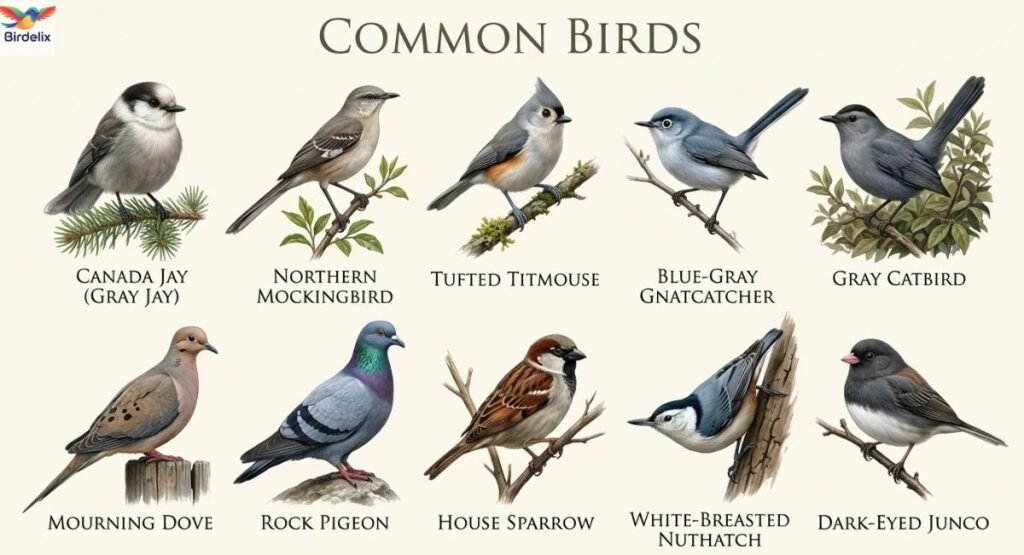
The Canada Jay, formerly widely called the Gray Jay, has a soft gray body and pale underside. Its face, throat, and forehead look whitish. Dark markings form a partial cap across the back of its head. This medium-sized bird lives in northern forests and western mountain areas. It eats insects, berries, small animals, and leftover food. Its curious nature makes it a memorable forest visitor. Look for its rounded head, short bill, and long tail.
2. Northern Mockingbird
The Northern Mockingbird has a gray back, pale underside, and long tail. Its most noticeable feature is the pair of white wing patches. These patches flash when the bird flies or spreads its wings. It commonly lives in gardens, parks, suburbs, and open areas. Its varied song is another helpful clue. A mockingbird may imitate other birds and repeat different sounds. Look for its slim body, long tail, and white wing flashes.
3. Tufted Titmouse
The Tufted Titmouse is a small bird with blue-gray upperparts and pale underparts. Its pointed crest gives its head a distinctive shape. It also has a dark forehead and large, dark eyes. You’ll often find it in deciduous woodlands and backyard feeders across the eastern United States. It eats insects, seeds, and nuts. Its compact body and raised crest help separate it from other small gray birds.
4. Blue-Gray Gnatcatcher
The Blue-Gray Gnatcatcher is a tiny bird with blue-gray upperparts and a white underside. Its long tail has black-and-white markings that stand out during movement. It often flicks its tail while searching for small insects among leaves. This active bird lives in woodlands and wooded neighborhoods across much of the United States. Its delicate body, narrow bill, and restless movements make it easier to recognize. It is a strong match for searches about a blue gray gnatcatcher bird.
5. Gray Catbird
The Gray Catbird has a smooth slate-gray body and a noticeable black cap. Its undertail feathers show a rusty color, especially when the bird raises its tail. It usually stays close to dense shrubs and tangled vegetation. Its call can sound like a cat’s meow, which explains its name. Look for its rounded body, long tail, and dark cap. The rusty undertail is an especially useful clue.
6. Mourning Dove
The Mourning Dove has soft gray-brown plumage with warm pinkish tones on its breast. Small black spots appear on its wings. Its long, pointed tail has pale edges that become noticeable during flight. This species often visits lawns, gardens, fields, and backyard feeders. It mainly eats seeds from the ground. Its gentle coo and quick takeoff sound can help you recognize it even before you see its markings.
7. Rock Pigeon
The Rock Pigeon is one of the most familiar gray birds in American cities. Many have gray bodies, darker wing bars, and two dark bands across their wings. Their neck feathers can shine green and purple in sunlight. However, domestic and urban pigeons come in many colors. You may see white, brown, black, or mixed patterns. Their sturdy bodies, small heads, and familiar city behavior make them easy to recognize.
8. House Sparrow
The male House Sparrow has a gray crown and cheeks with a black bib and chestnut-brown areas. Females look duller, with more brown and buff coloring. This small bird often gathers around buildings, gardens, shops, and outdoor dining areas. It eats seeds, grains, and insects. Although it isn’t fully gray, its head and breast markings can match searches for a small gray bird with darker features.
9. White-Breasted Nuthatch
The White-Breasted Nuthatch has a blue-gray back and bright white face and belly. A dark cap covers the top of its head. Its short tail and strong feet support an unusual climbing style. Unlike most birds, it often moves headfirst down tree trunks. It searches bark crevices for insects and seeds. Look for its compact body, pointed bill, and distinctive upside-down movements.
10. Dark-Eyed Junco
The Dark-Eyed Junco is a familiar winter visitor across much of the United States. Many forms have a dark gray head and back with a pale belly. White outer tail feathers flash when the bird flies away. Its appearance varies by region, with some populations showing more brown. Juncos often feed on the ground beneath trees and feeders. Watch for their rounded bodies, short bills, and quick hopping movements.
11. Eastern Phoebe
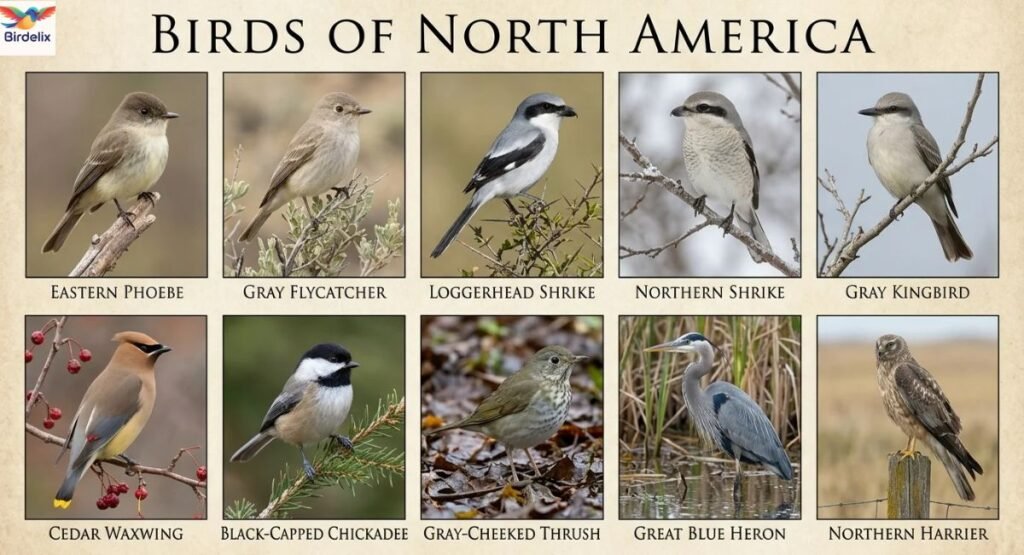
The Eastern Phoebe has gray-brown upperparts, a darker head, and a pale underside. It often perches on branches, fences, and buildings while watching for flying insects. One useful clue is its repeated tail-wagging movement. It catches insects in short flights and returns to its perch. Eastern Phoebes commonly use bridges, sheds, and other structures for nesting. Their simple colors make behavior especially important during identification.
12. Gray Flycatcher
The Gray Flycatcher is a subtle western species with gray upperparts and pale underparts. Its appearance can resemble other flycatchers, so color alone may not settle the identification. Watch its behavior instead. It often lowers its tail in a distinctive motion after landing. It lives in dry, open habitats with shrubs and scattered trees. Its small bill, upright posture, and repeated tail movements provide useful clues.
13. Loggerhead Shrike
The Loggerhead Shrike has a gray back, pale underside, black facial mask, and strong hooked bill. Its wings show black and white markings. Although it looks like a songbird, it hunts insects and small animals. It often watches from exposed branches, wires, and fence posts. The hooked bill and dark mask make it stand out among gray and black birds. Its hunting behavior is another important identification feature.
14. Northern Shrike
The Northern Shrike has gray upperparts, pale underparts, a dark facial mask, and white wing markings. Its hooked bill gives it a fierce appearance. It resembles the Loggerhead Shrike, but the two species differ in range and some identification details. Northern Shrikes occur farther north and may visit parts of the northern United States during winter. Check the bill, mask, wing pattern, and location before deciding which shrike you’ve spotted.
15. Gray Kingbird
The Gray Kingbird is a large flycatcher with gray upperparts, white underparts, and a dark mask. Its heavy bill and broad head give it a strong appearance. It often sits in exposed places while watching for insects. In the United States, it is most associated with southern Florida and the Keys. It catches flying insects with quick aerial movements. Its large bill and clean gray-and-white pattern are useful clues.
16. Cedar Waxwing
The Cedar Waxwing has smooth gray-brown plumage, a black facial mask, and a yellow belly. Its tail ends with a bright yellow band. Some adults also have small red, wax-like tips on their wing feathers. These colorful details make it one of the easiest species to recognize. Cedar Waxwings eat berries and insects. They often travel in flocks and visit fruiting trees, orchards, and gardens. Look for their sleek bodies and neat crest.
17. Black-Capped Chickadee
The Black-Capped Chickadee has a gray back, black cap, black bib, and bright white cheeks. Its small, rounded body makes it easy to recognize at feeders. It lives in forests, parks, and residential areas across much of the northern United States. Chickadees eat insects, seeds, and berries. They also store food in hidden places. Their familiar chick-a-dee-dee-dee call offers another helpful identification clue.
18. Gray-Cheeked Thrush
The Gray-Cheeked Thrush has a grayish face, muted upperparts, and a pale underside with dark breast spots. Its appearance is subtle, especially when compared with other spotted thrushes. It breeds in northern forests and migrates long distances to South America. During migration, it may appear in wooded areas and leafy thickets. Look for its plain gray face, spotted breast, and quiet behavior. Its call can help separate it from similar thrushes.
19. Great Blue Heron
The Great Blue Heron is a large North American wading bird with blue-gray plumage, a long neck, and long legs. Its head has dark markings, while its long, pointed bill helps catch fish. It often stands still near ponds, rivers, marshes, and coastal wetlands. When it flies, it pulls its neck back into an S-shape. This feature helps distinguish it from cranes and other large birds. It is a more suitable USA example than the Old World Gray Heron.
20. Northern Harrier
The adult male Northern Harrier has pale gray upperparts and darker wing tips. Females and young birds usually show more brown coloring. A white patch on the rump is a useful clue in flight. This bird hunts over grasslands, marshes, and open fields. It flies low while searching for small mammals and birds. Its long wings, owl-like facial disk, and gliding flight help distinguish it from other gray birds of prey.
Small Gray Birds
| Bird Name | Approximate Length | Key Identification Features |
| Blue-Gray Gnatcatcher | 4–5 inches | Blue-gray back, white belly, long tail |
| Black-Capped Chickadee | 4.5–5.5 inches | Black cap, white cheeks, gray back |
| Tufted Titmouse | 5.5–6.5 inches | Gray body, pointed crest, white underside |
| White-Breasted Nuthatch | 5–6 inches | Blue-gray back, white face, black cap |
| Dark-Eyed Junco | 5–6.5 inches | Gray body, white outer tail feathers |
| Gray Flycatcher | 5.5–6 inches | Gray upperparts, pale underside |
Medium-Sized Gray Birds
| Bird Name | Approximate Length | Key Identification Features |
| Canada Jay | 9–13 inches | Gray body, pale face, dark head markings |
| Northern Mockingbird | 8–11 inches | Gray back, white wing patches, long tail |
| Gray Catbird | 8–9 inches | Slate-gray body, black cap, rusty undertail |
| Mourning Dove | 9–13 inches | Gray-brown body, black wing spots, pointed tail |
| Rock Pigeon | 11–14 inches | Gray body, dark wing bars, iridescent neck |
| House Sparrow | 5–7 inches | Gray and brown plumage, black bib in males |
| Eastern Phoebe | 5.5–7 inches | Gray-brown back, pale belly, wagging tail |
| Loggerhead Shrike | 8–10 inches | Gray back, black mask, hooked bill |
| Northern Shrike | 9–10 inches | Gray body, black mask, hooked bill |
| Gray Kingbird | 8–10 inches | Gray upperparts, white underside, large bill |
| Cedar Waxwing | 6–7 inches | Soft gray body, black mask, yellow tail tip |
| Gray-Cheeked Thrush | 6–7 inches | Grayish face, spotted breast, pale underside |
Large Gray Birds
| Bird Name | Approximate Length | Key Identification Features |
| Great Blue Heron | 38–54 inches | Blue-gray body, long neck, long legs |
| Northern Harrier | 18–20 inches | Long wings, white rump, low hunting flight |
Gray Birds With White Bellies and White Markings
Many gray and white birds have pale underparts that contrast with darker backs. The White-Breasted Nuthatch has a white face and belly with a blue-gray back. The Northern Mockingbird shows bright white wing patches. The Blue-Gray Gnatcatcher has a white underside and dark tail markings. These patterns help you recognize a small gray and white bird even when its back looks plain.
White markings can appear on the cheeks, throat, wings, belly, or tail. A gray bird with white stripes on wings and tail may show those details most clearly during flight. A gray bird with white belly and long tail needs closer attention to its body shape and tail length. Compare several features rather than relying on white coloring alone.
Gray Birds With Yellow Breasts or Bellies
A gray bird with yellow belly markings may be easier to recognize than a bird with plain gray feathers. Cedar Waxwings are a good example. They have soft gray-brown bodies, yellow underparts, and yellow tail tips. Their black masks and red wing tips provide additional clues. Their appearance makes them a useful example of a yellow and gray bird.
Yellow can appear in different places across bird species. It may cover the breast, belly, undertail, or tail tip. The phrase yellow breasted gray bird doesn’t point to just one species. Check the bird’s size, bill, head pattern, and location. Searches such as gray bird with yellow breast, gray bird yellow breast, and gray bird yellow belly need those extra details for accurate identification.
Gray Birds With Red Heads or Red Markings
A bird with red head and gray body may be difficult to identify without more information. Red markings can appear on the head, face, breast, wings, or bill. Some birds also show rusty or reddish-brown areas that look brighter in direct sunlight. A bird with a red bill may belong to a different group than one with a red crown or face.
Look at the exact location and shade of the red coloring. Is it bright red, orange-red, or rusty brown? Does the bird have a gray back and white belly? These clues help narrow searches such as gray bird with red head, red and gray bird, and red headed bird with gray body. A gray bird with red beak also needs bill shape and size checked carefully.
Blue-Gray Birds and Gray Birds With Blue Markings
Some birds have naturally blue-gray feathers. Others look blue because of the way light reflects from their feather structure. The Blue-Gray Gnatcatcher is a clear example of a small bird with blue-gray upperparts. The Tufted Titmouse and White-Breasted Nuthatch also show blue-gray tones. These species can match searches for a blue gray bird or blue and gray bird.
A bird that looks like a Blue Jay may actually be a different species. Check its size, crest, tail, and facial markings. A Blue-Gray Gnatcatcher is tiny and has a long tail. A jay is much larger and has a stronger bill. This comparison helps with searches such as gray birds that look like blue jays, gray bird with blue tail, and gray bird with blue wings.
Gray Birds With Long Tails
A long tail can make a bird look different from other species with similar plumage. Northern Mockingbirds have long tails and white wing patches. Gray Catbirds have long tails with rusty undertail feathers. Blue-Gray Gnatcatchers have slim bodies and narrow tails. Mourning Doves also have long, pointed tails, but their bodies are much fuller.
Look at the tail’s shape and color. Is it pointed, rounded, forked, or narrow? Does it have white edges or dark bands? These details help with searches such as gray bird with long tail, gray and white bird long tail, and gray bird long tail. A gray bird with red tail or blue tail needs additional clues because tail color alone may not identify the species.
Gray Birds With Long or Colorful Beaks
A bird’s bill can tell you a great deal about its feeding habits. Shrikes have hooked bills for handling prey. Flycatchers use pointed bills to catch insects. Herons have long, sharp bills for catching fish and other aquatic animals. These shapes can help identify a bird even when its feathers are difficult to see.
Color adds another useful detail. Some birds have dark bills, while others show orange or yellow tones. To identify a gray bird with orange beak, check its size and habitat first. Also compare searches such as bird with orange beak gray body, gray bird with yellow beak, and gray bird black beak. A bill’s length, shape, and color work best as a group of clues.
Gray and Black Birds vs. Gray and White Birds
Gray and black birds often have dark caps, masks, bibs, or wing patches. Chickadees and shrikes are useful examples. Gray and white birds often show pale cheeks, bellies, or wing edges. Nuthatches and mockingbirds fit this pattern. However, these groups overlap. A single bird may have gray, black, and white markings together.
| Feature | Gray and Black Birds | Gray and White Birds |
| Head markings | Often dark caps or masks | Often pale cheeks or faces |
| Belly | May be gray or dark | Often white or pale |
| Wings | Black bars or patches | White bars or edges |
| Tail | Often dark | May have white edges or tips |
| Examples | Chickadees and shrikes | Nuthatches and mockingbirds |
Where Do Gray Birds Live?
Gray-plumaged birds live in many American habitats. You may see them in backyards, parks, gardens, forests, grasslands, wetlands, and coastal neighborhoods. Rock Pigeons are common in cities, while chickadees and titmice visit wooded yards. Shrikes prefer open country. Herons search for food around water.
Habitat can narrow down your choices before you study smaller details. A bird climbing down a tree may be a nuthatch. A large bird standing in shallow water may be a heron. A low-flying hunter over a field could be a Northern Harrier. Always consider the location alongside the bird’s appearance.
What Do Gray Birds Eat?
A bird’s diet depends on its species and habitat. Many small songbirds eat insects, spiders, seeds, and berries. Cedar Waxwings rely heavily on fruit during parts of the year. Doves and juncos often collect seeds from the ground. Flycatchers catch insects in the air, while shrikes hunt insects and small animals.
Larger birds have different feeding methods. Herons catch fish and other aquatic prey. Northern Harriers search for small mammals and birds across open ground. Some species change their diets with the seasons. Food availability also affects where birds gather. Watching a bird feed can therefore provide useful identification clues.
Gray Birds in the USA: When and Where to Spot Them
The best time to see a particular bird depends on its range and migration. Some species, such as Rock Pigeons and Northern Mockingbirds, occur in many populated areas throughout the year. Dark-Eyed Juncos become familiar winter visitors in many regions. Gray-Cheeked Thrushes are more likely to be noticed during migration or in their northern breeding range.
You can watch birds in neighborhood parks, woodland trails, wetlands, and open fields. Early morning often offers good opportunities because many birds are active and vocal. A quiet approach helps you notice small movements. Keep a field guide or bird identification app nearby. Record the date, location, size, and visible markings when you see an unfamiliar bird.
Gray Bird Identification Tips for Beginners
You don’t need to recognize every species immediately. Start with the bird’s size and shape. Then examine its head, belly, wings, tail, and bill. Notice whether it has a crest, mask, wing bars, or a long tail. These basic observations can reduce the number of possible matches.
Next, consider the habitat and behavior. A small bird near a feeder may be a chickadee or titmouse. A gray bird hunting from a fence could be a shrike. A bird near a pond may be a heron. Take a photograph when possible. Compare several clear features instead of relying on one color or marking.
Conclusion
Gray feathers appear across many North American bird species. Their markings can include black caps, white bellies, yellow underparts, and blue-gray wings. These details make each species different. Body shape, bill design, tail patterns, habitat, and behavior also help you identify an unfamiliar bird.
When you spot one, take a moment to observe it carefully. Start with its size and shape, then check its head, belly, wings, and tail. Listen to its call and notice where it feeds. With practice, you’ll become more confident at recognizing the many gray-plumaged birds around you.
FAQs
What is the most common gray bird?
Rock Pigeons are among the most familiar gray birds in American cities. Mourning Doves and Northern Mockingbirds are also common in many areas.
What small bird is gray with a black head?
The Black-Capped Chickadee is a good example. It has a black cap and bib, white cheeks, and a gray back.
What gray bird has a yellow belly?
The Cedar Waxwing has a soft gray-brown body and yellow belly. Its black mask and yellow tail tip provide extra clues.
What is a blue-gray bird called?
The Blue-Gray Gnatcatcher is a well-known example. It has blue-gray upperparts, a white underside, and a long tail.
How can I identify a gray bird in my backyard?
Check its size, head markings, belly, wings, tail, and bill. Then consider its behavior and habitat to narrow down the species.

Welcome to Birdelix! I’m Anam Sattar, an AI-powered SEO Specialist and Content Writer with over 5 years of experience in creating high-quality, search-optimized content. I help businesses improve their search engine rankings, increase organic traffic, and build beautiful, user-friendly websites. My mission is to make SEO, content creation, and web design simple, effective, and accessible for everyone. Let’s grow your online presence and achieve success together!