

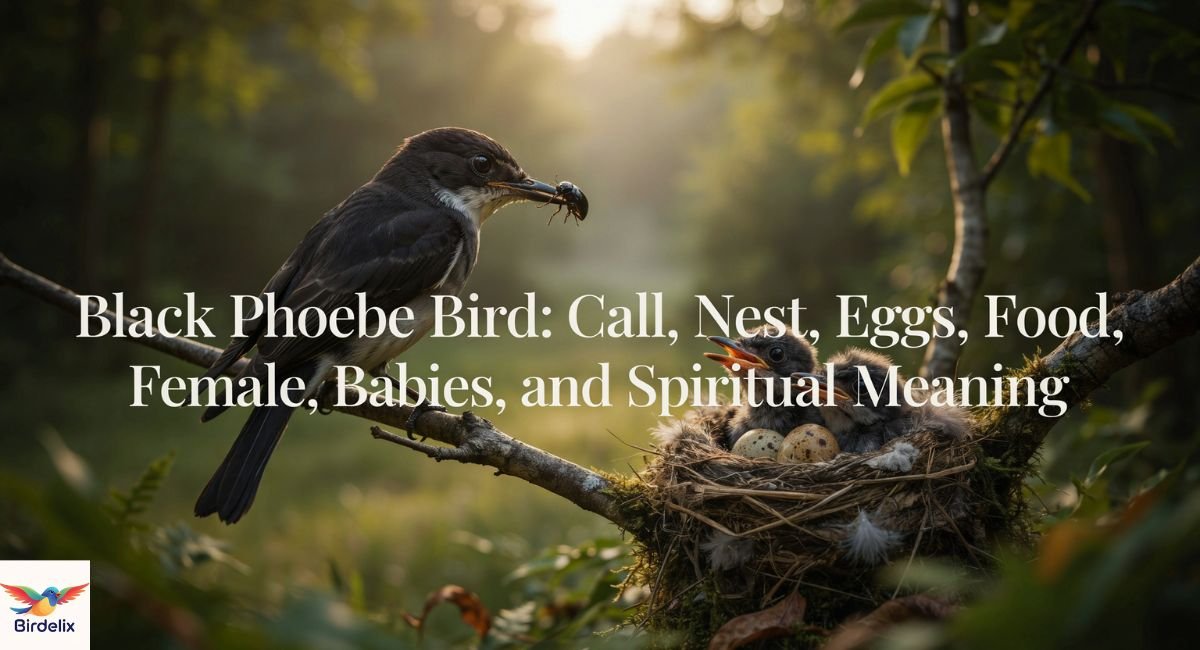
The Black Phoebe bird is a small, active songbird known for its dark body, white belly, and quick hunting movements. Found mainly in the western United States, especially California, this fascinating bird often lives near streams, ponds, gardens, and residential areas. Its habit of catching insects from a favorite perch makes it easy to recognize.
Learning about the Black Phoebe bird call, nesting habits, and feeding behavior can help you understand this species better. You’ll also discover what its eggs and babies look like, how to identify a female, and what people believe about its spiritual meaning and symbolism.
What Is a Black Phoebe Bird?
The Black Phoebe (Sayornis nigricans) is a small member of the tyrant flycatcher family. It belongs to a group of birds known for catching insects in flight. Its most noticeable features are its sooty-black head and upper body, clean white belly, and habit of repeatedly returning to a favorite perch. Unlike many birds that search through leaves, it often waits quietly before making a quick move to catch an insect.
Black Phoebes are usually easy to recognize once you learn their shape and behavior. They often sit upright with their tails moving up and down. They also prefer places where insects are easy to catch, such as areas near water, open yards, and sunny clearings. Although they may look plain compared with brightly colored birds, their sharp movements and familiar calls make them easy to notice.
The scientific name Sayornis nigricans refers to a species found mainly in the western and southwestern United States, with a range that extends into Mexico and parts of Central America and South America. In the United States, California is one of the best-known places to see this bird. It is generally a year-round resident in much of its range rather than a bird that travels long distances every winter.
Where Do Black Phoebe Birds Live?
Black Phoebes prefer habitats that offer both insects and suitable places to perch. You may see them near rivers, streams, ponds, lakes, wetlands, and irrigation channels. They also use parks, gardens, farms, and residential neighborhoods when these places provide open space and enough food. Water is common in their habitat, but they can also live away from natural streams if other conditions meet their needs.
These birds often choose locations with low perches and sheltered structures. A fence post, garden wall, bridge railing, or exposed branch gives them a clear view of flying insects. They usually hunt from one perch, fly out to catch prey, and return to the same spot. This repeated behavior makes them easier to observe than many small birds that constantly move through thick foliage.
Black Phoebe Habitat in California
California provides excellent habitat for Black Phoebes because the state has a mix of waterways, gardens, parks, farms, and urban spaces. They are commonly seen near creeks, ponds, drainage channels, and landscaped areas. In some neighborhoods, a Black Phoebe may regularly visit the same fence or patio railing because it offers a useful hunting position.
They can also nest on human-made structures, including bridges and buildings. A sheltered ledge can provide a safe place for a Black Phoebe nest, especially when it is close to a reliable food source. Their ability to live around people helps explain why homeowners and walkers often spot them without entering remote natural areas.
Black Phoebe Range Across North America
The Black Phoebe’s North American range includes much of the western United States and extends south through Mexico. It is particularly familiar in California and parts of the Southwest. Its distribution is linked to suitable habitat, especially areas where water, insects, and nesting sites are available.
Unlike many migratory songbirds, Black Phoebes usually remain in the same general region throughout the year. Local movements may happen when weather or food availability changes, but many birds stay near their established territories. This means you may see a Black Phoebe in the same area during different seasons, although its activity and nesting behavior can change throughout the year.
What Does a Black Phoebe Bird Look Like?
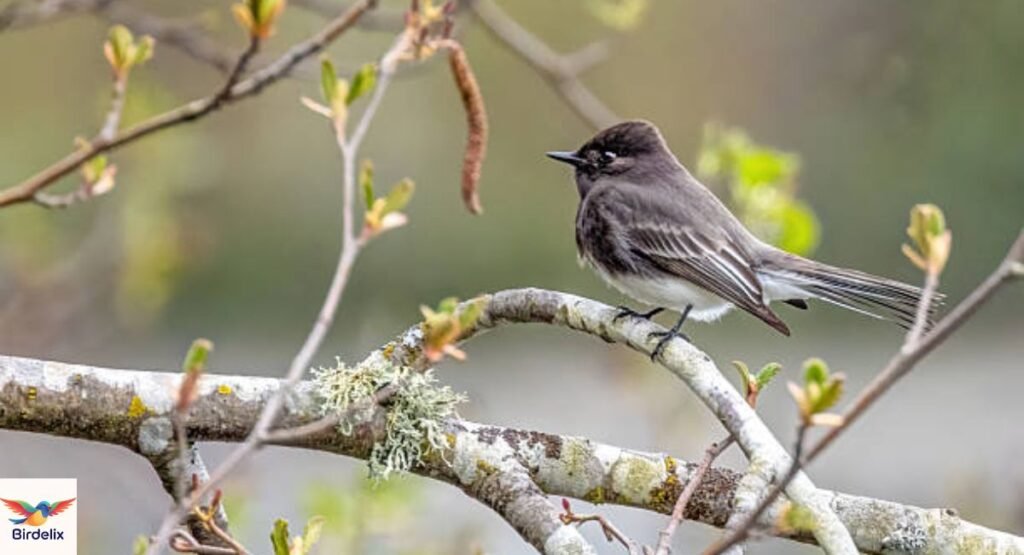
A Black Phoebe is a small bird with a rounded head, a slender bill, and a medium-length tail. Its upper body is dark charcoal or black, while its belly is white. The contrast between these two colors is its most useful identification feature. It usually measures around 6 to 7 inches long, although individual birds can vary slightly in size.
Its simple coloring can make it look similar to other dark birds at first. However, its body shape and behavior help distinguish it. Black Phoebes often sit upright on low perches, flick their tails, and make short flights after insects. If you see a dark bird with a white belly repeatedly returning to the same fence or rock, a Black Phoebe is a strong possibility.
Key Black Phoebe Identification Features
The easiest way to identify a Black Phoebe is to look for its dark head and back, white belly, and upright posture. Its bill is short and pointed, which helps it catch insects. The bird’s tail often moves up and down while it waits, giving birdwatchers another useful clue. Its flight is usually quick and direct when it leaves a perch to catch prey.
Young birds may have pale or rusty edges on some feathers, so they might not look as sharply black and white as adults. Lighting can also change how their dark feathers appear. In bright sunlight, the upper body may look charcoal gray rather than completely black. Watching the bird’s behavior alongside its coloring makes identification more reliable.
Female Black Phoebe Bird: How to Identify Her
Male and female Black Phoebes look very similar, which makes identifying a female by sight difficult. Both sexes have dark upperparts and white underparts. Their size and plumage overlap considerably, so color alone is not a dependable way to tell them apart. In ordinary backyard observations, it is often best to identify the bird as a Black Phoebe unless its sex is known from behavior or other evidence.
During the breeding season, behavior may offer clues, but it does not always provide a certain answer. A bird carrying nesting material or sitting on eggs may be involved in reproduction, yet observation alone may not establish its sex in every situation. For most casual birdwatchers, learning the species’ appearance and habits is more useful than trying to distinguish males from females.
Birds That Look Like a Black Phoebe
Several birds may resemble a Black Phoebe, especially when viewed from a distance. Eastern Phoebes and Say’s Phoebes are related flycatchers, but their coloring and geographic ranges differ. An Eastern Phoebe usually has a more muted gray-brown appearance above, while Say’s Phoebe has a rusty-orange belly. Black Phoebes stand out because of their stronger black-and-white contrast.
Other small dark birds may look similar when they sit in shadow. The best approach is to examine the whole bird rather than relying on one feature. Look at its belly color, bill shape, tail movements, and hunting style. Location also matters because some look-alike species are more common in different regions. Combining these clues can help you make a more accurate identification.
| Identification feature | Black Phoebe | Say’s Phoebe |
| Upper body | Black or sooty charcoal | Gray-brown |
| Belly | White | Usually rusty or salmon-colored |
| Typical behavior | Perches and catches flying insects | Perches and catches flying insects |
| Main identification clue | Strong black-and-white contrast | Warm-colored belly |
Black Phoebe Bird Call: What Does It Sound Like?
The Black Phoebe bird call is often described as a short, clear, slightly raspy sound. Its vocalizations may include sharp notes and repeated phrases that carry across a yard or stream. The bird does not produce the long, complex songs heard from some other songbirds. Instead, its calls are usually brief and direct, which suits a bird that spends much of its time watching for insects.
Calls can help birdwatchers locate a Black Phoebe before they see it. You may hear one near a pond, bridge, or garden and then notice it sitting on a nearby perch. Listening to recordings from a trusted bird guide can help you become familiar with its sound. However, calls may vary with the situation, and other nearby birds can make identification by sound alone less certain.
Common Black Phoebe Calls and Vocalizations
Black Phoebes use short calls in different situations, including interactions with nearby birds and activities around their territory. Some calls sound like a sharp, repeated note, while others have a more scratchy quality. You may hear more vocal activity during the breeding season, especially when birds are defending an area or communicating near a nest.
Learning the call is useful, but it works best alongside visual clues. If you hear a short call and see a black-and-white bird repeatedly returning to a low perch, the identification becomes stronger. Recordings can help you compare sounds, but avoid playing calls repeatedly near an active nest because this may disturb the birds.
Why Does a Black Phoebe Make Repeated Calls?
Repeated calling can serve several purposes. A Black Phoebe may call to communicate with its mate, respond to another bird, or defend its territory. It may also vocalize when something unfamiliar enters the area. During nesting season, activity near the nest can lead to more frequent calls as the adults respond to changes around them.
A bird that calls often is not necessarily distressed. It may simply be communicating or reacting to another bird nearby. If you notice repeated calls near a nest, observe from a respectful distance rather than approaching to investigate. Giving the birds space helps them continue feeding their young and defending their nesting area without unnecessary stress.
Male vs. Female Black Phoebe Bird: Key Differences
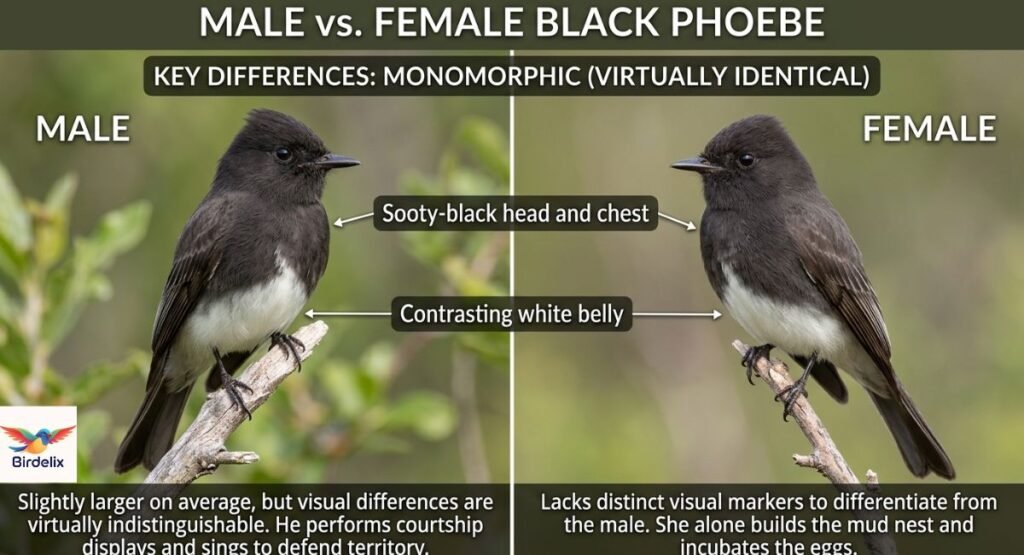
Male and female Black Phoebe birds look almost identical, making them difficult to distinguish by appearance alone. Both have dark blackish-gray upperparts, a white belly, and a slender bill. They also share similar sizes and behaviors, including catching insects in flight and flicking their tails while perched. Unlike some bird species, Black Phoebes do not show clear differences in color or markings between the sexes.
The most useful clues may come from observing their behavior during the breeding season. A female lays the eggs, while both parents help care for the young. However, watching a bird build a nest or feed chicks does not always provide a certain identification. For most birdwatchers, the best approach is to identify the species by its black-and-white plumage, upright posture, and characteristic hunting behavior rather than relying on visual differences between males and females.
What Does a Black Phoebe Bird Eat?
The Black Phoebe is mainly an insect-eating bird. Its diet includes flies, mosquitoes, beetles, moths, and other small insects. It often catches prey in midair, a hunting method known as flycatching. The bird waits on a perch, watches for movement, and quickly flies out to grab an insect before returning to its original position or choosing another nearby perch.
Black Phoebes may also pick insects from the ground, rocks, or surfaces near water. Their exact diet changes with the season and the prey available in their habitat. During warm weather, flying insects may be plentiful. When conditions change, the birds may search more actively for other small invertebrates. They provide a natural form of insect control, although they should not be viewed as a complete solution for mosquito problems.
Black Phoebes generally do not rely on seeds as a main food source. Adding seed feeders is therefore unlikely to attract them in the same way it attracts finches or sparrows. A yard with open hunting areas, nearby vegetation, and access to water may be more useful. Avoid using pesticides unnecessarily because these chemicals can reduce the insects that Black Phoebes and other insect-eating birds need to survive.
Black Phoebe Bird Nest: Where and How Does It Build One?
The Black Phoebe bird nest is often made from mud and plant material, creating a sturdy cup attached to a sheltered vertical surface. The birds may build beneath bridges, on building ledges, under eaves, or inside other protected spaces. These sites offer some protection from rain and direct sunlight while allowing the adults to approach the nest easily.
Both natural and human-made structures can provide nesting opportunities. A suitable site needs a stable surface, some shelter, and access to food. The birds may return to familiar nesting areas in later breeding seasons, particularly when the location has worked well before. If you find a nest near your home, watch from a distance and avoid touching it or blocking the adults’ path.
What Does a Black Phoebe Nest Look Like?
A Black Phoebe nest is usually a compact, cup-shaped structure built from mud mixed with grass, fibers, and other plant material. It may look like a small earthen shelf or cup attached to a wall or ledge. The outer surface can appear rough, while the inside is lined with softer material that helps support the eggs and chicks.
Because the nest is made partly from mud, it may resemble a small patch of dried earth beneath a sheltered overhang. Its position can make it easy to overlook, especially when it blends into a concrete wall or rocky surface. If you think you have found one, do not touch it to confirm its identity. Observing the adult birds visiting the site is usually a better way to investigate.
Where Do Black Phoebe Birds Build Their Nests?
Black Phoebes often choose sheltered locations near streams, ponds, and other insect-rich areas. They may build under bridges, on building ledges, beneath roof overhangs, or against protected rock surfaces. These sites help keep the nest secure and offer the adults a clear route for entering and leaving while carrying food.
The birds may also nest around houses and other buildings, which can bring them close to people. A nest in a quiet corner may go unnoticed until the adults begin making frequent feeding trips. If a nest appears near a doorway or patio, give the birds room to move freely and avoid disturbing the structure while eggs or young are present.
Do Black Phoebe Birds Reuse Their Nests?
Black Phoebes may reuse a successful nesting site, and they can sometimes repair or rebuild nests in familiar locations. Whether they reuse a particular nest depends on its condition, the site’s safety, and the birds’ behavior. A nest that remains sheltered and secure may be attractive again, but reuse is not guaranteed.
Old nests can also become damaged by weather or lose their stability over time. Never assume that an empty-looking nest is abandoned. Adults may be away feeding, and eggs or young can be difficult to see from the ground. If you need to repair a building or remove a nest, first check the applicable wildlife laws and seek guidance from a local wildlife authority when necessary.
Black Phoebe Bird Eggs: Color, Size, and Incubation

Black Phoebe eggs are generally white, often with small reddish-brown or darker markings. A clutch commonly contains around three to six eggs, although the number can vary. The female lays the eggs in a sheltered nest, where they remain protected from many weather conditions. Their pale color and small size can make them difficult to see inside the nest without getting too close.
Incubation usually lasts about two weeks, though timing may vary with conditions and the individual nesting attempt. The adults must balance keeping the eggs warm with leaving the nest to find food. After hatching, the young depend on their parents for warmth, protection, and regular meals. Because nesting birds can be sensitive to disturbance, it is best to observe from a distance and avoid shining lights or cameras directly into the nest.
The following table summarizes typical Black Phoebe nesting information. These figures are approximate rather than guarantees for every nest.
| Nesting detail | Typical information |
| Eggs per clutch | About 3–6 |
| Egg color | White, sometimes marked with reddish-brown spots |
| Nest structure | Mud cup with plant fibers and softer lining |
| Incubation period | Around two weeks |
| Nest location | Sheltered ledges, bridges, walls, and overhangs |
Baby Black Phoebe Birds: From Hatchlings to Fledglings
Baby Black Phoebes hatch small and helpless. They depend on their parents for food, warmth, and protection while their feathers develop. The adults make repeated feeding trips, bringing insects to the nest throughout the day. As the chicks grow, their bodies become better covered with feathers, and they begin to look more like the familiar black-and-white adults.
The nestling period is a demanding time for the parents. They must find enough insects to feed the growing chicks while also watching for potential threats. After the young leave the nest, they may still depend on their parents for food and guidance. A fledgling seen on a low branch or near the ground is not automatically abandoned, so people should avoid picking it up unless it is injured or in immediate danger.
What Do Baby Black Phoebe Birds Look Like?
Newly hatched Black Phoebes are tiny, with sparse down and closed or barely open eyes. They cannot fly and need constant care. As they grow, their feathers develop, and they begin to show the dark upperparts and pale underparts associated with the species. Young birds may have softer, less sharply defined coloring than adults.
A fledgling may look fully feathered but still have a shorter tail, less coordinated flight, or pale edges on its feathers. These features can make it look slightly different from a mature bird. If you find a young Black Phoebe outside its nest, watch from a distance to see whether its parents are nearby. Many fledglings spend time on low branches or sheltered surfaces while they build strength and improve their flying skills.
How Do Black Phoebe Parents Feed Their Babies?
Black Phoebe parents feed their chicks small insects, which provide the protein and energy needed for growth. The adults catch prey in flight or pick it from nearby surfaces, then carry it back to the nest. They may visit many times during the day, especially when the chicks are growing quickly and need frequent meals.
Parents also protect the nest and respond to potential threats. If people approach too closely, the adults may become more alert or call repeatedly. Watching from a quiet location gives you a better chance of seeing natural feeding behavior without interfering. Never try to feed nestlings yourself, as unsuitable food or incorrect feeding methods can harm them.
When Do Young Black Phoebes Leave the Nest?
Young Black Phoebes often leave the nest roughly two to three weeks after hatching, although the timing can vary. Their feathers and flight muscles need to develop enough for them to leave safely. Once they fledge, they may remain close to the nest while learning to fly confidently and catch insects.
Leaving the nest does not mean that a young bird is fully independent. Parents may continue feeding fledglings for a period after they leave. If you see a young bird sitting on the ground, first check whether it appears alert and uninjured. If it is feathered and moving normally, its parents may still be caring for it. Contact a licensed wildlife rehabilitator if the bird is injured, cold, weak, or clearly in danger.
Black Phoebe Bird Behavior: Habits You Should Know
One of the most recognizable Black Phoebe behaviors is its repeated tail movement. The bird often sits upright, flicks its tail downward, and scans the area for insects. When it spots prey, it launches into a quick flight, catches the insect, and may return to the same perch. This simple hunting pattern makes it easier to watch than birds that spend most of their time hidden in dense leaves.
Black Phoebes can also be territorial, especially around nesting areas. They may chase away other birds or react when a person approaches too closely. Their behavior changes with the season, with more nesting activity during the breeding period. Even when they live near people, they still need safe nesting sites, food, and enough space to raise their young. A quiet yard with insects and sheltered perches can support their natural behavior without requiring special feeding.
Black Phoebe Bird Spiritual Meaning and Symbolism
The Black Phoebe bird spiritual meaning depends on personal beliefs and cultural interpretation rather than established scientific evidence. Some people associate small, active birds with alertness, patience, adaptability, and the ability to notice opportunities. Because a Black Phoebe waits quietly before making a quick move, people may interpret its behavior as a reminder to stay observant and act at the right moment.
Its black-and-white coloring may also inspire symbolic ideas about balance, contrast, or clarity. These meanings are personal interpretations, not proven messages from nature. The bird’s actual behavior has practical explanations connected to hunting, breeding, and survival. You can appreciate the symbolism while also enjoying the Black Phoebe as a real wild bird with its own needs and habits.
What Does Seeing a Black Phoebe Mean Spiritually?
Some people interpret seeing a Black Phoebe as a reminder to stay patient, pay attention, and make thoughtful decisions. Its hunting style offers a simple example: it watches carefully, waits for an opportunity, and then acts quickly. For someone who enjoys spiritual symbolism, this behavior may represent preparation followed by purposeful action.
There is no scientific evidence that seeing a Black Phoebe predicts a future event or carries a universal spiritual message. The meaning depends on the observer’s personal beliefs and circumstances. You may simply enjoy the encounter as a chance to slow down and notice wildlife around you. Sometimes, the experience of watching a bird is meaningful without needing a supernatural explanation.
Black Phoebe Symbolism in Everyday Life
In everyday symbolism, a Black Phoebe may represent adaptability because it can live in natural habitats and areas shaped by people. Its ability to find food from a simple perch can also suggest resourcefulness. People who enjoy bird symbolism may connect its steady habits with patience, awareness, and making good use of available opportunities.
These ideas are best understood as personal reflections rather than facts about the species. A Black Phoebe does not behave with the intention of teaching people a lesson. Still, observing its calm waiting and quick movements can inspire a useful thought about balancing patience with action. Its presence can also encourage people to protect the small green spaces and waterways that support local wildlife.
How to Attract Black Phoebe Birds to Your Yard
The best way to attract Black Phoebes is to make your yard useful for insect hunting. They prefer open areas with low perches, so a fence, sturdy branch, or garden structure may give them a good place to watch for prey. A natural pond or other safe water feature can make the area more attractive, especially when the surrounding space also provides insects and shelter.
Avoid relying on seed feeders because Black Phoebes mainly eat insects. Limiting unnecessary pesticide use helps maintain their food supply and benefits other wildlife as well. If you already have a Black Phoebe visiting, give it quiet places to perch and avoid disturbing potential nesting areas. Do not approach an active nest or try to handle the birds. Their natural behavior is best enjoyed from a respectful distance.
Conclusion
The Black Phoebe bird is a fascinating small songbird with distinctive black-and-white coloring, quick hunting movements, and an interesting nesting style. It catches insects from open perches and often lives near water, gardens, bridges, and buildings. Its mud nest, pale eggs, and attentive parenting offer plenty to observe during the breeding season.
Although the Black Phoebe’s spiritual meaning can be interesting to explore, its real-life behavior is just as remarkable. You can learn to recognize its call, identify its features, and support its habitat by maintaining a wildlife-friendly yard. If you see one near your home, take time to observe it quietly. You may discover that this modest bird has a regular place in your local landscape.
FAQs
Is the Black Phoebe a Rare Bird?
The Black Phoebe is not generally considered rare across much of its established range. It is commonly seen in suitable habitats in California and parts of the western United States, especially near water and open spaces.
Are Male and Female Black Phoebe Birds Different?
Male and female Black Phoebes look very similar. Both have dark upperparts and white bellies, so their sex is usually difficult to determine by appearance alone.
Do Black Phoebe Birds Eat Mosquitoes?
Yes. Black Phoebes eat mosquitoes and other small flying insects when these are available. However, they also eat many other insects, so they should not be expected to control mosquitoes completely.
Do Black Phoebe Birds Stay in California All Year?
Many Black Phoebes remain in California throughout the year. Their presence depends on local habitat and conditions, but they are generally resident birds rather than long-distance seasonal migrants.
How Many Eggs Does a Black Phoebe Lay?
A Black Phoebe commonly lays about three to six eggs in a clutch. The eggs are usually white and may have reddish-brown markings, although individual clutches can vary.

Welcome to Birdelix! I’m Anam Sattar, an AI-powered SEO Specialist and Content Writer with over 5 years of experience in creating high-quality, search-optimized content. I help businesses improve their search engine rankings, increase organic traffic, and build beautiful, user-friendly websites. My mission is to make SEO, content creation, and web design simple, effective, and accessible for everyone. Let’s grow your online presence and achieve success together!