

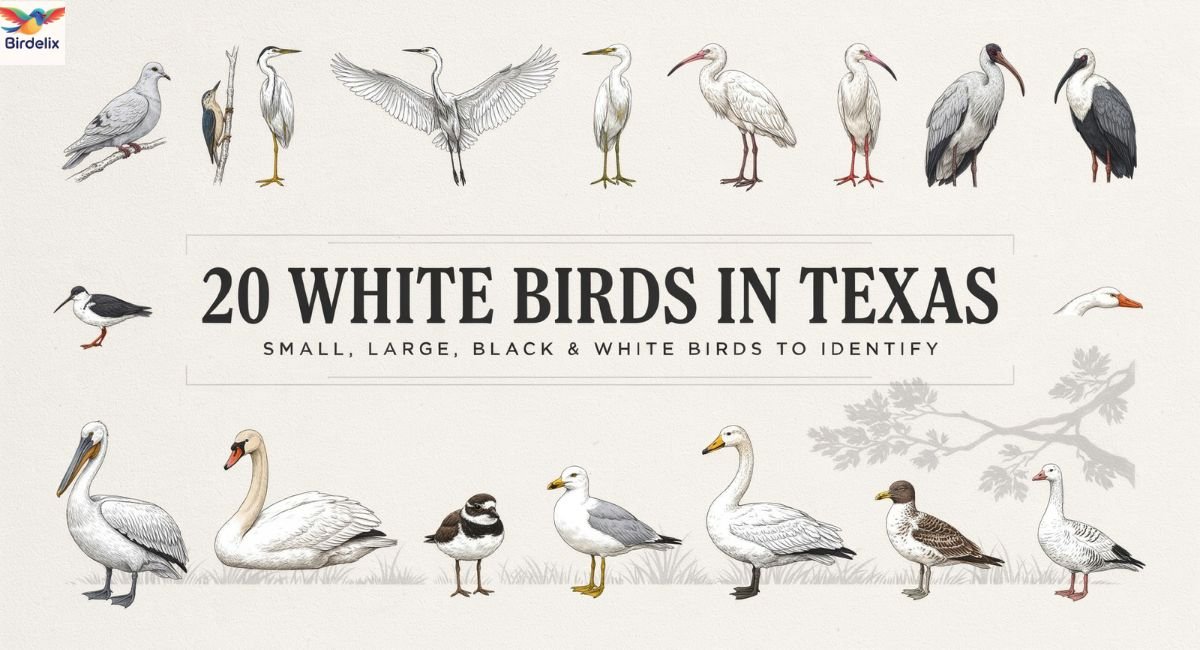
Texas is home to many beautiful birds with white feathers and striking color patterns. Some are large wading birds, while others are small, active, and easy to spot in backyards. However, identifying them can be confusing because several species look alike. Their size, bill shape, leg color, wings, and habitat offer helpful clues.
This guide to white birds in Texas introduces 20 species you may encounter across the state. You’ll discover small white birds, large white birds, and black and white birds found near wetlands, lakes, fields, coastal areas, and cities. Use these simple identification tips to recognize each bird more confidently.
How to Identify White Birds in Texas
Color is a helpful starting point, but it rarely tells the whole story. Two birds may have similar white feathers yet differ greatly in size, shape, and behavior. For better bird identification, study several features together. Also consider the season and location where you saw the bird.
A white bird near a marsh may be an egret or ibis. A large flock in a winter field could contain Snow Geese. Meanwhile, a white bird soaring above open grassland may be a kite. Habitat gives you a useful clue, but it should never replace physical features.
20 White Birds in Texas at a Glance
Use this table to compare the birds before reading their detailed descriptions. The size labels are general estimates. Age, season, and viewing distance can affect how large a bird appears.
| Bird | Size | Main Color Pattern | Key Identification Feature | Common Habitat |
| Great Egret | Large | White | Black legs and yellow bill | Wetlands |
| Snowy Egret | Medium | White | Black bill and yellow feet | Marshes and shallow water |
| American White Pelican | Very large | White | Huge wingspan and long bill | Lakes and coastal waters |
| White Ibis | Medium | White | Curved red bill and red legs | Shallow wetlands |
| Wood Stork | Large | White and black | Bare head and heavy bill | Marshes and swamps |
| Cattle Egret | Small to medium | White | Compact body and yellow bill | Fields and pastures |
| Ring-billed Gull | Medium | White and gray | Yellow bill with black ring | Coasts, lakes, and cities |
| Snow Goose | Medium | White or gray | Pink bill and black tail | Fields and wetlands |
| Ross’s Goose | Small to medium | White | Short, stubby bill | Lakes and farm fields |
| Trumpeter Swan | Very large | White | Black bill and long neck | Large lakes and rivers |
| White-tailed Kite | Small to medium | White and pale gray | White tail and hovering flight | Grasslands and open areas |
| Swallow-tailed Kite | Medium | White and black | Deeply forked tail | Open skies and wooded areas |
| Rock Pigeon | Medium | Variable | White or mixed-color plumage | Cities and parks |
| American Avocet | Medium | White and dark | Long, upturned bill | Shallow wetlands |
| Black-necked Stilt | Medium | Black and white | Very long pink legs | Ponds and marshes |
| White-faced Ibis | Medium | Dark with pale facial markings | Long curved bill | Freshwater wetlands |
| Black-bellied Plover | Medium | White and dark | Seasonal body pattern | Coastal areas |
| Forster’s Tern | Small to medium | Pale and white | Long pointed wings | Coastal wetlands |
| White-winged Dove | Small to medium | Gray and white | Bright white wing patches | Cities and backyards |
| Northern Mockingbird | Medium | Gray and white | White wing patches and long tail | Neighborhoods and open areas |
Important identification note: Not every bird in this table is completely white. Some have white wings, heads, or underparts. The list includes both mostly white species and birds with noticeable white-and-dark patterns.
20 White Birds in Texas You May See
The following species offer a useful mix of large wading birds, winter geese, shorebirds, and familiar backyard visitors. Their appearance and seasonal patterns can help you narrow down an identification. Remember that some species are common, while others appear only in certain regions or seasons.
1. Great Egret

The Great Egret is a tall, elegant bird with completely white plumage. Its long black legs and yellow, dagger-shaped bill are strong identification clues. It also has a long neck that bends into an S-shape. During flight, the egret pulls its neck back and lets its legs trail behind. You can look for it around marshes, ponds, lakes, and shallow wetlands. During breeding season, adults grow delicate feather plumes along their backs. These feathers once made the species a target for hunters who supplied the fashion trade.
2. Snowy Egret
The Snowy Egret is smaller than the Great Egret. It has a white body, a slim black bill, and black legs. Its bright yellow feet are especially useful for identification. The bird often moves through shallow water while stirring the bottom with its feet. This action can reveal small fish, insects, and other prey. Look for it around marshes, coastal wetlands, and ponds. Its dark bill and yellow feet help separate it from other white egrets.
3. American White Pelican
The American White Pelican is one of the largest white birds you may see in Texas. Its enormous body, long bill, and broad wings make it easy to notice. Adults have a wingspan that can reach more than nine feet. A yellow patch appears around the base of the bill during much of the year. During breeding season, adults develop a temporary plate on the upper bill. These pelicans use freshwater lakes and reservoirs, then move toward coastal areas during colder months. They often soar in groups with very little wing movement.
4. White Ibis
The White Ibis has a bright white body, red legs, and a long curved red bill. Its bare facial skin is also red. When the bird flies, black tips on its wings become easier to see. White Ibises often feed in shallow water, where they probe mud for insects and small aquatic animals. They may gather in large groups around marshes, coastal wetlands, and ponds. Their curved bills make them easy to separate from egrets and gulls. Young birds look different because their feathers are brownish before they develop adult plumage.
5. Wood Stork
The Wood Stork is a large wading bird with a white body and black flight feathers. Its featherless head looks dark and scaly. It also has a long, thick bill that curves slightly downward. These features give it a very different appearance from an egret. Wood Storks search for fish and other aquatic prey in marshes, swamps, and shallow wetlands. In Texas, coastal wetlands and wildlife refuges offer useful places to look. Its size and bare head make it easier to identify from a distance.
6. Cattle Egret
The Cattle Egret is a compact, smaller member of the heron family. Its short neck and sturdy body make it look different from taller egrets. Nonbreeding adults are mostly white with a yellow bill. During breeding season, adults develop golden-orange feathers around the head, chest, and back. You may find them in pastures and agricultural fields rather than directly beside water. They often follow cattle or other grazing animals to catch insects disturbed by their movement. This feeding habit is one of the best clues for identifying them.
7. Ring-billed Gull
The Ring-billed Gull has a white head, white body, gray back, and black wing tips. Its yellow bill has a noticeable black band near the tip. Yellow legs provide another useful clue. This medium-sized gull appears around beaches, lakes, rivers, docks, and other open-water habitats. It also visits parking lots, farmland, and urban areas while searching for food. Unlike some coastal birds, it can be seen far inland. Check the bill carefully when separating it from other gull species.
8. Snow Goose
The Snow Goose is a familiar winter visitor across parts of Texas. Most adults have a white body, pink legs, and a pink bill with dark markings. Their black tail feathers create a noticeable contrast against the white body. Some Snow Geese have a blue-gray body instead of a white one. This color form is called the blue morph. During migration, Snow Geese often gather in large flocks around fields, lakes, and wetlands. Their size, flocking behavior, and loud calls can make them easier to notice.
9. Ross’s Goose
The Ross’s Goose looks similar to the Snow Goose, but it is smaller and more compact. It has a short neck, a rounded head, and a small, stubby bill. Its body is mostly white, while its wing tips are black. The bill and legs often appear reddish-orange. Ross’s Geese may travel in flocks with Snow Geese, which makes comparison useful. Look closely at the head and bill rather than relying on body color alone. During migration and winter, they use marshes, lakes, and agricultural fields.
10. Trumpeter Swan

The Trumpeter Swan is an enormous white waterbird with a long neck and broad body. Adults have a black bill and black facial skin around the base of the bill. Their size makes them stand out from most other waterbirds. However, they are not a regular sight across Texas. The Texas Bird Records Committee lists them as a rarity, so treat a Texas sighting as unusual. If you see one, note the location and take photographs from a respectful distance. Large lakes and open water are useful places to check during unusual winter movements.
11. White-tailed Kite
The White-tailed Kite is a small raptor with a white head, white underside, and pale gray back. Its long white tail and dark wing markings help with identification. Unlike a heron, it hunts from the air. The bird often faces into the wind and hovers above open ground while searching for prey. It mainly feeds on small mammals and other animals. Look for it over grasslands, marsh edges, and open woodland. Its hovering flight is one of its clearest identifying behaviors.
12. Swallow-tailed Kite
The Swallow-tailed Kite has a striking black-and-white appearance. Its head and underparts are white, while its back and deeply forked tail are dark. Long, pointed wings give it a graceful shape in flight. It often glides above forests, wetlands, and open areas while searching for insects and other prey. Its deeply split tail is the strongest clue. This bird is a seasonal visitor and breeder in parts of Texas. It migrates south after the breeding season, so sightings depend on the time of year.
13. Rock Pigeon
The Rock Pigeon is one of the most familiar birds in Texas towns and cities. Many have gray bodies, dark wing bars, and iridescent neck feathers. However, their plumage varies widely. Some individuals are almost completely white, while others show patches of several colors. This variation comes from domesticated pigeon ancestry and selective breeding. Look for Rock Pigeons around buildings, bridges, parks, and busy streets. Their rounded bodies, short necks, and quick wingbeats can help you recognize them even when their color looks unusual.
14. American Avocet
The American Avocet is a graceful shorebird with a pale body, dark wings, and long legs. Its most unusual feature is its long, thin bill, which curves upward. During breeding season, its head and neck often turn a warm cinnamon color. In other seasons, those areas become paler. The bird feeds in shallow water by sweeping its bill from side to side. Look for it around mudflats, ponds, and shallow wetlands. Its upturned bill makes it easier to distinguish from other long-legged shorebirds.
15. Black-necked Stilt
The Black-necked Stilt has a bold black-and-white pattern and extremely long pink legs. Its thin, straight bill is dark and pointed. The bird often appears to walk on stilts as it moves through shallow water. This unusual shape makes it easy to recognize. It feeds on small aquatic insects and other tiny animals in wetlands, ponds, and flooded fields. Look for it along muddy edges where water is not too deep. Its long legs and narrow body separate it from most other black-and-white birds.
16. White-faced Ibis
The White-faced Ibis is not a white bird overall. Its body is mostly dark chestnut with green or purple shine on the upper feathers. It has a long, down-curved bill and reddish legs. During breeding season, a narrow white border appears around the bare facial skin. This pale marking gives the species its name. It prefers freshwater marshes but also feeds in flooded fields and other wetlands. In Texas, it breeds and winters along the Gulf Coast and may appear inland during migration. Its dark body helps separate it from the White Ibis.
17. Black-bellied Plover
The Black-bellied Plover is a medium-sized shorebird with contrasting dark and pale plumage. Its appearance changes with the season. Breeding adults develop a black face, throat, and belly with white markings along the sides. In nonbreeding plumage, the bird looks much paler and more gray. This seasonal change can confuse new birdwatchers. Look for it on beaches, mudflats, coastal fields, and open shorelines. Its sturdy body and short bill help distinguish it from smaller sandpipers.
18. Forster’s Tern
The Forster’s Tern has a pale body, long pointed wings, and a slender bill. During breeding season, it develops a dark cap on its head. Outside that period, the head becomes mostly white with a dark patch near the eye. It often flies over coastal wetlands, bays, lakes, and marshes while searching for small fish. Its narrow wings and light flight make it look more delicate than a gull. Watch how it hovers briefly before diving toward the water to catch prey.
19. White-winged Dove
The White-winged Dove is a familiar Texas bird with a gray-brown body and bright white wing patches. Those patches are easiest to see when the bird flies. It also has a dark cheek mark and a long tail with white edges. You may find it around neighborhoods, parks, gardens, and desert-edge habitats. It often feeds on seeds and visits trees or utility wires. Although it isn’t completely white, its clear wing markings make it a useful species to include in a guide to white-patterned Texas birds.
20. Northern Mockingbird
The Northern Mockingbird has a gray back, pale underside, long tail, and noticeable white wing patches. The white markings flash when it flies or spreads its wings. This makes it easier to identify than its plain coloring might suggest. Mockingbirds live in neighborhoods, parks, open woodland, and scrubby areas. They often perch in exposed spots and sing a wide range of sounds. Their active behavior and repeated songs are useful clues. In Texas, this familiar bird is also the state bird.
Small White Birds in Texas
| Bird Name | Size | Main Identification Features |
| White-winged Dove | Small to medium | Gray body and white wing patches |
| Forster’s Tern | Small to medium | Pale body and long pointed wings |
| Black-necked Stilt | Medium | Black-and-white body and very long pink legs |
| Black-bellied Plover | Medium | Dark and pale seasonal plumage |
| Rock Pigeon | Medium | Variable plumage, sometimes mostly white |
| Northern Mockingbird | Medium | Gray body and white wing patches |
Large White Birds in Texas
| Bird Name | Size | Main Identification Features |
| American White Pelican | Very large | Huge wingspan and long bill |
| Great Egret | Large | White body, black legs, and yellow bill |
| Wood Stork | Large | White body, black flight feathers, and bare head |
| Trumpeter Swan | Very large | White body, long neck, and black bill |
| Snow Goose | Medium to large | White body, black tail, and pink bill |
| White Ibis | Medium | White body and curved red bill |
| Cattle Egret | Small to medium | Compact white body and yellow bill |
Note: Some birds in these tables are not completely white. They are included because they have noticeable white feathers or contrasting white patterns. Trumpeter Swans are rare in Texas.
Black and White Birds in Texas
Some Texas birds have strong black-and-white patterns rather than fully white bodies. These markings can appear on the wings, back, neck, tail, or underside. Black-necked Stilts have very long pink legs. Swallow-tailed Kites show a dramatic forked tail. Ring-billed Gulls have gray backs and black wing tips.
Black-necked Stilt
Its black upperparts contrast with a white underside. The long pink legs are the most noticeable feature. Look for this bird in shallow wetlands and flooded fields.
Black-bellied Plover
This plover changes appearance during the year. Breeding adults show a bold black belly and face, while winter birds look much paler. Seasonal plumage is important for accurate identification.
Swallow-tailed Kite
The Swallow-tailed Kite has a white head and underside with a dark back and tail. Its deeply forked tail is easy to notice while it glides above open areas.
Ring-billed Gull
The Ring-billed Gull has a white body, gray back, and black wing tips. Its yellow bill has a dark ring near the end. It often appears around lakes, beaches, and urban areas.
White Birds With White or Pale Heads in Texas
A white head can help identify a bird, but it should not be your only clue. Some species have white heads with dark backs, while others have mostly white bodies. Compare the bill, wings, and tail as well. This is especially useful when identifying birds in flight.
White-tailed Kite
The White-tailed Kite has a white head, pale gray back, and white underside. Its long white tail adds another clue. Look for its distinctive hovering behavior over open land.
Swallow-tailed Kite
The Swallow-tailed Kite has a white head and underparts. Its black back and deeply forked tail create a strong contrast. Its graceful flight makes it easier to recognize in open skies.
American White Pelican
The American White Pelican has a white head and body, a long bill, and an enormous wingspan. Its size separates it from smaller white-headed birds such as gulls.
Ring-billed Gull
The Ring-billed Gull has a white head, gray back, and white underside. Its yellow bill with a black band is the best clue. Look around inland lakes and coastal areas.
Where to Find White Birds in Texas
Texas has many habitats, from Gulf Coast marshes to dry grasslands and busy cities. Each habitat attracts different birds. A wetland may hold egrets and ibises, while a winter field may attract geese. When you search for birds, consider the habitat before narrowing down the species.
Coastal Texas
Beaches, bays, mudflats, and coastal wetlands attract gulls, terns, ibises, and other waterbirds. Shallow shorelines provide feeding areas for birds that search for fish, insects, and small aquatic animals. Coastal areas are especially useful for observing groups of birds at rest or feeding.
Lakes, Rivers, and Wetlands
Egrets, pelicans, ibises, storks, and waterfowl use Texas wetlands. Great Egrets often walk slowly through shallow water. Pelicans may gather on open lakes, while ibises probe wet soil for food. Look along quiet edges where birds can feed without much disturbance.
Fields, Grasslands, and Open Areas
Open fields can attract Snow Geese and Ross’s Geese during migration and winter. Cattle Egrets often follow livestock, while White-tailed Kites search for prey above grasslands. These habitats show why not every pale bird lives beside water.
Cities, Parks, and Backyards
Rock Pigeons and White-winged Doves are common around human settlements. Gulls may also visit parking lots, rooftops, and large open spaces. Northern Mockingbirds often use gardens, shrubs, and trees as feeding and nesting areas. Watch utility wires and building edges for resting birds.
White Birds in South Texas
South Texas offers coastal wetlands, agricultural fields, ponds, and urban habitats. These areas can support White Ibises, egrets, geese, shorebirds, and other species. The Rio Grande Valley and Gulf Coast are useful places to explore because different habitats sit close together. This variety can produce many kinds of bird sightings.
However, location alone cannot confirm an identification. A white bird near the coast could be a gull, tern, ibis, or egret. Check its bill, legs, body shape, and flight pattern. Also consider the season. Some birds pass through during migration, while others remain in the region for much longer.
White Birds in Texas by Size
Size is one of the easiest ways to narrow down a bird’s identity. It won’t confirm the species on its own, but it helps remove unlikely choices. Compare the bird with nearby objects or familiar species whenever possible. Avoid judging size when the bird is far away or viewed alone.
| Size Group | Examples | Key Features |
| Small | White-winged Dove and smaller shorebirds | Compact body and shorter wings |
| Medium | Egrets, gulls, and ibises | Moderate body size and varied bill shapes |
| Large | Pelicans and Wood Storks | Long wings, large bodies, or long legs |
| Very large | Trumpeter Swan | Huge body and long neck; rare in Texas |
A large white bird standing in a marsh may be an egret or stork. A bird with an enormous wingspan over a lake may be a pelican. Geese have a different body shape, with shorter legs and a broad body. These comparisons make field identification easier.
How to Tell Similar White Birds Apart
Some species are easy to confuse because they share similar colors or habitats. The best approach is to compare one feature at a time. Look at the bill, legs, body shape, and wing pattern. Then consider whether the bird is a resident, winter visitor, or seasonal migrant.
Great Egret vs. Snowy Egret
The Great Egret is larger and has a yellow bill with black legs. The Snowy Egret is smaller and has a black bill, black legs, and yellow feet. If you can see the feet clearly, that bright yellow color is a useful clue.
Snow Goose vs. Ross’s Goose
Both geese can have white bodies and black wing tips. The Snow Goose is larger and has a longer neck and bill. Ross’s Goose is smaller, with a shorter neck and stubby bill. They may gather in the same flock, so compare nearby birds.
White Ibis vs. White-faced Ibis
The White Ibis has a white body, red legs, and a curved red bill. The White-faced Ibis is mostly dark chestnut with a long curved bill. During breeding season, the White-faced Ibis shows a narrow white border around its facial skin.
Swallow-tailed Kite vs. White-tailed Kite
The Swallow-tailed Kite has a deeply forked tail, dark back, and white underparts. The White-tailed Kite has a mostly white tail and pale gray back. Their hunting styles also differ. White-tailed Kites often hover in place, while Swallow-tailed Kites glide and turn smoothly.
Cattle Egret vs. Other Egrets
Cattle Egrets are smaller and more compact than Great Egrets. Their yellow bill and field-dwelling habits are useful clues. Great and Snowy Egrets are more closely associated with shallow water. Breeding Cattle Egrets may also show golden-orange feathers.
When Can You See White Birds in Texas?
The best time to see a particular bird depends on its migration and breeding patterns. Some species occur in Texas throughout the year, while others visit during winter or migration. Seasonal plumage can also change a bird’s appearance. Always check current local sightings before planning a birdwatching trip.
Year-Round Birds
Some familiar species, such as Rock Pigeons, White-winged Doves, and Northern Mockingbirds, can be seen in many parts of Texas throughout the year. Their presence still depends on local habitat. A wetland species may be common in one region but harder to find elsewhere.
Winter Visitors
Snow Geese and Ross’s Geese are important winter visitors. They often gather in fields, lakes, and wetlands. Winter also brings other waterbirds into Texas. Large flocks can make these seasonal visitors easier to spot.
Summer and Breeding Birds
Some species become more noticeable during breeding season. Great Egrets may develop long display plumes, while other birds show changes in head or body color. Swallow-tailed Kites are seasonal birds in Texas. Their presence is closely linked to the warmer breeding months.
Birds Seen During Migration
Spring and fall migration can bring birds through areas where they aren’t seen as often during other seasons. Wetlands, coastal sites, and open fields may attract resting and feeding birds. Keep notes about the date and location. These details can help confirm your identification later.
White Bird Identification Tips for Beginners
A good identification starts with careful observation. First, estimate the bird’s size and shape. Then study its head, bill, legs, wings, and tail. Notice its behavior and habitat. Finally, consider the season. This simple process reduces mistakes and helps you compare similar species with more confidence.
Try to take a photograph when possible, but don’t approach or disturb the bird. Use a bird guide or a trusted identification resource to compare your observations. If you cannot confirm the species, record it as an unknown bird rather than guessing. Accurate notes are more useful than an uncertain name.
Conclusion
Texas has many birds with white feathers or noticeable white markings. Some are large wading birds, while others are geese, gulls, kites, or backyard visitors. Their size, bill shape, leg color, wing pattern, and habitat can help you identify them. Don’t rely on color alone.
When you spot an unfamiliar bird, take a moment to observe its shape and behavior. Check the season and habitat before choosing a name. With practice, you’ll become better at recognizing Texas birds and telling similar species apart.
FAQs
What is the most common white bird in Texas?
There isn’t one answer for every part of Texas. Great Egrets, gulls, and White Ibises are familiar in suitable habitats, while white Rock Pigeons occur around many cities.
What are the large white birds in Texas?
American White Pelicans, Great Egrets, and Wood Storks are large white birds. Trumpeter Swans are extremely large but rare in Texas.
What are the small white birds in Texas?
White-winged Doves have white wing patches, while small terns and shorebirds may look pale from a distance. Check their bills, wings, and flight patterns.
What are the black and white birds in Texas?
Black-necked Stilts, Swallow-tailed Kites, and Ring-billed Gulls show strong black-and-white or dark-and-pale patterns. Their body shapes and markings help separate them.
What birds in Texas have white heads?
White-tailed Kites, Swallow-tailed Kites, American White Pelicans, and Ring-billed Gulls can show white heads. Compare their bills, bodies, and tails for a better identification.

Welcome to Birdelix! I’m Anam Sattar, an AI-powered SEO Specialist and Content Writer with over 5 years of experience in creating high-quality, search-optimized content. I help businesses improve their search engine rankings, increase organic traffic, and build beautiful, user-friendly websites. My mission is to make SEO, content creation, and web design simple, effective, and accessible for everyone. Let’s grow your online presence and achieve success together!