


Discover the fascinating world of 4 letter birds and learn why these short names are worth exploring. From familiar crows and doves to unusual kagu and smew, each bird has something special to offer. This collection features four-letter bird names from different parts of the world. You’ll find small birds, large species, flightless birds, and colorful birds with unique features. Some live in forests and grasslands, while others prefer wetlands, islands, and coastal areas.
You’ll also learn about their appearances, natural habitats, and interesting behaviors. Whether you’re a bird lover or solving a crossword puzzle, these amazing birds will make learning enjoyable.
What Makes a Bird Name Four Letters Long?
A four-letter bird name contains exactly four letters in its common English spelling. Names such as Crow, Dove, Hawk, and Swan are easy examples. These are common bird names, which people use in everyday conversations, books, and wildlife guides. Some names describe one species, while others refer to several related birds. For example, the word Hawk covers many different birds of prey.
Common names are different from scientific names. Scientists use scientific names to identify species more precisely across languages and countries. A crow may belong to the genus Corvus, while the common loon is known scientifically as Gavia immer. Short bird names are also useful for word games, spelling activities, and crossword puzzles. Their simple spelling makes them easy to remember, but learning about the birds behind those names makes them even more interesting.
Quick Comparison of 36 Four-Letter Birds
| Bird Name | Bird Type | Size | Habitat |
| Crow | Perching bird | Medium | Forests, farms, and cities |
| Dove | Pigeon and dove family | Small–Medium | Woodlands, gardens, and cities |
| Hawk | Bird of prey | Medium–Large | Forests and open areas |
| Swan | Waterfowl | Large | Lakes and wetlands |
| Kiwi | Flightless bird | Small–Medium | Forests and scrublands |
| Wren | Songbird | Small | Forests, gardens, and shrubs |
| Lark | Songbird | Small–Medium | Grasslands and open fields |
| Gull | Seabird | Small–Large | Coasts, lakes, and harbors |
| Ibis | Wading bird | Medium–Large | Wetlands and marshes |
| Rook | Corvid | Medium | Farmland and open woodland |
| Tern | Seabird | Small–Medium | Coasts, islands, and lakes |
| Kite | Bird of prey | Small–Medium | Woodlands and open areas |
| Loon | Diving water bird | Medium–Large | Lakes and coastal waters |
| Myna | Starling family | Small–Medium | Gardens, towns, and open woodland |
| Rhea | Flightless bird | Large | Grasslands and scrublands |
| Dodo | Extinct flightless bird | Large | Formerly forests on Mauritius |
| Kagu | Ground-dwelling bird | Medium | Forests of New Caledonia |
| Kaka | Parrot | Medium | New Zealand forests |
| Chat | Common name for several bird groups | Small–Medium | Varies by species |
| Coua | Cuckoo family | Medium–Large | Madagascar’s forests and woodlands |
| Guan | Cracid | Medium–Large | Central and South American forests |
| Huia | Extinct songbird | Medium | Formerly forests in New Zealand |
| Iora | Songbird | Small | Asian gardens and woodlands |
| Knot | Shorebird | Small–Medium | Arctic tundra and coastal wetlands |
| Koel | Cuckoo | Medium | Forests and gardens |
| Lory | Parrot | Small–Medium | Tropical forests and islands |
| Nene | Goose | Medium | Hawaiian grasslands and shrublands |
| Rail | Wetland bird | Small–Medium | Marshes and swamps |
| Ruff | Shorebird | Medium | Wetlands and grasslands |
| Shag | Diving seabird | Medium | Rocky coasts and islands |
| Skua | Seabird | Medium–Large | Polar regions and open oceans |
| Smew | Diving duck | Small–Medium | Freshwater lakes and wetlands |
| Sora | Rail | Small | Freshwater marshes |
| Tody | Small tropical bird | Small | Caribbean forests |
| Weka | Flightless rail | Medium | New Zealand forests and grasslands |
| Baza | Bird of prey | Small–Medium | Woodlands and forests |
36 Amazing 4-Letter Birds and Their Interesting Facts
1. Crow
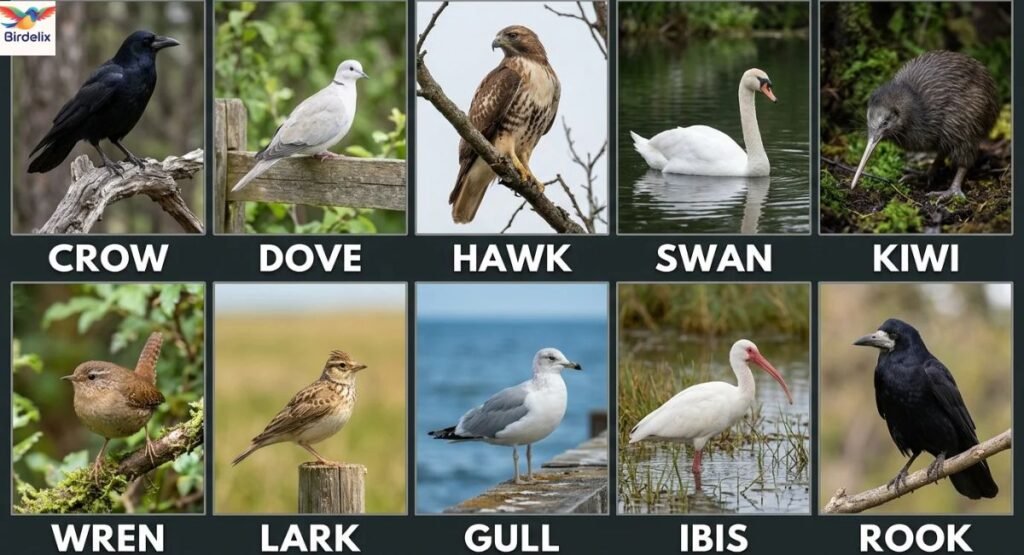
Crows are intelligent birds belonging to the corvid family. Most have black feathers, strong bills, sturdy legs, and long tails. They live in many environments, including forests, farms, parks, and busy cities. Their ability to adapt helps them find food in places where other birds may struggle. Crows eat insects, seeds, fruit, eggs, and small animals. They also use different calls to communicate with other members of their group. One remarkable fact is their intelligence. Crows can recognize human faces and remember people who have treated them as threats. Some even use simple tools to reach food. Their problem-solving skills make them some of the most fascinating birds to observe.
2. Dove
Doves are gentle-looking birds from the Columbidae family, which also includes pigeons. They usually have rounded bodies, small heads, short necks, and soft feathers. Their colors vary from plain gray and brown to white and green. Doves live across much of the world and often visit gardens, parks, woodlands, and farms. Many feed on seeds and grains they find on the ground. Their soft cooing calls are familiar sounds in many neighborhoods. Doves also have an important place in art, culture, and symbolism. People often associate them with peace and love. However, these birds are more than symbols. They are adaptable animals with strong navigation skills and interesting family behaviors.
3. Hawk
Hawks are birds of prey known for their sharp eyesight and hunting abilities. They have hooked bills, powerful feet, and strong talons for catching prey. Their bodies are built for flight and help them search large areas from above. Different hawk species live in forests, grasslands, deserts, mountains, and open countryside. Their diets may include rodents, reptiles, insects, and smaller birds. In the United States, the red-tailed hawk is one of the most familiar species. It often sits on trees, poles, or roadside structures while watching for food. Hawks also play an important role in natural ecosystems. By controlling populations of small animals, they help maintain balance in their habitats.
4. Swan
Swans are large waterfowl with long necks, broad wings, and strong bodies. Many species have white feathers, although black swans are also well known. They usually live around lakes, ponds, rivers, and coastal wetlands. Their long necks help them reach underwater plants and other food. Swans also eat grasses, seeds, and small aquatic animals. Their elegant appearance makes them popular in parks and nature photography. However, they can become defensive when protecting their nests or young. Some swan species form long-lasting pair bonds and often remain with the same partner for many years. Their graceful movements on water make them easy to recognize, even from a distance.
5. Kiwi
The kiwi is a unique flightless bird native to New Zealand. It has a rounded body, shaggy brown feathers, strong legs, and tiny wings. Its long bill has nostrils near the tip, which helps it locate food by smell. Unlike many birds, kiwis are mostly active at night. They search forest floors for worms, insects, larvae, and other small animals. Their feathers look more like loose hair than the smooth feathers of many flying birds. Kiwis also have unusually large eggs compared with their body size. This makes their reproduction especially interesting. Although they cannot fly, they are excellent runners and use their strong legs to move through dense vegetation.
6. Wren
Wrens are small, active songbirds known for their loud voices. Many have brown feathers, short wings, rounded bodies, and narrow bills. Their tails often point upward as they move through bushes and low branches. Different wren species live in the Americas, Europe, Asia, Australia, and New Zealand. They prefer habitats with plenty of insects and places to hide. Gardens, forests, hedges, and scrubland can all provide suitable shelter. Despite their small size, wrens can produce surprisingly powerful songs. They often sing from hidden positions, making them easier to hear than see. Some species also build several nests during the breeding season, although they may use only one.
7. Lark
Larks are passerine birds commonly found in open landscapes. They usually have brown or sandy feathers that help them blend into grass and soil. Their bodies are built for walking and running across the ground. Many species feed on seeds and insects. Larks live in grasslands, fields, dry plains, and other open habitats. Their songs are one of their most memorable features. Some larks sing while flying high above the ground, creating a beautiful sound across open countryside. The Eurasian skylark is especially famous for this behavior. Their natural colors may look simple, but their songs and flight displays make them remarkable birds.
8. Gull
Gulls are familiar seabirds often seen around beaches, lakes, harbors, and fishing areas. They have long wings, webbed feet, strong bills, and bodies suited to flying over water. Their feathers are commonly white, gray, or black, depending on the species. Many gulls eat fish, insects, shellfish, and other small animals. Some also search for leftover food near towns and coastal settlements. Their flexible diets allow them to live in many environments. Gulls are also clever when searching for meals. Certain species drop hard-shelled food onto solid surfaces to break it open. Although people often associate them with the ocean, many gulls live far inland.
9. Ibis
Ibises are wading birds recognized by their long legs and curved bills. Their bills bend downward and help them search for food in mud or shallow water. Depending on the species, their feathers may be white, black, brown, or brightly colored. They often live in marshes, swamps, riverbanks, and coastal wetlands. Their diet includes insects, worms, small fish, crustaceans, and other aquatic animals. The sacred ibis is one of the best-known species because of its connection to ancient Egyptian culture. In ancient Egypt, this bird was associated with the god Thoth. Today, different ibis species occur across several continents. Their unusual bills make them easy to distinguish from many other water birds.
10. Rook
The rook is a member of the corvid family and is closely related to crows. It has black feathers, a sturdy body, and a strong bill. Adult rooks often have pale, bare skin around the base of the bill. They mainly live in Europe and parts of Asia. Farmland, open countryside, and woodland edges provide suitable feeding and nesting areas. Rooks eat insects, seeds, grains, worms, and other available food. They are social birds and often gather in large groups. Their nesting colonies are known as rookeries. These colonies can contain many nests placed high in trees. Like other corvids, rooks show interesting social behavior and can adapt to changing environments.
11. Tern
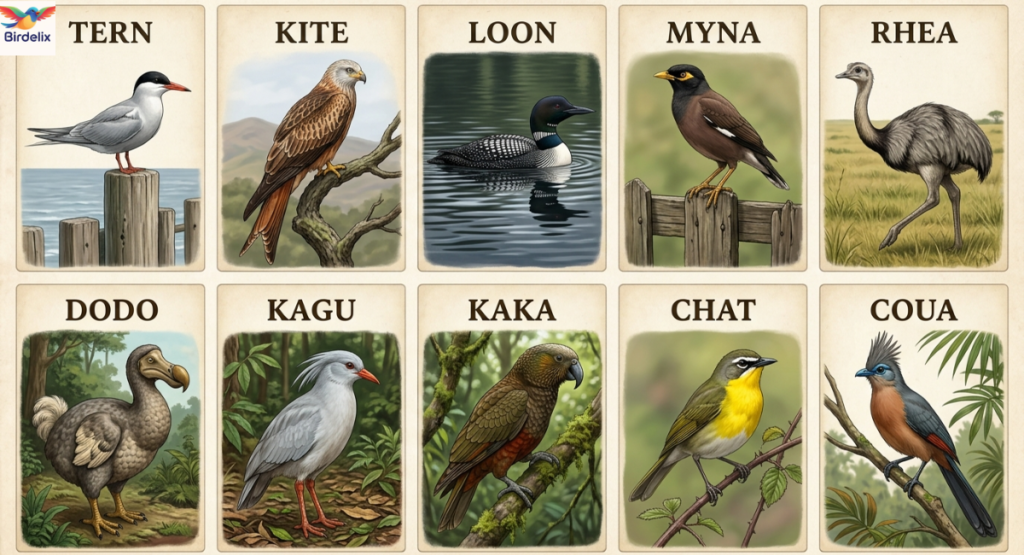
Terns are graceful seabirds with narrow wings, pointed bills, and streamlined bodies. Many have long, forked tails that help them steer during flight. Their feathers are often white and gray with darker markings on the head or wings. Terns live near oceans, beaches, islands, and inland lakes. They usually catch fish by diving into the water from above. Their sharp eyesight helps them locate prey near the surface. The Arctic tern is particularly famous for its migration. It travels between Arctic breeding areas and southern ocean regions each year. This journey is among the longest regular migrations in the animal world. Terns are excellent flyers and spend much of their lives moving between feeding and nesting areas.
12. Kite
Kites are birds of prey known for their smooth, graceful flight. Many have long wings, light bodies, and forked or slightly curved tails. These features help them glide and turn while searching for food. Kites occur in several regions, including Africa, Asia, Europe, and Australia. Depending on the species, they may live in forests, grasslands, wetlands, and open countryside. Their diets can include insects, small mammals, reptiles, and carrion. Some kites spend long periods soaring without making many wing movements. This helps them cover large areas while using little energy. Their flight style makes them easy to recognize when they circle high above fields or open landscapes.
13. Loon
Loons are diving water birds found mainly in the Northern Hemisphere. They have long bodies, pointed bills, and legs positioned far back on their bodies. This position makes them powerful swimmers but less comfortable when walking on land. Many loons live on freshwater lakes during the breeding season. They may move toward coastal waters during colder months. Their diet mainly includes fish, although they also eat aquatic insects and other small animals. The common loon is famous for its haunting calls across quiet lakes. Its patterned breeding plumage is also easy to recognize. Loons are skilled divers and can travel underwater to catch fish beneath the surface.
14. Myna
Mynas are members of the starling family and are common across parts of South and Southeast Asia. They have sturdy bodies, strong bills, and active personalities. Some species have dark feathers with bright yellow patches around their eyes or bills. They live in gardens, towns, farmland, parks, and open woodland. Their diet includes insects, fruit, seeds, and food scraps. Many mynas are comfortable around people and often search for food near buildings. Some species can imitate sounds, including parts of human speech. Their ability to adapt has helped certain mynas spread beyond their original ranges. These social birds often travel in pairs or groups while searching for food.
15. Rhea
Rheas are large, flightless birds native to South America. They have long legs, long necks, and soft, shaggy feathers. Their appearance may remind people of ostriches, although rheas belong to a different bird group. They live in grasslands, savannas, and open scrubland. Their strong legs help them run quickly across wide landscapes. Rheas eat plants, seeds, fruit, insects, and other small food items. One interesting feature is their breeding behavior. In several rhea species, males take responsibility for incubating eggs and caring for the chicks. A male may protect a nest containing eggs from more than one female. Their size and running ability make them well suited to open habitats.
16. Dodo
The dodo was a large extinct bird that lived on Mauritius, an island in the Indian Ocean. It had a heavy body, small wings, strong legs, and a large hooked bill. Unlike flying birds, the dodo could not fly. It lived in forest habitats and evolved in an island environment with few natural land predators. Human arrival, hunting, habitat changes, and introduced animals contributed to its extinction. The dodo disappeared during the 17th century. Today, it remains one of the world’s best-known extinct birds. Its story also shows how quickly island wildlife can disappear when new threats enter an ecosystem. Although no living dodos remain, scientists continue to study their bones and historical descriptions.
17. Kagu
The kagu is an unusual bird native to New Caledonia in the South Pacific. It has pale gray feathers, bright red legs, and a noticeable crest. Its wings are not suited for sustained flight, so it spends much of its time on the forest floor. Kagus search for worms, insects, snails, and other small animals among leaves and soil. Their natural habitat includes forested areas with thick ground cover. One unusual feature is their powder-down feathers. These feathers break down into a fine powder that helps maintain their plumage. Kagus are also known for their distinctive calls. Their restricted island range makes the protection of their forest habitat especially important.
18. Kaka
The kākā is a forest parrot native to New Zealand. It has a strong curved bill, brownish feathers, and colorful markings beneath its wings. Kākās use their powerful bills to reach food hidden in tree bark and other hard-to-access places. Their diet includes seeds, fruit, nectar, insects, and tree sap. They mainly live in native forests, although some visit parks and wooded areas. These parrots are active and often make loud calls while moving through the canopy. Their strong feet help them climb and hold branches while feeding. Kākās are also important members of their forest ecosystems because they help move seeds and pollen between plants.
19. Chat
The word chat is a common bird name used for several different groups of birds. Some chats belong to the flycatcher group and live in Europe, Asia, or Africa. Other birds with chat in their common names occur in Australia and North America. Their appearance varies, but many have compact bodies, upright postures, and noticeable calls. They may live in grasslands, scrub, open woodland, or areas with scattered bushes. The yellow-breasted chat is a familiar North American example. It has a bright yellow chest and a distinctive voice. Because the name covers different birds, it’s important to identify the exact species when learning about its habitat and behavior.
20. Coua
Couas are members of the cuckoo family and are native to Madagascar. They vary in size and appearance, but many have long tails and colorful patches around their eyes. Their feathers may include shades of blue, green, brown, and gray. Different coua species live in forests, dry woodlands, and scrub habitats. Many search for insects, seeds, fruit, and small animals on the ground. Unlike some cuckoos, several coua species spend much of their time walking through vegetation. Their long tails help them balance as they move between branches. Couas are a good example of Madagascar’s unusual birdlife and the many species found nowhere else naturally.
21. Guan

Guans are medium-to-large birds belonging to the Cracidae family. This family also includes chachalacas and curassows. Guans often have long tails, strong legs, and bodies that resemble large forest-dwelling chickens. Their feathers vary between species and may include dark, brown, or patterned colors. They mainly live in tropical forests across Central and South America. Their food includes fruit, seeds, leaves, and small animals. Some species spend much of their time in trees, where they search for fruit and shelter. Guans can also help forests by spreading seeds after eating fruit. Their role in seed dispersal makes them valuable members of tropical ecosystems.
22. Huia
The huia was an extinct bird once found on New Zealand’s North Island. It had dark feathers, white tips on its tail, and a striking appearance. Its most unusual feature was the difference between male and female bills. Males had shorter, straighter bills, while females had longer, more curved bills. This difference helped the pair search for food in different places. Huia lived in forest habitats and fed on insects and other small animals. The species became extinct during the early 20th century. Its loss is an important part of New Zealand’s conservation history. The huia also shows how unusual adaptations can develop within isolated island species.
23. Iora
Ioras are small songbirds native to South and Southeast Asia. The common iora is known for its bright yellow and greenish feathers. Males can show stronger yellow coloring and darker markings during breeding season. These birds have compact bodies, short bills, and active movements. They live in gardens, open forests, wooded areas, and places with scattered trees. Their diet mainly includes insects and other small invertebrates. Ioras often move through leaves and branches while searching for food. Their bright colors can make them stand out against green foliage. However, their quick movements can make them difficult to watch for long. Their cheerful calls add to the sound of tropical gardens.
24. Knot
Knots are migratory shorebirds that travel between Arctic breeding grounds and warmer coastal regions. They have compact bodies, medium-length bills, and legs suited to walking across mudflats. Their plumage changes with the seasons. Some develop reddish feathers during breeding season, while their winter appearance is often more gray. Knots feed on small shellfish, worms, and other invertebrates found along shorelines. They depend on coastal wetlands and mudflats for food during migration. The red knot is especially famous for its long-distance journeys. Some populations travel thousands of miles between breeding and wintering areas. These journeys show how birds can depend on several distant habitats throughout the year.
25. Koel
Koels are members of the cuckoo family and occur across parts of Asia and Australasia. They have long tails and strong bodies. Male and female birds often look quite different. In some species, males are mostly dark, while females have brown feathers with pale markings. Koels live in forests, gardens, plantations, and wooded neighborhoods. They mainly eat fruit, although their diet can include other food. Many koels are known for their loud calls, especially during breeding season. Like several other cuckoos, they lay their eggs in the nests of other birds. This behavior is called brood parasitism. It allows the parent birds to leave incubation and much of the chick-rearing work to another species.
26. Lory
Lories are colorful parrots native mainly to Indonesia and nearby island regions. They have curved bills, active bodies, and bright feathers in combinations of red, blue, green, yellow, and orange. Their most unusual feature is their brush-tipped tongue. This specialized tongue helps them collect nectar and pollen from flowers. Their diet may also include fruit and other soft foods. Lories mainly live in tropical forests and wooded island habitats. They are often seen moving quickly between flowering trees. Their loud calls and colorful appearance make them memorable birds. Lories are related to lorikeets, and both groups have adaptations for feeding on nectar.
27. Nene
The nēnē, also called the Hawaiian goose, is native to the Hawaiian Islands. It has a dark head, a patterned neck, and strong legs. Its body resembles that of other geese, but its feet are adapted for walking over rough volcanic ground. Nēnēs live in grasslands, shrublands, and open areas, including landscapes shaped by volcanic activity. They mainly feed on grasses, leaves, seeds, and other plant material. The nēnē is Hawaii’s official state bird. It has also become an important symbol of wildlife conservation in the islands. Its history shows why protecting native habitats matters, especially for birds with limited natural ranges.
28. Rail
Rails are a diverse group of wetland birds in the Rallidae family. They often have compact bodies, short wings, and long toes. These features help them move through marshes and thick vegetation. Their colors vary by species, with some showing brown, gray, black, or patterned feathers. Rails live in swamps, reed beds, wet grasslands, and other damp habitats. They feed on insects, seeds, worms, small fish, and aquatic animals. Many rails are secretive and stay hidden among plants. Their calls may reveal their presence before anyone sees them. Some species can also swim well, while others spend most of their time walking through shallow water.
29. Ruff
The ruff is a migratory shorebird known for the male’s unusual breeding plumage. During breeding season, male birds can develop large neck feathers that form a dramatic collar. These feathers vary in color and pattern between individuals. Females are smaller and usually have a simpler appearance. Ruffs breed mainly in northern Eurasia and move to warmer regions during winter. They use wetlands, marshes, and muddy areas to find food. Their diet includes insects and other small invertebrates. Male ruffs also have unusual mating behavior. Different males may use different strategies to attract females. This makes the species especially interesting to researchers who study bird behavior.
30. Shag
Shags are diving seabirds closely related to cormorants. They have dark feathers, long necks, hooked bills, and webbed feet. Their bodies help them swim underwater while searching for fish. Many shags live along rocky coastlines and islands. They often rest on cliffs, rocks, or coastal structures between feeding trips. Their diet mainly consists of fish and other small marine animals. After diving, shags may spread their wings to help dry their feathers. This behavior is one of their most recognizable habits. Different shag species occur in several coastal regions, and their appearance varies depending on the species.
31. Skua
Skuas are strong seabirds known for their bold behavior and powerful flight. They have sturdy bodies, hooked bills, and long wings. Their feathers are often brown, gray, or a mixture of darker shades. Many skuas live in polar and coastal regions. Some breed in the Arctic, while others live in the Southern Hemisphere. They feed on fish, eggs, small birds, and other animals. Some also steal food from other seabirds in a behavior known as kleptoparasitism. Certain skuas make remarkable long-distance migrations between northern and southern regions. Their ability to travel across open oceans makes them impressive members of the seabird world.
32. Smew
The smew is a small diving duck found in parts of Eurasia. The male has striking black-and-white feathers, while the female has softer gray and chestnut coloring. Both have narrow bills and bodies suited to swimming and diving. Smews usually live near freshwater lakes, rivers, and wetlands. During winter, some move toward milder regions where open water and food remain available. They mainly eat fish and other small aquatic animals. Their diving ability helps them catch prey below the surface. The male’s unusual pattern makes the smew one of the more distinctive ducks in its range. Its seasonal movements also make it interesting to birdwatchers.
33. Sora
The sora is a small North American wetland bird in the rail family. It has a compact body, a short yellow bill, and dark markings around its face. Its brown feathers help it blend into reeds and marsh vegetation. Soras live in freshwater wetlands across parts of North America. They feed on seeds, insects, and small aquatic animals. During migration, some travel toward warmer regions in the southern United States, Mexico, and beyond. Soras are often heard before they are seen because they make loud, distinctive calls. They can move quickly through thick marsh plants, which makes them challenging to observe. Their secretive nature adds to their appeal for birdwatchers.
34. Tody
Todies are tiny, colorful birds native to the Caribbean. They have bright green backs, colorful throats, and long, flattened bills. Their small bodies allow them to move quickly through branches and leaves. Todies mainly live in tropical forests and wooded habitats. They feed on insects and other small invertebrates, often catching prey from leaves or branches. One unusual feature is their nesting behavior. They dig small tunnels into earthen banks and use them as nesting chambers. Despite their small size, todies have loud calls that can carry through the forest. Their bright colors and distinctive shape make them some of the most memorable birds of the Caribbean.
35. Weka
The weka is a flightless rail native to New Zealand. It has a sturdy body, brown feathers, strong legs, and a thick bill. Wekas live in forests, grasslands, scrubland, and other habitats with enough food and cover. They search for insects, fruit, seeds, and small animals. Their strong legs help them move through dense vegetation and across uneven ground. Wekas are curious and often investigate unfamiliar objects. They may even carry away small items they find. This behavior makes them memorable to people who encounter them in the wild. Like other island birds, wekas depend on suitable habitats and protection from introduced predators.
36. Baza
Baza is a common name used for several birds of prey in the Aviceda genus. These birds have hooked bills, strong feet, and rounded wings. Some species also have noticeable crests on their heads. Their appearance varies, but their bodies are adapted for hunting and catching small animals. Bazas occur across parts of Africa, Asia, and Australasia. They live mainly in woodland and forest habitats, where they search for insects, small reptiles, and other prey. Some species have unusual facial feather structures that help protect their faces while feeding. Bazas are less familiar to many bird lovers than hawks and eagles, but they add an interesting name to this collection of four-letter birds.
Different Types of Birds With Four-Letter Names
Birds of Prey
Hawk, Kite, and Baza are examples of birds of prey. These birds hunt other animals for food. They usually have hooked bills, strong feet, and sharp claws called talons. Their eyesight helps them locate prey from a distance. Some search for food while flying, while others wait on branches or high structures. Hawks may catch rodents and smaller birds. Kites can feed on insects and other small animals. Bazas hunt in wooded habitats. Although they share a hunting lifestyle, their sizes, flight patterns, and feeding habits vary.
Water Birds and Wetland Birds
Swan, Loon, Ibis, Rail, Sora, and Smew are examples of water birds. However, they do not all use water in the same way. Swans swim and feed on aquatic plants. Loons dive underwater to catch fish. Ibises use their curved bills to search through mud. Rails and soras move through thick marsh vegetation. Smews dive to catch aquatic prey. These differences show how bird species develop special features for their surroundings. Wetlands are especially important because they provide food, shelter, and breeding areas for many water birds.
Seabirds
Gull, Tern, Skua, and Shag are examples of seabirds. They spend much of their lives near oceans, coastlines, and islands. Gulls often search beaches and harbors for food. Terns catch fish by diving into the water. Skuas may hunt other birds or steal their food. Shags dive underwater to catch fish. Some seabirds travel across enormous distances during migration. Their long wings and strong flight abilities help them move over open water. Many also depend on safe coastal nesting areas to raise their young.
Flightless Birds
Kiwi, Rhea, Weka, and Dodo are examples of flightless birds. Their wings cannot support normal flight, but their bodies have other useful adaptations. Kiwis use their strong legs and long bills to search for food on the forest floor. Rheas run across open South American landscapes. Wekas move through New Zealand’s forests and grasslands. The dodo lived on Mauritius but became extinct centuries ago. These birds show that flight is not essential for every bird species. Some have evolved strong legs, unusual feeding habits, or other features suited to life on the ground.
Parrots and Colorful Birds
Kaka and Lory are members of the parrot family. Both have curved bills and strong feet that help them climb and handle food. Kākās live in New Zealand forests, while lories are native to tropical regions around Indonesia and nearby islands. Tody is another colorful bird, but it does not belong to the parrot family. It is a small Caribbean bird with a flattened bill and bright feathers. These examples show that colorful plumage occurs in different bird groups. Their diets also vary, from seeds and fruit to nectar and insects.
Small and Large Birds With Four Letters
Small Birds With Four-Letter Names
Wren, Tody, and Iora are good examples of small birds with four-letter names. Wrens are active songbirds that search for insects among bushes and low branches. Todies are tiny Caribbean birds with bright feathers and flattened bills. Ioras are small Asian songbirds that move quickly through trees and gardens. Their small bodies help them reach narrow spaces and search for food among leaves. Many also use dense vegetation for protection. Although these birds are small, they have distinct calls, feeding habits, and appearances.
Large Birds With Four-Letter Names
Swan, Rhea, Dodo, and some hawks are examples of larger birds with four-letter names. Swans have long necks and broad bodies suited to swimming. Rheas are tall, flightless birds that run across South American grasslands. The dodo was also large, but it is now extinct. Hawks vary greatly in size, with some species having powerful bodies and wide wings. These birds do not share the same lifestyle. Their size reflects different adaptations for swimming, running, hunting, or living on the ground.
Where Do These Four-Letter Birds Live?
Birds Found in North America
North America is home to several birds in this list. Crow, Hawk, Gull, Loon, Knot, and Sora are examples. Crows are common in forests, farmland, and cities. Hawks hunt across open areas and wooded landscapes. Gulls live near lakes, rivers, and coastlines. Loons breed on freshwater lakes in northern regions. Knots use coastal areas during migration, while soras inhabit freshwater marshes. Some of these birds remain in the same region throughout the year. Others move south when temperatures fall or food becomes harder to find.
Birds Native to Australia and New Zealand
Australia and New Zealand support several unusual birds. Kiwi, Weka, and Kaka are native to New Zealand, while koels occur across parts of Australia and nearby regions. These birds use different habitats and have different lifestyles. Kiwis and wekas spend much of their time on the ground. Kākās climb through forests and search for food in trees. Koels are more often heard calling from wooded areas. New Zealand’s island ecosystems have allowed many distinctive birds to develop. However, introduced predators and habitat changes can create serious challenges for native wildlife.
Birds Found in Asia and Africa
Asia and Africa support many different bird groups, including Ibis, Myna, Iora, Lory, and Baza. Ibises often use wetlands and shallow water to find food. Mynas live in towns, gardens, and open woodland. Ioras move through trees and search for insects. Lories feed on nectar and fruit in tropical forests. Bazas hunt in wooded habitats. These birds show how native birds adapt to different climates and food sources. Some are common in populated areas, while others depend on less disturbed natural habitats.
Birds Native to Islands and Tropical Regions
Islands often support birds with unusual features and limited natural ranges. Couas are native to Madagascar, while the kagu occurs naturally in New Caledonia. Nene is native to Hawaii, and todies live in the Caribbean. The dodo once lived on Mauritius before becoming extinct. Island environments can allow birds to develop special adaptations because they may face different conditions from mainland species. However, island wildlife can also be vulnerable to introduced predators, disease, and habitat loss. Protecting forests and nesting areas is especially important for birds with small natural ranges.
Interesting Facts About Birds With Four Letters
Four-letter bird names belong to species with remarkable abilities and behaviors. Some can travel across oceans, while others cannot fly at all. Some use specialized bills to find food, and others depend on sharp eyesight or strong memories. These interesting bird facts show that even familiar birds can have surprising features. Looking beyond their names helps us understand their place in nature.
Birds also play important roles in their ecosystems. They spread seeds, control insect populations, pollinate flowers, and provide food for other animals. Some are sensitive to changes in their habitats. Others adapt well to towns and farms. Learning about their habitat, migration, and conservation needs can help people understand why protecting birds matters.
Birds That Cannot Fly
Kiwi, Rhea, and Weka are living birds that cannot fly. Their bodies are adapted for walking, running, or searching for food on the ground. The dodo was another flightless bird, but it became extinct during the 17th century. Flightlessness often develops when birds live in environments where flying offers fewer advantages. Strong legs may become more useful than large wings. However, flightless birds can face greater risks from ground predators, especially on islands where they evolved without many natural enemies.
Birds That Migrate Long Distances
Some birds travel thousands of miles between breeding and wintering areas. The Arctic tern is famous for its long annual journey between northern and southern regions. Red knots also make impressive migrations between Arctic breeding grounds and warmer coastal habitats. Some skuas travel between distant polar regions. These long-distance migrants depend on suitable feeding areas along their routes. Wetlands, beaches, and coastal mudflats can provide essential food during migration. Losing one important stopover site may make a long journey more difficult.
Birds With Unusual Beaks
Bird bills come in many shapes because different birds eat different foods. The ibis has a long, curved bill that helps it search through mud. The kiwi uses its long bill to find food in soil and leaf litter. Lories have brush-tipped tongues that help them collect nectar and pollen. Hawks have hooked bills for tearing food. These examples show how bird adaptations support different feeding methods. A bird’s bill can often provide useful clues about its diet and natural environment.
Birds Known for Intelligence
Crows are famous for their problem-solving abilities and strong memories. Some can use tools and recognize familiar human faces. Parrots, including kākās and lories, also show complex behavior. Many can learn sounds, solve simple problems, and interact with objects in their surroundings. Intelligence helps birds find food, avoid danger, and communicate. However, different species use their abilities in different ways. Observing their behavior can reveal how they learn from experience and respond to changes in their environment.
Extinct Birds and Endangered Species
The dodo and huia are two examples of birds that have disappeared. Both were native to islands and faced serious pressures after human arrival. Their stories show how hunting, habitat changes, and introduced animals can affect wildlife. Other birds, such as the nēnē and kagu, have faced conservation challenges but still survive. Their protection depends on suitable habitats, careful wildlife management, and control of threats. Endangered species need continued attention because small populations can be especially vulnerable to sudden environmental changes.
Four-Letter Bird Names for Word Games and Crosswords
Bird names are common answers in crossword puzzles, quizzes, and word games. Short names are especially useful because they fit into spaces with limited letters. Words such as Crow, Dove, Hawk, and Tern are familiar to many people. Other answers, such as Coua and Smew, may be less obvious. Knowing a wider range of four-letter bird names can make solving word puzzles easier.
Crossword clues may describe a bird’s appearance, habitat, or behavior. A clue about a diving water bird might point toward Loon. A clue about a wetland bird could suggest Ibis or Rail. However, several answers may fit the same clue. The crossing letters usually help you choose the correct word. It is also useful to remember that crossword puzzles sometimes use less familiar bird names.
Easy Four-Letter Bird Names
Some four-letter bird names are easy to recognize because they are common in everyday English. Crow, Dove, Hawk, Swan, Gull, and Kiwi are good examples. Many people have seen these birds in parks, gardens, books, or wildlife programs. Their names are also simple to spell. These familiar words are useful for basic word games and school activities. They can also help beginners build a small vocabulary of common bird names before learning more unusual species.
Unusual Four-Letter Bird Names
Some names in this list are less familiar to people outside their native regions. Coua, Kagu, Nene, Smew, and Tody are good examples. Each name represents a real bird or bird group with its own appearance and habitat. Learning these names can make word games more interesting. It also introduces readers to birds they may never have seen before. For example, the kagu is native to New Caledonia, while the smew is a diving duck found in parts of Eurasia.
Four-Letter Bird Answers for Crossword Puzzles
Many bird names fit crossword spaces that contain four letters. Tern, Ibis, Loon, Rail, Gull, and Crow are useful examples. The best answer depends on the clue and the letters already filled in. A clue about a seabird may suggest Tern or Gull. A clue about a long-billed wading bird may point toward Ibis. If a puzzle mentions a small diving bird, Smew may be worth considering. Always check the crossing letters before choosing an answer because several bird names can match similar clues.
Conclusion
Four-letter bird names may be short, but the birds behind them are full of surprises. From intelligent crows and graceful swans to tiny todies and unusual kagu, each bird has its own features and lifestyle. Some fly across oceans, while others spend their lives on the ground or in wetlands. A few, such as the dodo and huia, are now extinct.
This collection of 4 letter birds offers a simple way to explore bird names, habitats, and interesting facts. You can use it to learn about wildlife, improve your bird vocabulary, or find answers for word games. Every name opens the door to another fascinating part of the bird world.
FAQs
What Are Some Common Birds With Four Letters?
Common examples include Crow, Dove, Hawk, Swan, Gull, and Kiwi. These names are easy to recognize and appear in many bird guides and word games.
What Is the Most Popular Four-Letter Bird Name?
There is no single answer because popularity depends on location and audience. Crow, Dove, Hawk, and Swan are familiar names for many people.
What Are Some Large Birds With Four Letters?
Swan and Rhea are good examples of large living birds. The Dodo was also large, but it became extinct during the 17th century.
Which Four-Letter Birds Cannot Fly?
Kiwi, Rhea, and Weka are living flightless birds. Dodo is another well-known example, but it is extinct.
Are There Four-Letter Bird Names Suitable for Crossword Puzzles?
Yes. Crow, Gull, Tern, Ibis, Loon, and Rail are useful four-letter answers. The crossing letters can help you find the correct one.

Welcome to Birdelix! I’m Anam Sattar, an AI-powered SEO Specialist and Content Writer with over 5 years of experience in creating high-quality, search-optimized content. I help businesses improve their search engine rankings, increase organic traffic, and build beautiful, user-friendly websites. My mission is to make SEO, content creation, and web design simple, effective, and accessible for everyone. Let’s grow your online presence and achieve success together!