


Florida is home to many birds with gray, blue-gray, and gray-brown feathers. You can spot them near wetlands, lakes, beaches, forests, and even in neighborhood gardens. Some are tall wading birds with long legs, while others are tiny songbirds that move quickly through trees. Their similar colors can make identification tricky, especially when you see them from a distance. However, details such as body size, beak shape, leg length, tail markings, and calls can help you tell them apart.
This guide introduces 15 gray birds in Florida, including large gray birds, small gray birds, and gray and white birds, with useful clues about their appearance, behavior, feeding habits, and habitats.
Gray Birds in Florida at a Glance
The following table compares 15 birds that have gray or partly gray plumage. Their colors range from pale blue-gray to dark gray-black. Some are mainly gray, while others have gray mixed with brown, white, or black. Use their size and habitat as starting points when identifying a bird outdoors.
| Bird | Size | Main Color | Key Feature | Common Habitat |
| Great Blue Heron | Large | Blue-gray | Long legs and neck | Wetlands |
| Little Blue Heron | Medium | Blue-gray | Slender body | Marshes |
| Tricolored Heron | Medium | Gray-blue | White belly and stripes | Wetlands |
| Black-crowned Night Heron | Medium | Gray and white | Black crown | Wetlands |
| Yellow-crowned Night Heron | Medium | Gray | Yellow crown | Coastal wetlands |
| Gray Catbird | Small | Gray | Black cap | Gardens and forests |
| Northern Mockingbird | Medium | Gray and white | Long tail | Open areas |
| Blue-gray Gnatcatcher | Small | Blue-gray | Tiny body | Woodlands |
| Eastern Phoebe | Small | Gray and brown | Upright posture | Parks and forests |
| Gray Kingbird | Medium | Gray and white | Black mask | Coastal areas |
| Eastern Wood-Pewee | Small | Gray-brown | Subtle wing markings | Forests |
| Mourning Dove | Medium | Gray-brown | Long pointed tail | Backyards |
| Fish Crow | Medium | Dark gray-black | Strong bill | Coastal areas |
| Common Grackle | Medium | Dark gray-black | Long tail | Urban areas |
| Ring-billed Gull | Medium | Gray and white | Yellow bill with ring | Beaches |
15 Gray Birds in Florida
Florida has gray-colored birds of many shapes and sizes. Some are easy to recognize because of their height or unusual markings. Others need closer observation because their feathers blend into trees and vegetation. The following species include wading birds, songbirds, coastal birds, and familiar backyard visitors.
1. Great Blue Heron
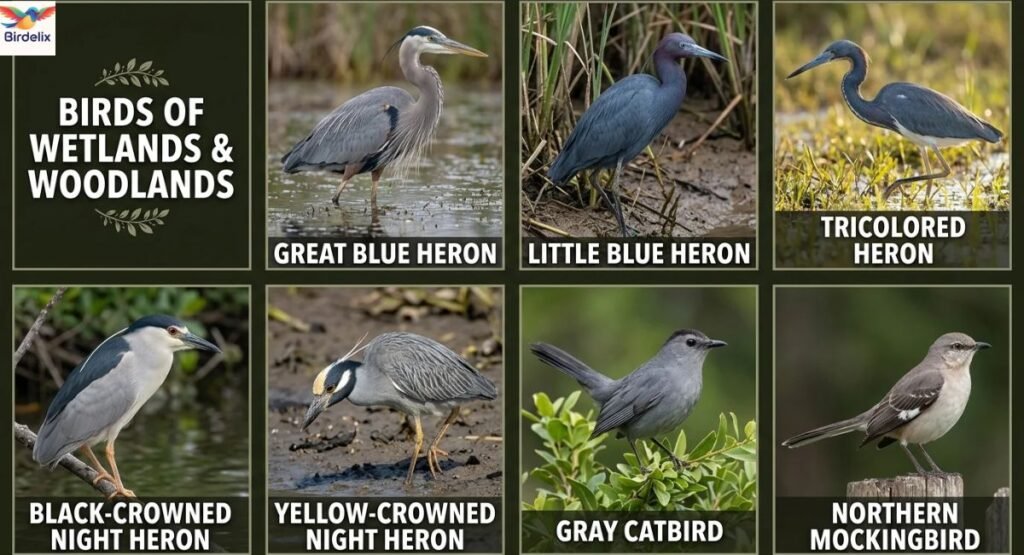
The Great Blue Heron is one of the most recognizable large wading birds in North America. It has long legs, a long neck, and a pointed bill. Its body looks blue-gray, with darker markings around the head and neck. Adults also have a dark stripe above the eye. When standing still, this bird can look almost like a statue.
You can find Great Blue Herons around Florida’s marshes, ponds, lakes, rivers, and coastal wetlands. They often stand in shallow water while waiting for fish to swim close. Then they strike quickly with their sharp bill. Their height and long neck make them easy to distinguish from smaller gray birds.
2. Little Blue Heron
The Little Blue Heron is a medium-sized wading bird with a slender body and blue-gray feathers. Adults usually have a dark reddish or purplish head and neck. Their bill is long and pointed. Although they belong to the same family as the Great Blue Heron, they are noticeably smaller and more delicate.
This species lives around freshwater marshes, ponds, shallow lakes, and coastal wetlands. It slowly walks through the water while searching for small fish, insects, and other aquatic animals. Young Little Blue Herons look mostly white, which can make them confusing to identify. Their plumage changes as they mature.
3. Tricolored Heron
The Tricolored Heron has a striking mix of blue-gray, white, and darker feathers. Its body is slender, and its neck is long. A white belly contrasts with its darker upper body. During breeding season, some feather details become more noticeable. This color pattern helps separate it from other similar herons.
You may see this bird in Florida’s marshes, shallow ponds, mangroves, and coastal wetlands. It often feeds by moving quickly through shallow water. Unlike herons that remain still for long periods, it may run, turn, and dart after small fish. Its active feeding style is a useful bird identification clue.
4. Black-crowned Night Heron
The Black-crowned Night Heron has a stocky body, short neck, and noticeable black crown. Its upper body is gray or gray-black, while its underside is pale. Adults usually have red eyes and a strong dark bill. These features make it easier to recognize than some other gray wetland birds.
This heron uses freshwater and coastal wetlands across much of North America, including Florida. It often rests in trees or thick vegetation during the day. It becomes more active around dusk and at night. Its shorter neck and heavier body help distinguish it from the tall, slender Great Blue Heron.
5. Yellow-crowned Night Heron
The Yellow-crowned Night Heron has a gray body, dark face, and noticeable pale yellow crown markings. It also has a relatively heavy bill and thick legs. Its overall shape looks more compact than that of a Great Blue Heron. These features help identify it when it stands near water or searches along a shoreline.
In Florida, this bird uses coastal wetlands, marshes, and freshwater habitats. It is especially associated with areas where it can find crustaceans, including crabs and crayfish. It may feed along muddy edges and shallow water. Its strong bill helps it handle hard-shelled prey.
6. Gray Catbird
The Gray Catbird is a small songbird with smooth gray feathers and a black cap. It also has a dark patch beneath its tail. Its body is much smaller than a heron’s, and it usually stays among shrubs and thick vegetation. This bird is often heard before it is seen because it produces a variety of calls and sounds.
Gray Catbirds use gardens, woodland edges, parks, and areas with dense bushes. They eat insects, berries, and other small foods. Their name comes from a call that sounds somewhat like a cat’s meow. If you notice a small gray bird making a catlike sound from a shrub, a Gray Catbird may be worth considering.
7. Northern Mockingbird
The Northern Mockingbird has a gray back, pale underside, long tail, and noticeable white wing patches. Its wings show white flashes during flight. This medium-sized songbird is common in many parts of Florida. It often sits on exposed branches, fences, rooftops, and other open perches.
Northern Mockingbirds live in residential neighborhoods, gardens, parks, and open areas. They eat insects, fruits, and berries. They are famous for copying the songs and calls of other birds. A single bird may repeat different sounds during a long singing session. Its long tail and white wing markings help with identification.
8. Blue-gray Gnatcatcher

The Blue-gray Gnatcatcher is a tiny bird with delicate blue-gray upperparts and a pale underside. It has a narrow body, a small bill, and a long tail. Its tail often moves from side to side as it searches for food. Because it moves quickly, spotting one clearly can take patience.
This species uses forests, woodland edges, parks, and areas with mature trees. It feeds on tiny insects and spiders, often picking them from leaves and branches. Its small size and active movements make it quite different from larger gray birds. Listen for its thin, high-pitched calls when searching among trees.
9. Eastern Phoebe
The Eastern Phoebe is a small flycatcher with gray-brown upperparts and a pale underside. Its head often looks darker than its body. One useful feature is its habit of perching upright and repeatedly moving its tail downward. This behavior can help identify it when its colors are difficult to see.
Eastern Phoebes use wooded areas, parks, bridges, and open spaces near water. They often perch on a branch or structure before flying out to catch insects. They may return to the same perch after feeding. Their simple appearance makes posture and behavior especially useful for identification.
10. Gray Kingbird
The Gray Kingbird has gray upperparts, a pale underside, and a dark facial mask. It is a medium-sized flycatcher with a strong bill and upright posture. Its dark mask gives the face a distinctive appearance. Although it may look similar to other gray-and-white birds, its body shape and facial markings provide helpful clues.
This species is strongly associated with coastal and open habitats in Florida. It often sits on exposed branches, wires, or other high perches. From there, it flies out to catch insects. It may also defend its nesting area against larger birds. Look for it around coastal neighborhoods, open parks, and suitable shoreline habitats.
11. Eastern Wood-Pewee
The Eastern Wood-Pewee is a small gray-brown flycatcher. It has a fairly plain appearance, with subtle wing bars and a pale underside. Its body may look slightly larger and less delicate than a gnatcatcher’s. One useful clue is its habit of sitting quietly on a branch before flying out to catch insects.
This bird uses deciduous and mixed woodlands. It often chooses an open perch beneath the forest canopy. After catching an insect, it may return to the same branch. Its call is also helpful because it gives a clear, repeated whistle. Listening carefully can make this species easier to find.
12. Mourning Dove
The Mourning Dove has soft gray-brown feathers, a rounded body, and a long pointed tail. Small black spots appear on its wings. Its overall coloring may look gray, tan, or brown depending on the light. It has a small head and slender bill, which give it a different shape from many other medium-sized birds.
Mourning Doves are common in Florida’s backyards, gardens, parks, and open fields. They often feed on seeds on the ground. Their soft, mournful call is easy to recognize once you become familiar with it. When they take off, their wings may produce a sharp whistling sound.
13. Fish Crow
The Fish Crow is a dark bird with blackish or dark gray feathers. It has a strong bill and a compact crow-like body. At a glance, it can be difficult to separate from the American Crow. Size alone may not be enough because the two species can overlap in appearance.
Fish Crows often live near water, including coastal areas, rivers, marshes, and lakes. They eat a wide range of foods, such as fish, insects, eggs, and discarded food. Their nasal calls can help distinguish them from other crows. Listening to their vocal sounds is often more useful than judging their color.
14. Common Grackle
The Common Grackle has a dark body, long tail, and strong bill. Its feathers may look black or dark gray from a distance. In bright sunlight, they can show blue, purple, or bronze reflections. The bird’s pale yellow eyes are another noticeable feature. Its long tail often extends beyond its folded wings.
Common Grackles use open woodlands, fields, parks, farms, and urban areas. They often gather in groups while searching for food. Their diet includes insects, seeds, fruits, and human food scraps. Their noisy calls and social behavior make them noticeable around parking lots and residential areas.
15. Ring-billed Gull
The Ring-billed Gull has a white head and body with gray wings. Its yellow bill has a dark ring near the tip, which gives the species its name. Adults also have pale eyes and pinkish legs. These details help separate it from other gulls that may appear along Florida’s beaches and lakes.
Ring-billed Gulls use beaches, coastal areas, lakes, parking lots, and other open places. They feed on fish, insects, scraps, and other available food. Their presence may change with the season and location. Look closely at the bill when identifying one because the dark ring is an important feature.
Big Gray Birds in Florida
| Bird Name | Size | Main Color | Height / Appearance | Common Habitat |
| Great Blue Heron | Large | Blue-gray | Very tall, long legs and neck | Wetlands |
| Sandhill Crane | Large | Gray | Tall body, long legs, red forehead | Marshes and grasslands |
| Double-crested Cormorant | Large | Dark gray | Long neck and broad body | Lakes and coastal waters |
| Wood Stork | Large | White and gray | Large body, long legs and dark flight feathers | Wetlands |
Small Gray Birds in Florida
| Bird Name | Size | Main Color | Key Identification Feature | Common Habitat |
| Blue-gray Gnatcatcher | Small | Blue-gray | Tiny body and long tail | Woodlands |
| Gray Catbird | Small | Gray | Black cap and dark undertail | Gardens and forests |
| Eastern Phoebe | Small | Gray-brown | Upright posture and tail dipping | Parks and woodlands |
| Eastern Wood-Pewee | Small | Gray-brown | Subtle wing bars and small bill | Forests |
Medium-Sized Gray Birds in Florida
| Bird Name | Size | Main Color | Key Identification Feature | Common Habitat |
| Little Blue Heron | Medium | Blue-gray | Slender body and pointed bill | Marshes |
| Tricolored Heron | Medium | Gray-blue and white | White belly and long neck | Wetlands |
| Black-crowned Night Heron | Medium | Gray, black, and white | Black crown and stocky body | Wetlands |
| Yellow-crowned Night Heron | Medium | Gray | Yellow crown markings | Coastal wetlands |
| Northern Mockingbird | Medium | Gray and white | Long tail and white wing patches | Gardens |
| Gray Kingbird | Medium | Gray and white | Dark facial mask | Coastal areas |
| Mourning Dove | Medium | Gray-brown | Rounded body and pointed tail | Backyards |
| Fish Crow | Medium | Dark gray-black | Strong bill and nasal call | Coastal areas |
| Common Grackle | Medium | Dark gray-black | Long tail and glossy feathers | Urban areas |
| Ring-billed Gull | Medium | Gray and white | Yellow bill with dark ring | Beaches |
Tall Gray Birds in Florida
| Bird Name | Size | Main Color | Height / Key Feature | Common Habitat |
| Great Blue Heron | Tall | Blue-gray | Long legs, neck, and pointed bill | Wetlands |
| Sandhill Crane | Tall | Gray | Long legs and red forehead | Marshes and grasslands |
| Great Egret | Tall | White | Long neck and black legs | Wetlands |
| Little Blue Heron | Medium-tall | Blue-gray | Slender body and long legs | Marshes |
| Tricolored Heron | Medium-tall | Gray-blue and white | Long neck and white belly | Coastal wetlands |
Gray and White Birds in Florida
| Bird Name | Size | Main Color | Key Identification Feature | Common Habitat |
| Northern Mockingbird | Medium | Gray and white | Long tail and white wing patches | Gardens and open areas |
| Gray Kingbird | Medium | Gray and white | Dark facial mask | Coastal areas |
| Black-crowned Night Heron | Medium | Gray, black, and white | Black crown and pale underside | Wetlands |
| Ring-billed Gull | Medium | Gray and white | Yellow bill with dark ring | Beaches and lakes |
| Tricolored Heron | Medium | Gray-blue and white | White belly and dark upper body | Wetlands |
Gray Birds in Florida by Region
Florida’s birdlife changes from one region to another. South Florida has tropical and coastal habitats, while northern areas include more temperate woodlands. Central Florida contains many lakes and freshwater wetlands. These differences influence which birds you are most likely to see.
South Florida
South Florida includes coastal areas, mangroves, marshes, and the Everglades. These habitats support several wading birds, including Great Blue Herons, Little Blue Herons, and Tricolored Herons. Coastal and urban areas may also attract Gray Kingbirds, Northern Mockingbirds, and other adaptable species.
You can look for birds around wetland edges, parks, gardens, and shorelines. The Everglades provide extensive wetland habitat, while coastal areas offer different feeding and nesting opportunities. A bird’s location can help narrow down the possibilities, but it should always be considered alongside its appearance and behavior.
Central Florida
Central Florida has many freshwater lakes, ponds, marshes, parks, and wooded areas. Great Blue Herons and other wading birds often use shallow water to find food. Smaller species, such as Blue-gray Gnatcatchers and Eastern Phoebes, may appear in suitable wooded habitats.
Residential areas also support birds such as Northern Mockingbirds and Mourning Doves. These species adapt well to neighborhoods with trees, shrubs, and open lawns. When identifying a bird in Central Florida, consider whether you saw it near water, in woodland, or around buildings.
North Florida
North Florida has forests, rivers, marshes, and open habitats. Its birdlife includes both resident species and seasonal visitors. Gray Catbirds, Northern Mockingbirds, Eastern Phoebes, and several wetland birds may appear in suitable environments. Some species are easier to find during particular seasons.
Woodlands offer shelter and food for small songbirds. Rivers and marshes provide feeding areas for herons and other water-associated birds. If you are watching birds in this region, pay attention to the habitat and time of year. These details can help you understand which species may be present.
Florida Panhandle
The Florida Panhandle has beaches, pine forests, coastal marshes, and freshwater habitats. These environments support a mix of coastal birds, woodland species, and wetland visitors. Ring-billed Gulls may appear around suitable shorelines, while herons use marshes and shallow water.
Pine forests and wooded areas provide different opportunities for finding songbirds. Open coastal habitats may attract birds that feed on insects or fish. The best identification approach is to combine location with physical clues. A gray bird near the beach may not be the same species as one in a forest.
Gray Birds in Florida by Habitat
Habitat is one of the most useful clues when identifying an unfamiliar bird. A species that spends much of its time in shallow water may have different features from one that lives among tree branches. Looking at the surroundings can help you narrow down the choices before examining smaller details.
Wetlands and Marshes
Wetlands are important habitats for herons and night herons. These birds use shallow water to search for fish, insects, frogs, and other small animals. Great Blue Herons often stand still before striking at prey. Little Blue Herons and Tricolored Herons may move more actively while feeding.
Marshes also provide shelter and nesting areas for many water-associated birds. Look along muddy edges, shallow pools, and vegetation near the water. A tall bird with long legs may be a heron, while a stockier bird with a shorter neck may be a night heron. These wetland birds can often be identified through their body shape and feeding style.
Beaches and Coastal Areas
Florida’s beaches and coastal areas support gulls, kingbirds, and other birds that use open shorelines. Ring-billed Gulls may search for food near the water or gather around places where people leave food scraps. Gray Kingbirds often use exposed perches to catch flying insects.
Coastal habitats also include mangroves, estuaries, and saltwater marshes. These environments provide feeding areas for many species. Watch the bird’s bill, wings, and behavior. A gull usually has a different shape and flight style from a kingbird. The habitat helps, but physical features are still important.
Lakes and Ponds
Lakes and ponds attract wading birds and other water-associated species. Great Blue Herons often stand along the edges, waiting for fish. Little Blue Herons and other smaller herons may feed in shallow areas. Gulls can also visit lakes, especially where food is available.
Water levels and vegetation can affect which birds use a pond. Shallow edges may attract wading birds, while open water can support swimming and diving species. Look at how the bird moves. A heron usually walks through shallow water, while a cormorant often swims and dives.
Forests and Woodlands
Forests and woodlands provide food and shelter for gnatcatchers, phoebes, and wood-pewees. These birds often feed on insects found among branches and leaves. Some remain active near the canopy, while others use lower branches and woodland edges.
Small birds can be difficult to see among leaves. Listening for calls may help you locate them. Then look for tail movements, posture, and body shape. A Blue-gray Gnatcatcher is tiny and active, while an Eastern Phoebe often returns to the same open perch after catching insects.
Backyards and Urban Areas
Backyards and urban spaces can attract Northern Mockingbirds, Mourning Doves, Common Grackles, and Gray Catbirds. These birds may use trees, shrubs, lawns, and garden spaces for feeding and shelter. Some also visit areas where people leave food or where fruit-bearing plants grow.
You don’t always need to visit a wildlife refuge to enjoy birdwatching. A quiet garden or neighborhood park may offer several interesting sightings. Watch from a distance and avoid disturbing nests. A pair of binoculars can help you examine markings without approaching too closely.
Gray Birds in Florida With Distinctive Markings
Gray Bird With Orange Beak in Florida
An orange or yellow-orange bill can be a useful clue. However, several bird species have bills that change in color with age or breeding condition. Some herons may show brighter bill colors during particular periods. Lighting can also make a yellow bill look orange.
Check the bird’s size, body shape, legs, and habitat before choosing a species. A large bird standing in shallow water may be a heron. A smaller bird with a short, strong bill may belong to a different group. A clear view of the head and bill is especially helpful.
Blue-Gray Bird in Florida
Some birds have a noticeable blue-gray appearance rather than plain gray feathers. The Blue-gray Gnatcatcher is a good example. It has a tiny body, narrow bill, and long tail. Its active movements among tree branches make it different from larger blue-gray wading birds.
The Little Blue Heron also has blue-gray feathers, but it is much larger and has long legs. Habitat can help you separate these possibilities. A tiny bird moving through woodland branches is more likely to be a songbird. A tall bird feeding in a marsh may be a heron.
Small Gray Bird With Red Chest in Florida
A small bird with a red chest needs careful identification. Color descriptions can be misleading, especially when the bird is seen briefly or in poor light. The red area might be on the throat, breast, or another part of the body. It may also be an effect of sunlight or surrounding colors.
Look at the bird’s size, head markings, bill, and tail. Note whether the red color covers the whole chest or appears as a small patch. Also consider the habitat and season. A single description such as “small gray bird with red chest” is not enough to identify a species confidently.
Black, White, and Gray Birds in Florida
Several Florida birds show combinations of black, white, and gray. The Northern Mockingbird has a gray back, white underside, and white wing patches. The Black-crowned Night Heron has a dark crown and back with a paler underside. These contrasting patterns can make both species easier to recognize.
Look at the bird’s size and shape as well as its colors. A mockingbird has a long tail and slender body, while a night heron has a heavier body and shorter neck. The bird’s habitat can provide another clue. One may be sitting in a garden, while the other rests near a wetland.
Gray Bird With a Loud or Obnoxious Squawk
Bird calls can help identify a species when you cannot see it clearly. Some birds produce soft whistles, while others make harsh squawks, nasal calls, or repeated cries. The Fish Crow, for example, has a distinctive nasal call. Grackles also make a range of loud and harsh sounds.
Listen to the call’s pitch, rhythm, and repetition. Then look for the bird’s size, color, and surroundings. Sound alone may not be enough because different species can produce similar noises. Combining calls with visible bird markings and behavior gives you a better chance of identifying the bird.
How to Identify Gray Birds in Florida
| Identification Feature | What to Look For | Example Bird |
|---|---|---|
| Bird Size | Large, medium, or small body size | Great Blue Heron |
| Feather Color | Gray, blue-gray, gray-brown, or gray-black feathers | Mourning Dove |
| Color Patterns | White patches, black caps, pale bellies, or dark markings | Northern Mockingbird |
| Beak Shape | Long pointed, short, thin, or strong bill | Great Blue Heron |
| Leg Length | Long legs for wading or short legs for perching | Great Blue Heron |
| Tail Shape | Long pointed tail or noticeable tail movements | Mourning Dove |
| Wing Markings | White wing patches or subtle wing bars | Northern Mockingbird |
| Habitat | Wetlands, beaches, forests, gardens, or backyards | Ring-billed Gull |
| Bird Behavior | Wading, swimming, perching, or catching insects | Eastern Phoebe |
| Bird Calls | Catlike sounds, nasal calls, or repeated whistles | Gray Catbird / Fish Crow |
Conclusion
Florida has many birds with gray, blue-gray, and gray-brown feathers. Some, such as the Great Blue Heron, stand out because of their size. Others, including the Blue-gray Gnatcatcher and Gray Catbird, are much smaller and harder to spot. Their habitats also range from wetlands and beaches to forests and backyards.
To identify gray birds in Florida, look beyond feather color. Pay attention to size, beak shape, legs, tail markings, calls, and behavior. The more features you observe, the easier it becomes to recognize different species. Take your time, use a reliable field guide, and enjoy discovering Florida’s birdlife.
FAQs
What are the most common gray birds in Florida?
Northern Mockingbirds, Mourning Doves, and several heron species are among the gray or gray-patterned birds people may encounter. The species you see depends on your location and habitat.
What is the big gray bird in Florida?
The Great Blue Heron is a prominent large blue-gray bird. You can often spot it around wetlands, ponds, rivers, and shallow water.
What are the small gray birds in Florida?
The Blue-gray Gnatcatcher, Gray Catbird, and Eastern Phoebe are examples of smaller birds with gray or gray-brown plumage. Their size, markings, and behavior help tell them apart.
What gray and white birds live in Florida?
The Northern Mockingbird, Gray Kingbird, Black-crowned Night Heron, and Ring-billed Gull have noticeable gray-and-white patterns. Their body shapes and habitats are useful identification clues.
Where can I see gray birds in Florida?
Look around wetlands, beaches, lakes, parks, and wooded areas. Wildlife refuges and nature trails can also offer good birdwatching opportunities. Bring binoculars and observe birds without disturbing them.

Welcome to Birdelix! I’m Anam Sattar, an AI-powered SEO Specialist and Content Writer with over 5 years of experience in creating high-quality, search-optimized content. I help businesses improve their search engine rankings, increase organic traffic, and build beautiful, user-friendly websites. My mission is to make SEO, content creation, and web design simple, effective, and accessible for everyone. Let’s grow your online presence and achieve success together!