

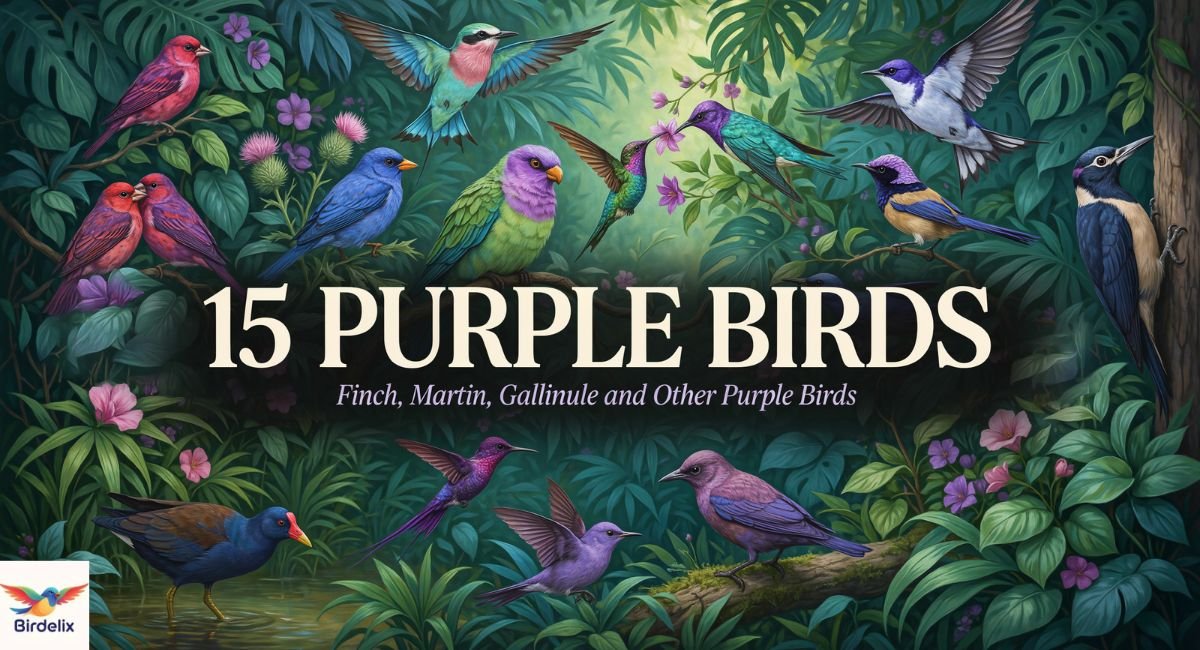
Purple birds bring stunning colors and unique beauty to the natural world. Some have deep violet feathers while others display glossy blue-purple or reddish shades. From the familiar Purple Finch and Purple Martin to colorful tropical species, these birds attract attention wherever they appear. You can find them in North American forests, freshwater wetlands, African grasslands, and tropical rainforests. Each species has distinctive features, feeding habits, and nesting preferences.
Learning about these beautiful birds helps you recognize them more easily during birdwatching trips. In this guide, discover 15 fascinating purple bird species, their natural habitats, feather patterns, and feeding habits, along with helpful identification tips.
15 Beautiful Purple Birds You Should Know
Not every bird with purple-looking feathers has the same shade. Some display bright violet patches while others have dark plumage with a metallic shine. A few species also combine purple with green, blue, red, or yellow.
The following birds come from different parts of the world. Their colors, sizes, and natural habitats make each species interesting to observe. Some are familiar to North American birdwatchers while others are tropical species worth discovering.
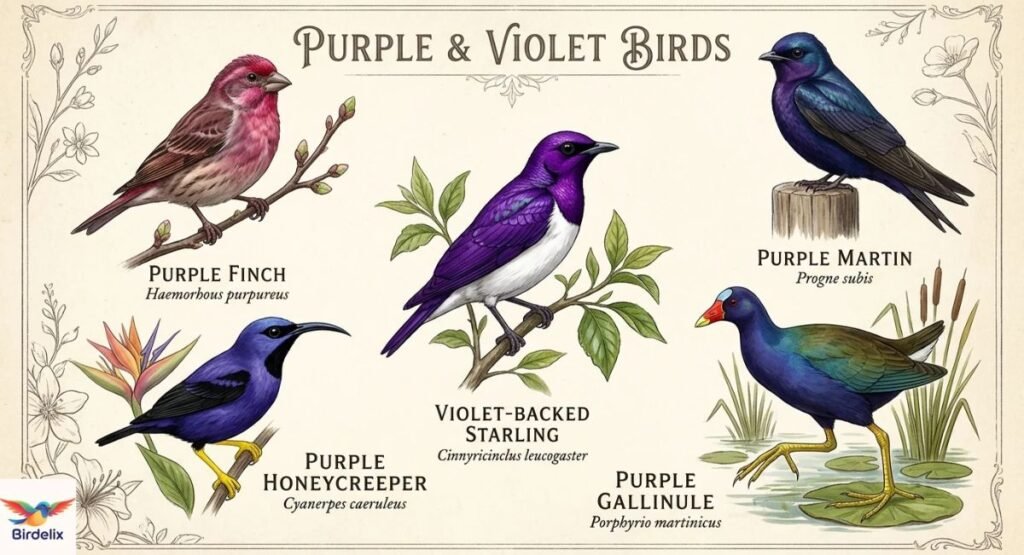
1. Purple Finch
The Purple Finch is a charming North American songbird known for its raspberry-red appearance. Despite its name, the adult male usually looks more reddish-pink than truly purple. His head, chest, and back show rich raspberry coloring with brown streaks on the wings.
Females look quite different because they have brown and white streaked feathers without the male’s colorful appearance. These birds visit forests, gardens, and backyard feeders. They commonly eat seeds, buds, berries, and small fruits. Sunflower seeds can help attract them to suitable feeders.
2. Purple Martin
The Purple Martin is one of the most recognizable dark purple-looking birds in North America. Adult males have glossy blue-black feathers that reflect violet and purple tones in bright sunlight. Females and young birds usually have duller plumage with lighter gray or brown areas.
These aerial insect hunters catch flying insects while moving through open skies. They commonly nest in specially designed martin houses or natural cavities. Purple Martins are especially popular among backyard bird enthusiasts because they readily use properly managed nesting colonies in much of eastern North America.
3. Purple Gallinule
The Purple Gallinule is a striking wetland bird with colorful feathers and unusually long toes. Its head, neck, and body appear deep purple or blue-green depending on the lighting. Bright green wings and a red bill with a yellow tip create a beautiful contrast.
This species lives around freshwater marshes, ponds, and wetlands with thick vegetation. Its long toes help it walk across floating plants and lily pads. It eats aquatic insects, seeds, small fish, snails, and other available foods. You may spot it in parts of the southeastern United States.
4. Purple Honeycreeper
The Purple Honeycreeper is a small tropical bird found mainly in northern South America and nearby islands. Adult males display striking violet-blue plumage with darker wings. Females look greener and have noticeable streaking underneath. Their different appearances make identification easier.
These active birds visit forest edges, flowering trees, and tropical gardens. They use their narrow, curved bills to feed on nectar and small fruits. Insects also provide important food. Their bright colors and quick movements make them attractive subjects for tropical birdwatchers and wildlife photographers.
5. Violet-Backed Starling
The Violet-Backed Starling is a beautiful African bird with a shiny violet-purple back. Adult males have a bright white chest and belly that contrast sharply with their dark upperparts. Females have brown and white streaked plumage that looks much less colorful.
This species inhabits woodlands, savannas, and forest edges across sub-Saharan Africa. It often feeds on fruits and insects while moving through trees. Males look particularly impressive when sunlight highlights their glossy feathers. Their contrasting colors make them easier to recognize than many other small starlings.
6. Purple Starling
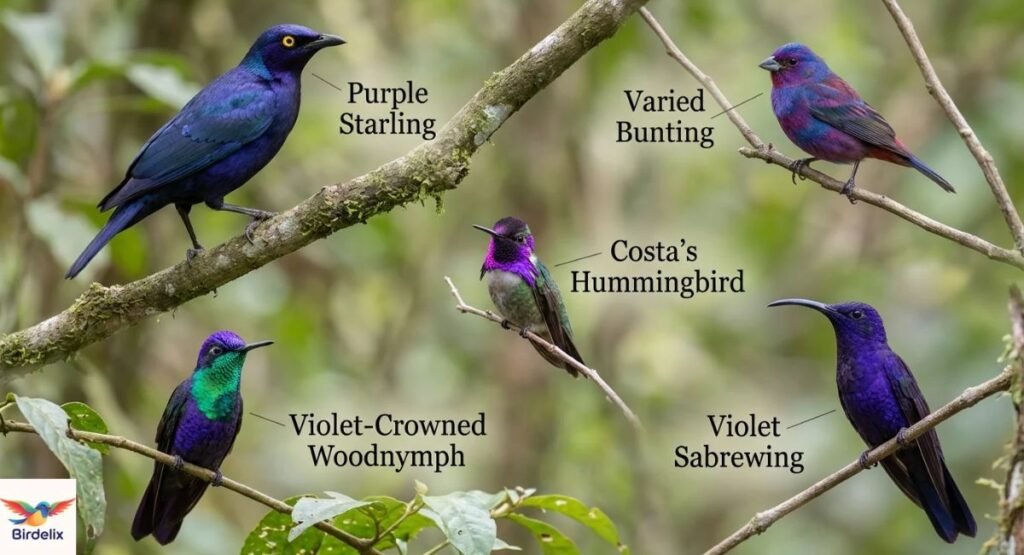
The Purple Starling is another African species with attractive glossy plumage. Adult males usually show dark violet or purple feathers with a metallic appearance. Their bright eyes add another noticeable feature. Females are generally less colorful and have duller brownish plumage.
This bird occurs mainly in parts of West Africa. It uses open woodland, savanna, and cultivated landscapes where food is available. Its diet includes fruits and insects. Although its appearance resembles other glossy starlings, its range and plumage details help separate it from related species.
7. Varied Bunting
The Varied Bunting is a colorful songbird found in the southwestern United States and Mexico. Adult males display a beautiful mixture of red, purple, and blue across their heads and bodies. Females are mostly brown with subtle markings that provide camouflage.
You can find these birds in dry brushland, thorny scrub, and desert habitats. They commonly feed on seeds and insects. Their colorful appearance makes them interesting to observe during the breeding season. Look for them around shrubs and open areas in suitable parts of the Southwest.
8. Costa’s Hummingbird
Costa’s Hummingbird is a small desert species famous for the male’s brilliant purple feathers. His crown and throat feature vivid violet coloring that can appear especially bright in direct sunlight. During courtship displays, the elongated throat feathers spread outward like a colorful fan.
This hummingbird lives mainly in the southwestern United States and Baja California. It visits desert flowers and garden feeders for nectar. Small insects also provide protein. Its compact body and distinctive purple head make it a rewarding bird to identify in dry landscapes.
9. Violet Sabrewing
The Violet Sabrewing is a large and impressive hummingbird native to Central America. Adult males have deep violet or purple feathers across much of their bodies. Females usually display greener upperparts and lighter underparts with noticeable markings.
These hummingbirds inhabit humid forests, mountain slopes, and forest edges. They feed on nectar from flowering plants and may defend productive feeding areas against other hummingbirds. Their powerful flight and large size make them stand out among smaller nectar-feeding species.
10. Violet-Crowned Woodnymph
The Violet-Crowned Woodnymph is a tropical hummingbird recognized by its colorful crown and green body. Adult males have a violet-blue crown with bright green plumage. Females are generally less colorful and show more noticeable pale markings underneath.
This species occurs in parts of Central America and northern South America. It visits flowering plants in forests, gardens, and woodland edges. Like other hummingbirds, it feeds mainly on nectar while catching tiny insects. Its fast flight can make close observation challenging.
11. Purple-Crested Turaco
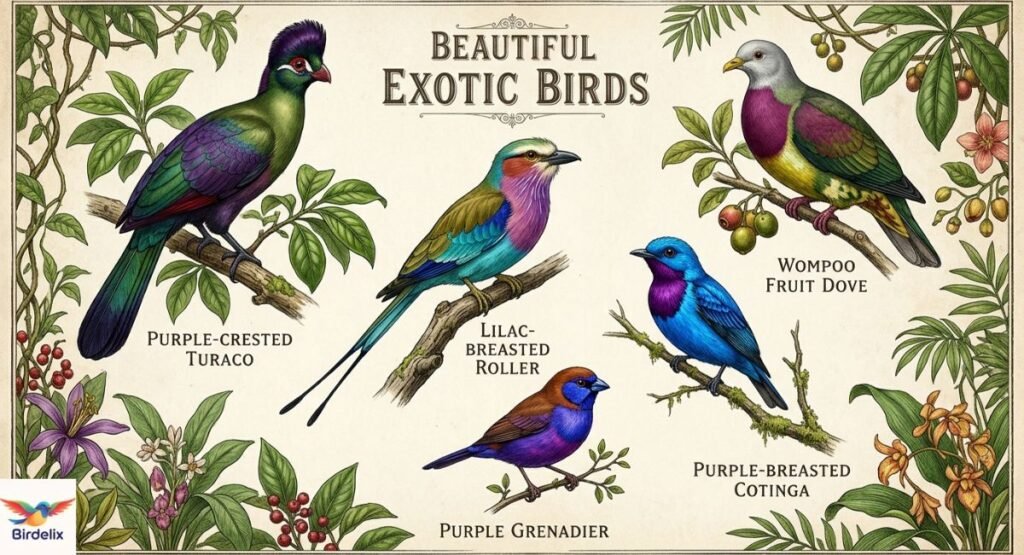
The Purple-Crested Turaco is an attractive African bird with a prominent purple crest. Its body is mostly green with darker wings and a long tail. The colorful crest stands out clearly when raised and gives the bird its distinctive appearance.
This species lives in woodland and forest habitats across southeastern Africa. It spends much of its time moving through trees in search of food. Fruits and leaves make up much of its diet. Its strong legs and feet help it climb through branches with ease.
12. Wompoo Fruit Dove
The Wompoo Fruit Dove is a beautiful Australian bird with colorful green, yellow, and purple plumage. Its chest and breast show a rich purple tone that contrasts with its green wings. Its overall appearance makes it one of the most attractive fruit doves.
This species inhabits rainforests and other wooded areas along eastern Australia. It mainly eats fruit and plays an important role in seed dispersal. You may hear its distinctive calls before seeing it among dense tree branches. Its bright colors can blend surprisingly well with tropical foliage.
13. Lilac-Breasted Roller
The Lilac-Breasted Roller is a spectacular African bird with a soft lilac-colored chest. Its wings and tail feature bright blue and turquoise shades. The combination creates a colorful appearance that is easy to recognize in open landscapes.
It lives across eastern and southern Africa in savannas, grasslands, and open woodland. This bird often perches on exposed branches while watching for prey. Its diet includes insects and small animals such as lizards. During courtship, it performs impressive aerial movements that show off its colorful wings.
14. Purple-Breasted Cotinga
The Purple-Breasted Cotinga is a striking South American bird with vivid purple-blue plumage. Adult males display bright colors across their bodies while females are generally much duller. Their different appearances help birdwatchers distinguish between the sexes.
This species inhabits tropical forests in northern South America, including parts of the Amazon region and the Guianas. It often feeds on fruits in the forest canopy. Its brilliant plumage can be difficult to spot among dense leaves. Patient observation near fruiting trees may improve your chances.
15. Purple Grenadier
The Purple Grenadier is a colorful African finch found in eastern parts of the continent. Adult males have purple-blue bodies with reddish facial markings. Females look less colorful and usually show brownish plumage with lighter underparts.
These small birds inhabit dry scrub, thorny bushes, and open savannas. They mainly eat seeds and sometimes consume small insects. Their attractive colors and social behavior make them popular among bird enthusiasts. Look for them around low vegetation where they search for food.
How to Identify Purple Birds
Identifying a purple-looking bird requires more than noticing its main color. Several species display similar shades but have different body shapes, bills, wing patterns, and behaviors. Paying attention to these details can help you narrow down the possibilities.
Start by observing the bird’s size and overall shape. Then check its head markings, tail length, bill color, and habitat. A photograph can help you compare these features later. Remember that lighting can change how purple feathers appear.
Check Feather Color and Patterns
Look closely at the bird’s head, chest, back, and wings. Some species have completely glossy bodies while others show purple only around the throat or breast. A Purple Martin appears dark and shiny whereas a Purple Gallinule has several contrasting colors.
Observe the Bill and Feet
Bill shape and foot color can provide useful identification clues. The Purple Gallinule has a colorful red bill with a yellow tip and long yellow legs. Hummingbirds have slender bills designed for feeding on nectar.
Consider Size and Behavior
A bird’s movement can help you identify it. Purple Martins catch insects while flying whereas Purple Finches usually search for seeds in trees and feeders. Gallinules walk across wetland vegetation using their unusually long toes.
Where Do Purple Birds Live?
Birds with purple feathers inhabit many different environments around the world. Some prefer forests and gardens while others live near wetlands, grasslands, and tropical woodlands. Their locations depend on food availability, nesting opportunities, climate, and seasonal movements.
North America has several recognizable purple-looking species. Tropical regions support an even wider variety of colorful birds. Understanding their natural habitats helps you know where to look and which species you might encounter.
Purple Birds in North America
The Purple Finch and Purple Martin are familiar species across parts of North America. The Purple Gallinule occurs in suitable wetlands, especially in the southeastern United States. Costa’s Hummingbird and Varied Bunting are more closely associated with southwestern regions.
Purple Birds in Tropical Regions
Tropical forests in South America and Central America support colorful species such as the Purple Honeycreeper and Violet Sabrewing. African forests and savannas are home to Purple Starlings, Violet-Backed Starlings, and Purple-Crested Turacos.
Purple Birds in Forests, Grasslands, and Wetlands
Different habitats attract different species. Purple Gallinules prefer marshes with floating vegetation while fruit doves and cotingas often use forest canopies. Purple Martins need open spaces for catching insects and suitable nesting cavities for raising their young.
Purple Martin Bird Houses: How to Attract Purple Martins
Purple Martins are among the most popular birds for backyard nesting projects in the United States. Unlike many wild birds, eastern populations commonly depend on human-provided houses. A properly designed nesting site can encourage these aerial insect hunters to return season after season.
However, installing a house does not guarantee that martins will move in. Location, housing design, predator protection, and regular maintenance all matter. You should also understand local nesting patterns before setting up a colony.
Choosing the Right Purple Martin Bird House
Choose a martin house with several suitable nesting compartments and enough room for adult birds and their young. Good designs include drainage holes, ventilation, and removable sections for cleaning. Natural or artificial gourds can also provide nesting spaces when designed for martins.
Where to Place Purple Martin Bird Houses
Place the house in an open area with clear flight access from every direction. A location roughly 12–18 feet above the ground is commonly recommended. Keep it away from nearby trees and make sure you can lower the house for inspections and maintenance.
How to Maintain Purple Martin Houses
Clean nesting compartments between breeding seasons and remove old nesting material when appropriate. Check for damaged parts and install suitable predator guards. During the nesting season, monitor the house carefully without disturbing active nests or handling young birds unnecessarily.
Why Do Some Birds Have Purple Feathers?
Purple feathers develop through natural processes involving pigments and microscopic feather structures. Some birds have colors that look purple because their feathers reflect particular wavelengths of light. Others display a mixture of blue, red, or violet tones.
These colors can help birds attract mates, communicate, and blend into their surroundings. Feather appearance may also change with sunlight and viewing angle. That is why one bird can look dark blue in shade but bright purple under direct sunlight.
Structural Color and Feather Iridescence
Some birds produce shiny purple colors through microscopic structures inside their feathers. These structures scatter and reflect light in specific ways. The result is called structural coloration. Iridescent feathers may change appearance when you view them from different angles.
Pigments and Natural Feather Colors
Pigments also contribute to bird coloration. Melanins create dark shades while carotenoids produce yellow, orange, and red tones. The final appearance depends on how pigments interact with feather structures. Different combinations create the wide range of colors seen in birds.
Purple Finch vs. Purple Martin vs. Purple Gallinule
The Purple Finch, Purple Martin, and Purple Gallinule are three different birds with noticeably different appearances and lifestyles. Their names can confuse beginners because each has some connection to purple coloring. Comparing their size, habitat, diet, and behavior makes identification easier.
| Feature | Purple Finch | Purple Martin | Purple Gallinule |
| Bird type | Songbird | Swallow | Waterbird |
| Main appearance | Raspberry-red male | Glossy blue-purple male | Purple and green body |
| Habitat | Forests and gardens | Open areas and towns | Freshwater wetlands |
| Main food | Seeds and fruits | Flying insects | Plants and small animals |
| Nesting | Trees and shrubs | Bird houses and cavities | Wetland vegetation |
| Common location | North America | North America | Southeastern United States and other regions |
Are There Purple and Yellow Birds?
Yes, several bird species display both purple and yellow or golden shades. However, their colors may appear in separate body areas rather than forming a clear purple-and-yellow pattern. Some tropical birds show especially striking combinations of bright colors.
People sometimes search for a purple and yellow cardinal. However, there is no recognized North American cardinal species naturally known for that exact color combination. A bird with unusual purple and yellow coloring may belong to another species or have been photographed under unusual lighting.
Interesting Facts About Purple Birds
Purple birds are fascinating because their colorful feathers, unusual behaviors, and special adaptations make them stand out in nature. Some species have naturally violet plumage while others appear purple because their feathers reflect sunlight in different ways. Here are some interesting facts that make these birds even more remarkable.
1. Some Purple Birds Are Not Actually Purple: The Purple Finch is a perfect example. Despite its name, the adult male usually has raspberry-red or reddish-pink feathers rather than true purple plumage. Similarly, Purple Martins have glossy blue-black feathers that can show violet and purple shades under bright sunlight.
2. Purple Martins Catch Insects While Flying: Purple Martins are skilled aerial hunters. They catch mosquitoes, flies, beetles, and other flying insects while moving through the air. Instead of searching for food on the ground, they spend much of their time flying over open areas and catching insects in flight.
3. Purple Gallinules Can Walk on Floating Plants: These colorful wetland birds have exceptionally long toes that help distribute their weight. This special adaptation allows them to walk across floating vegetation such as lily pads. They also use their long toes to reach food in shallow water and marshy areas.
4. Some Purple Feathers Change Color in Different Light: A bird’s feathers may look dark blue, violet, or bright purple depending on the lighting and viewing angle. This effect is called iridescence. Tiny structures inside the feathers reflect light in different ways, creating beautiful changing colors.
5. Male and Female Purple Birds Often Look Different: In several species, males have brighter feathers than females. For example, male Purple Honeycreepers display vivid violet-blue plumage while females are mostly green. These differences can help birdwatchers identify the sex of a bird.
6. Costa’s Hummingbird Uses Its Purple Feathers During Courtship: Male Costa’s Hummingbirds have brilliant violet feathers around their crown and throat. During courtship displays, they spread their elongated throat feathers to create an eye-catching appearance. This colorful display helps attract potential mates.
7. Not All Purple Birds Live in the Same Habitats: Purple-looking birds occupy a wide range of environments. Purple Gallinules prefer freshwater marshes while Purple Martins use open spaces for catching insects. Tropical species such as Purple Honeycreepers live around forests and flowering trees.
8. Purple Birds Help Maintain Natural Ecosystems: Many colorful bird species play useful roles in their habitats. Fruit-eating birds such as the Wompoo Fruit Dove help spread seeds through their droppings. Insect-eating species also help regulate insect populations, supporting the natural balance of their ecosystems.
Conclusion
Purple-looking birds bring remarkable color and variety to the natural world. From the familiar Purple Finch and Purple Martin to tropical species such as the Violet Sabrewing and Purple Honeycreeper, each bird has distinctive features worth exploring. Their habitats, diets, and behaviors also make identification more interesting.
When observing these birds, pay attention to their feather patterns, bill shapes, size, and surroundings. If you want to attract Purple Martins, provide suitable nesting houses and maintain them carefully. With patience and regular observation, you can discover many beautiful birds in your own backyard or during your next birdwatching trip.
FAQs
1. What Is the Most Common Purple Bird in North America?
The Purple Martin and Purple Finch are two familiar purple-named birds in North America. Their actual colors differ, with the martin showing glossy blue-purple feathers and the finch displaying raspberry-red plumage.
2. Is a Purple Finch Actually Purple?
Not exactly. Adult male Purple Finches usually have raspberry-red or reddish-pink feathers. Their name can be misleading because their natural coloring is closer to red than true purple.
3. Where Can I Find Purple Martins?
Purple Martins occur across much of North America during the breeding season. Eastern populations commonly nest in specially designed martin houses while western populations often use natural cavities.
4. What Does a Purple Gallinule Eat?
Purple Gallinules eat a varied diet that includes aquatic plants, seeds, insects, snails, and small animals. They search for food around freshwater marshes and vegetation-covered wetlands.
5. Why Do Some Birds Look Purple in Sunlight?
Some birds have iridescent feathers that reflect light differently depending on the viewing angle. Microscopic feather structures create these effects and can make dark feathers appear blue, violet, or purple.

Welcome to Birdelix! I’m Anam Sattar, an AI-powered SEO Specialist and Content Writer with over 5 years of experience in creating high-quality, search-optimized content. I help businesses improve their search engine rankings, increase organic traffic, and build beautiful, user-friendly websites. My mission is to make SEO, content creation, and web design simple, effective, and accessible for everyone. Let’s grow your online presence and achieve success together!